
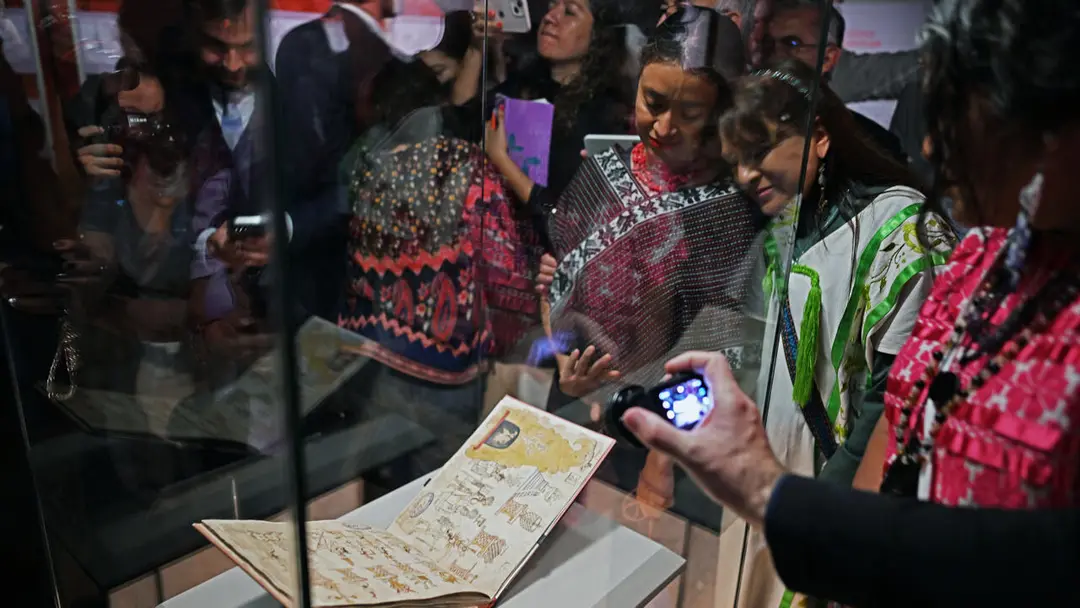
Rare Aztec codex on display in Mexico after two centuries in France
The 16th-century Codex Azcatitlan, which recounts Aztec history in pictograms, went on display Thursday at Mexico City's National Museum of Anthropology, nearly two centuries after it was taken to France. France's National Library loaned two folios to mark 200 years of bilateral relations but has refused Mexico's demands for its return. Officials said over 16,200 items have been repatriated since 2018. Foreign Minister Roberto Velasco called the exhibition a reuniting of people with collective memory.
Source
France 24 · read the original report ↗
Desk check · compared with the source
What the desk checked (5)
- Two folios of the 16th-century Codex Azcatitlan went on display Thursday at Mexico City's National Museum of Anthropology. — Reported directly by the source from the exhibition opening; date given as Thursday relative to publication.
- France's National Library loaned the codex to mark 200 years of France-Mexico relations, while refusing to return it permanently. — Attributed in source to the National Library's position; no document cited.
- Over 16,200 items have been repatriated to Mexico since 2018. — Figure appears in source, attributed to the National Institute of Anthropology and History last year.
- The manuscript was taken to France by Joseph Marius Alexis Aubin and donated to the National Library of France in 1898 by the widow of Eugene Goupil. — Historical detail stated in source without further sourcing.
- In 1982 Mexican lawyer Jose Luis Castaneda stole the Codex Tonalamatl from France's National Library and took it to Mexico. — Stated as background in source; no official record cited.
Analysts’ view opinion
This looks like a museum story, but it is really a case study in cultural diplomacy used as a strategic instrument. By lending the codex while still refusing permanent restitution, France has chosen the middle path — signalling goodwill without conceding ownership. For Mexico, this is simply the next step in a campaign that has already brought back more than 16,200 items since 2018, and President Sheinbaum raising it directly with Macron has pushed it high up the bilateral agenda.
- The loan format suits France strategically: it conveys goodwill while avoiding a precedent that could invite similar claims from other countries.
- Mexico is framing the issue around national identity and justice for Indigenous communities — a politically powerful argument at home and a difficult one to refuse outright.
- The 1982 Codex Tonalamatl episode shows this dispute has a confrontational history, which explains why French institutions are holding firm on ownership.
- Because the Codex Borbonicus sits in the library of the French parliament's lower house, any handover is not a purely executive decision — legislative and institutional consent would also be needed.
- Colonial-era restitution has become a recurring pressure point in Europe–Global South ties, and whatever Mexico achieves is likely to be cited as a template by other claimant states.
What to watch — Watch how the manuscript is handled once the exhibition period ends, whether France opens the door to a long-term loan or shared-custody formula, and whether anything moves at the parliamentary level on the Codex Borbonicus.
The story gives no indication that France is shifting its position on permanent restitution, and it does not set out the loan's duration, the details of any negotiations, or the French government's formal stance.
Deep dive
Research brief · 8 facts · 7 dates · exam-readyThe brief
Context
The Codex Azcatitlan is a 16th-century Mexican manuscript that narrates Aztec history in pictograms, from the migration out of the mythical Aztlan to the fall of the empire during the Spanish conquest. It was taken to France in the 19th century and has been held by France's National Library for over a century. To mark 200 years of Mexico-France relations, the library loaned two folios for display at Mexico City's National Museum of Anthropology, but has refused Mexico's demand for permanent return. The episode is part of a wider Mexican campaign to recover colonial-era cultural objects held abroad.
Key facts
- The Codex Azcatitlan, a 16th-century manuscript recording Aztec history in pictograms, went on display Thursday at Mexico City's National Museum of Anthropology.
- Two folios were loaned by France's National Library to commemorate 200 years of Mexico-France relations; France has refused to return the codex.
- The manuscript fills 25 sheets of parchment imported from Europe in the 16th century.
- It was brought to France by French researcher Joseph Marius Alexis Aubin, and donated to the National Library of France in 1898 by the widow of Franco-Mexican collector Eugene Goupil.
- Since 2018, over 16,200 items have been repatriated from various countries, according to the National Institute of Anthropology and History (stated last year).
- The Codex Borbonicus, showing divinatory and solar calendars, is kept at the library of the National Assembly, the lower house of the French parliament.
- In 1982, Mexican lawyer Jose Luis Castaneda stole the Codex Tonalamatl from France's National Library and brought it to Mexico; Mexico kept it.
- President Claudia Sheinbaum pressed Emmanuel Macron to return the Codex Azcatitlan and the Codex Borbonicus during the French president's visit to Mexico last year.
Timeline
- 16th centuryCodex Azcatitlan written shortly after the arrival of the Spanish, on 25 sheets of parchment imported from Europe.
- Mid-19th century (about half a century before 1898)French researcher Joseph Marius Alexis Aubin takes the codex to France.
- 1898The widow of Franco-Mexican collector Eugene Goupil donates the codex to the National Library of France.
- 1982Mexican lawyer Jose Luis Castaneda takes the Codex Tonalamatl from France's National Library to Mexico, causing bilateral tensions.
- 2018 onwardsMexico's repatriation drive; over 16,200 items returned from various countries.
- Last yearPresident Claudia Sheinbaum presses Emmanuel Macron during his Mexico visit to return the Codex Azcatitlan and Codex Borbonicus.
- Thursday (of the story)Two folios of the Codex Azcatitlan go on display at the National Museum of Anthropology in Mexico City.
Who has a stake
- Government of Mexico / Foreign Ministry — Leading a push to recover colonial-era cultural objects; Foreign Minister Roberto Velasco framed the show as reuniting people with collective memory.
- France's National Library (Bibliotheque nationale) — Has held the codex for over a century, loaned two folios, and insists it is the rightful owner.
- French National Assembly — Its library holds the Codex Borbonicus and insists it is the rightful owner.
- Indigenous communities, such as the Hnahnu — Have campaigned for restitution; Emilia Mendoza said history was hidden and stolen, calling the display a first step.
- President Claudia Sheinbaum and President Emmanuel Macron — Bilateral diplomacy over restitution demands during the 200th anniversary of relations.
- Scholars and the public, e.g. ethnohistorian Karen Trejo — Access to primary sources of Aztec history; asked why a Mexican object is not in Mexico.
Why it matters
The dispute is a test case in the global argument over restitution of cultural property taken during and after colonial rule, where loans are offered but ownership is withheld. For Mexico, the codices are primary records of pre-Hispanic civilisation and identity; for France, institutional claims of rightful ownership remain unchanged despite the anniversary gesture.
UPSC angle
Prelims pointers
- Codex Azcatitlan: 16th-century pictogram manuscript on Aztec history, 25 parchment sheets, held by France's National Library.
- Codex Borbonicus: Aztec manuscript of divinatory and solar calendars, held at the library of France's National Assembly.
- Codex Tonalamatl: taken from France's National Library to Mexico in 1982 by lawyer Jose Luis Castaneda.
- Aztlan: mythical birthplace of Aztec civilisation; Tenochtitlan: forerunner of present-day Mexico City.
- Mexico's National Institute of Anthropology and History reported over 16,200 items repatriated since 2018.
- The 2025-era loan marks 200 years of Mexico-France diplomatic relations.
Mains framing
The display of two folios of the Codex Azcatitlan in Mexico City illustrates the unresolved politics of colonial-era cultural property: objects removed in the 19th century, absorbed into European national collections through private donations (Aubin's removal, Goupil's widow's 1898 donation), and now claimed by source countries as constitutive of national and Indigenous identity. Mexico's approach combines diplomacy at the highest level, with Sheinbaum raising the codices with Macron, and an administrative repatriation drive that has brought back over 16,200 items since 2018, while Indigenous groups such as the Hnahnu press the moral case that their history was hidden from them. France's institutions counter with legal claims of rightful ownership, and the 1982 Codex Tonalamatl episode shows how unilateral action can inflame relations rather than settle title. A temporary loan tied to a bicentenary anniversary satisfies public access and scholarship but sidesteps the ownership question, suggesting a way forward through negotiated frameworks: provenance research, joint custody or long-term loans, digitisation for wider access, and clear criteria distinguishing objects acquired by force or asymmetric power from legitimate transfers.
Key terms
- Codex
- A manuscript volume; here, Mesoamerican pictorial manuscripts recording history, ritual and calendars.
- Restitution / repatriation
- Return of cultural objects to their country or community of origin, as demanded by Mexico for the codices.
- National Museum of Anthropology
- Mexico City museum where the two loaned folios of the Codex Azcatitlan are displayed in a glass case.
- National Institute of Anthropology and History
- Mexican body that reported over 16,200 items repatriated from various countries since 2018.
- Hnahnu community
- Indigenous group in Mexico that has campaigned for the codex's restitution.
- Tenochtitlan
- The Aztec promised land and forerunner of modern Mexico City, endpoint of the migration from Aztlan.
Practice questions
- Discuss the ethical and legal dimensions of restituting colonial-era cultural objects, using the dispute over the Codex Azcatitlan between Mexico and France.
- "Temporary loans are no substitute for ownership." Examine this claim in the context of contested heritage held in Western museums and libraries.
- How do pre-colonial manuscripts and artefacts shape national and Indigenous identity? Illustrate with examples from the story.
Grounded only in the source report — figures and dates are the source's, not inferred.