
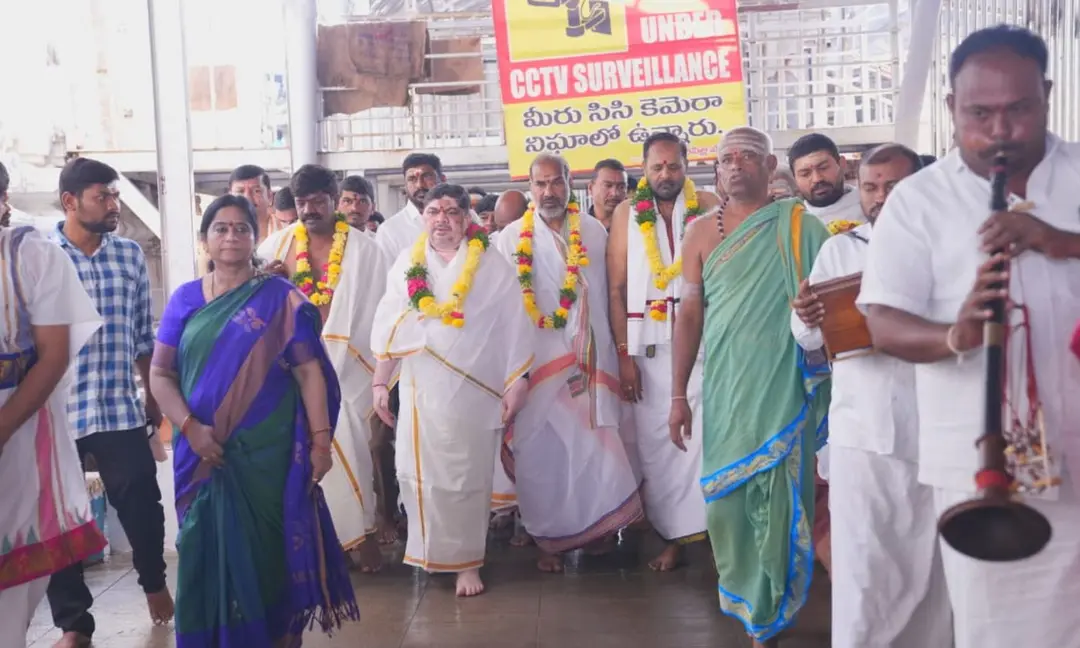
Minister Ponnam Prabhakar offers special prayers at Vemulawada temple
Minister Ponnam Prabhakar, Whip Adi Srinivas and Vemula Veeresham performed special prayers at the Bheemanna temple in Vemulawada. Speaking later, the minister said, "We are Dravidians, we live in the south, we are devotees of Shiva," adding that this did not mean belittling Rama or Venkateswara. As the Chief Minister had said, Shiva was the god of the poor, he noted, asking whether BJP leaders had ever chanted "Om Namah Shivaya". The BJP only said "Jai Shri Ram" and practised Manuvada politics, he alleged, saying his government treats all gods equally and is developing temples.
Source
Vemulawada — స్థానికం · read the original report ↗
Desk check · some claims need care
What the desk checked (4)
- Minister Ponnam Prabhakar, Whip Adi Srinivas and Vemula Veeresham performed special prayers at the Vemulawada Bheemanna (Rajarajeshwara) temple. — Stated as reported fact in the source; no official source named.
- Ponnam Prabhakar said 'we are Dravidians, southerners and devotees of Shiva' and that this does not mean belittling Rama or Venkateswara. — Direct remarks attributed to the minister in the source.
- The minister said, as the Chief Minister stated, that Shiva is the god of the poor and asked whether BJP leaders had ever chanted 'Om Namah Shivaya'. — Attributed to the minister; the Chief Minister is referenced but not named in the source.
- The minister alleged the BJP practises 'Manuvada' politics and does politics in the name of god, while his government treats all gods equally and is developing temples. — Unverified political allegation attributed to the minister; no BJP response in the source.
Analysts’ view opinion
This is less a temple visit than a piece of political signalling. By framing Shiva as the "god of the poor" and tying devotion to a Dravidian, southern identity, the ruling party is refusing to concede religious ground to the BJP while layering social-justice language on top of it. The jab that the BJP says only "Jai Shri Ram", plus the "Manuvadi politics" charge, is an attempt to cast the BJP as a northern, upper-caste outfit — and the venue, in a region where the BJP has been competitive, is unlikely to be accidental.
- By explicitly citing the Chief Minister, the minister signals this is a government line rather than a personal remark.
- The careful rider that Ram and Venkateswara are not being belittled shows a strategy of attacking the BJP without alienating devotees.
- Shifting the argument from piety to Dravidian identity, caste and poverty is favourable terrain for the ruling party, avoiding a pure devotion-versus-devotion contest.
- The presence of the whip and a local leader alongside the minister suggests a coordinated party message, not an offhand comment.
- A BJP counter would typically focus on temple funding and the government's delivery record, but no such response is recorded in this story.
What to watch — Watch whether BJP leaders answer the "Manuvadi" charge directly, and whether ruling-party figures turn such temple appearances into a sustained campaign template.
The story offers no figures backing the claim of even-handed temple development, no BJP response and no electoral context, so it establishes a political message — not its accuracy or its impact.
Deep dive
Research brief · 8 facts · 1 dates · exam-readyThe brief
Context
Telangana minister Ponnam Prabhakar, accompanied by Whip Adi Srinivas and Vemula Veeresham, performed special prayers at the Bheemanna (Rajanna) temple at Vemulawada in the erstwhile Karimnagar district. Speaking afterwards, he framed Shiva worship as a Dravidian and southern tradition and as the faith of the poor, echoing a remark he attributed to the Chief Minister. He used the occasion to attack the BJP, alleging it chants only "Jai Shri Ram", ignores Shiva as the god of the poor, and practises "Manuvada" politics in the name of god. He said his government treats all gods equally and is developing temples.
Key facts
- Report published 29 September 2026, 11:44 AM IST, datelined Vemulawada.
- Minister Ponnam Prabhakar, Whip Adi Srinivas and Vemula Veeresham performed special prayers at the Bheemanna temple, Vemulawada.
- Prabhakar said: "We are Dravidians, we live in the south, we are devotees of Shiva."
- He clarified that this does not mean belittling Rama or Venkateswara.
- He said, as the Chief Minister had stated, Shiva is the god of the poor.
- He asked whether BJP leaders had ever chanted "Om Namah Shivaya", alleging the BJP says only "Jai Shri Ram".
- He alleged the BJP practises "Manuvada" politics and does politics in the name of god.
- He said his government views all gods equally and is developing temples.
Timeline
- 29 September 2026 (report published 11:44 AM IST)Ponnam Prabhakar, Adi Srinivas and Vemula Veeresham offer special prayers at Vemulawada Bheemanna temple; minister's remarks on Shiva worship and the BJP follow.
Who has a stake
- Ponnam Prabhakar, Minister — Frames the ruling party's religious outreach as inclusive; positions Shiva worship as Dravidian and pro-poor while countering BJP's religious messaging.
- Adi Srinivas, Whip, and Vemula Veeresham — Participated in the temple prayers, lending local political weight to the visit.
- The Chief Minister (of the state) — Cited by the minister for the line that Shiva is the god of the poor; his framing anchors the government's position.
- BJP — Accused of chanting only "Jai Shri Ram", ignoring Shiva as the god of the poor, and practising Manuvada politics in god's name.
- Vemulawada Bheemanna temple and devotees — Site of the prayers; temple development is claimed as a government priority.
- Voters of erstwhile Karimnagar district — Audience for the competing religious-political appeals in the region.
Why it matters
The episode shows how temple visits have become a medium of political contestation, with parties competing over which deity and which social constituency they represent. By tying Shiva worship to Dravidian identity and the poor, and labelling the rival's appeal "Manuvada", the minister converts devotion into a claim about social justice and inclusion. It signals that faith-based symbolism will remain central to political messaging in the region.
UPSC angle
Prelims pointers
- Vemulawada, in the erstwhile Karimnagar district, is the site of the Bheemanna (Rajanna) temple referred to in the report.
- Minister Ponnam Prabhakar was accompanied by Whip Adi Srinivas and Vemula Veeresham at the special prayers.
- "Om Namah Shivaya" is the Shaivite chant the minister invoked; "Jai Shri Ram" is the slogan he attributed to the BJP.
- "Manuvada" refers to politics allegedly based on the Manu-derived caste order, an allegation levelled at the BJP.
- The minister cited the Chief Minister's line that Shiva is the god of the poor.
- Report date: 29 September 2026.
Mains framing
Religious symbolism has long been a resource in Indian electoral politics, and this episode illustrates its regional inflection: a minister uses a temple visit at Vemulawada to assert a Dravidian, southern, Shaivite identity and to describe Shiva as "the god of the poor", while insisting that Rama and Venkateswara are not being belittled. The underlying contest is less theological than social — by asking whether BJP leaders ever chanted "Om Namah Shivaya" and alleging "Manuvada" politics, the minister seeks to recast his rival's religious appeal as socially exclusionary, and to claim equal treatment of all deities and temple development as the government's record. The implications are twofold: such framing can deepen the entanglement of state patronage of temples with partisan competition, and it risks reducing pluralism to a sectarian scoreboard even as it raises legitimate questions about whose faith and which communities receive recognition. A way forward lies in keeping temple administration, renovation and welfare spending transparent and rule-bound so that religious institutions are not instruments of political mobilisation, and in debating social justice claims on the terrain of policy rather than devotion.
Key terms
- Vemulawada Bheemanna temple
- The Shiva temple at Vemulawada where the minister and his colleagues performed special prayers.
- Om Namah Shivaya
- A Shaivite chant invoked by the minister to question the BJP's devotion to Shiva.
- Jai Shri Ram
- The Rama-centred slogan the minister says the BJP alone uses.
- Manuvada
- Term used pejoratively for politics seen as upholding the Manu-derived caste hierarchy; alleged by the minister against the BJP.
- Whip
- Party office in a legislature responsible for enforcing discipline; held here by Adi Srinivas, who joined the prayers.
Practice questions
- Examine how religious symbolism and deity-based slogans are used in competitive electoral politics in India, with reference to recent instances of ministers' temple visits.
- "State patronage of temples can blur the line between governance and political mobilisation." Discuss with reference to temple development claims made by governments.
- Critically analyse the use of terms such as 'Manuvada' in political discourse: does it advance the debate on social justice or deepen polarisation?
Grounded only in the source report — figures and dates are the source's, not inferred.