
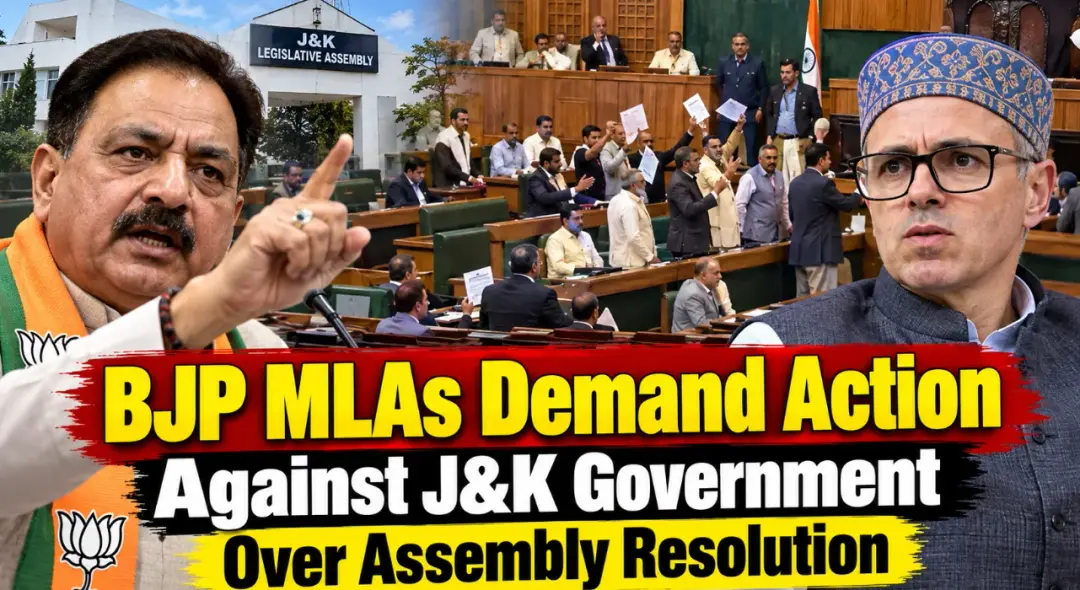
BJP MLAs demand dismissal of Jammu and Kashmir government
BJP MLAs on Friday demanded the immediate dismissal of the Jammu and Kashmir government led by Chief Minister Omar Abdullah. MLA Sham Lal Sharma alleged the NC-Congress government moved an Assembly resolution seeking to revive autonomy and the pre-1953 constitutional arrangement. He said the BJP leadership had committed in the House to grant statehood at an appropriate time. Abdullah's resolution sought restoration of full statehood; its reference to a 2000 greater-autonomy resolution triggered BJP protests and disrupted proceedings.
Source
Jammu and Kashmir — CM & govt · read the original report ↗
Desk check · some claims need care
What the desk checked (5)
- BJP MLAs on Friday demanded immediate dismissal of the Omar Abdullah-led J&K government. — Attributed in source to BJP MLAs, with quotes from Sham Lal Sharma at a press conference in Jammu.
- Chief Minister Omar Abdullah moved an Assembly resolution seeking immediate restoration of full statehood, referring to two earlier resolutions. — Stated as fact in the source with no further document or official citation given.
- The resolution's reference to a 2000 greater-autonomy resolution triggered BJP protests and disrupted proceedings. — Reported in source without named official attribution; figure/year appears in source.
- The NC's agenda has remained unchanged since its earlier incarnation as the Muslim Conference in 1932. — Allegation explicitly attributed to Sharma; opinion, not verified.
- Sharma questioned whether prescribed Assembly procedure was followed and said the chair failed to maintain its sanctity. — Attributed to Sharma as a claim; no response from the Speaker or government included in the source.
Analysts’ view opinion
This is less a fight about one resolution than a contest over who actually holds power in Jammu and Kashmir. By moving a resolution for full statehood, Omar Abdullah keeps his central electoral promise alive and shifts the blame for delay onto the Centre; by seizing on the resolution's reference to the 2000 autonomy resolution, the BJP gets the argument it prefers — that this is about autonomy, not statehood. The demand to dismiss the government looks unlikely to be acted on in practice, but it is a useful signal for the BJP as it consolidates its base in the Jammu region.
- In a Union Territory where real authority rests with the Lieutenant Governor and the Union Home Ministry, resolutions are one of the few political instruments an elected government has left.
- Abdullah gains by foregrounding statehood, showing Valley voters he has not abandoned the promise he campaigned on.
- The BJP gains by pivoting the debate to autonomy and national integrity language that plays strongly in Jammu — Sharma's invocations of 1932 and the Sheikh Abdullah era are exactly that historical framing.
- The BJP's own position — statehood "at an appropriate time" — leaves it in an awkward middle: it cannot oppose statehood outright, only deny Abdullah credit for it.
- By questioning procedure and the chair's handling, the BJP signals this battle will continue as a series of rules-and-process disputes in coming sittings.
What to watch — Watch the tone of any response from the Centre or the Home Ministry, what ultimately happens to the resolution, and whether the NC and Congress stay aligned on the autonomy question.
The story does not establish whether the Centre or the Home Ministry gives the dismissal demand any weight, what the resolution's actual text says, or how the NC and the Speaker respond — these are the allegations of one BJP MLA.
Deep dive
Research brief · 8 facts · 6 dates · exam-readyThe brief
Context
Jammu and Kashmir, reorganised into a Union Territory with a legislature, has an elected National Conference-Congress government headed by Chief Minister Omar Abdullah. On September 25, Abdullah moved a resolution in the Assembly seeking the "immediate and urgent restoration of full statehood", citing two earlier resolutions, one of them a 2000 resolution on greater autonomy. That reference triggered protests by BJP members and disrupted proceedings, after which BJP MLA Sham Lal Sharma demanded that the Centre dismiss the elected government.
Key facts
- On September 25 (Friday), BJP MLAs demanded the immediate dismissal of the Omar Abdullah-led Jammu and Kashmir government.
- Omar Abdullah moved an Assembly resolution calling for the "immediate and urgent restoration of full statehood" to Jammu and Kashmir.
- The resolution referred to two earlier resolutions; its reference to a 2000 greater-autonomy resolution triggered BJP protests and disrupted House proceedings.
- BJP MLA Sham Lal Sharma alleged the NC-Congress government sought to revive autonomy and the pre-1953 constitutional arrangement.
- Sharma said the BJP leadership had committed on the floor of the House that statehood would be provided "at an appropriate time".
- Sharma appealed to the Government of India, and specifically the Home Minister, "under whose direct control this Union Territory comes", to dissolve the government.
- Sharma alleged the NC's agenda has remained unchanged since its earlier incarnation as the Muslim Conference in 1932.
- Sharma questioned whether the Assembly's prescribed rules were followed, alleging the chair failed to maintain the "sanctity" of procedure and that the CM moved the resolution during the course of business.
Timeline
- 1932The National Conference's earlier incarnation, the Muslim Conference, was formed — cited by the BJP MLA as proof of an unchanged agenda.
- Pre-1953The constitutional arrangement for Jammu and Kashmir that the BJP alleges the ruling coalition wants to revive.
- 2000A greater-autonomy resolution was passed, reference to which in the new resolution triggered BJP protests.
- Reorganisation of the erstwhile state (year not stated in the source)Jammu and Kashmir's existing constitutional framework was defined, per Sharma.
- September 25 (Friday), earlier in the dayAbdullah moved the statehood resolution; BJP members protested in the Assembly and proceedings were disrupted.
- September 25 (Friday)Sharma held a press conference in Jammu demanding immediate dismissal of the government.
Who has a stake
- Chief Minister Omar Abdullah — Moved the resolution for full statehood; faces BJP demand that he and his ministers have "no right to remain in the chair".
- BJP MLAs / Sham Lal Sharma — Opposing autonomy demands; seeking dissolution of the government while claiming to back statehood "at an appropriate time".
- National Conference-Congress government — Its political agenda and continuance in office are under challenge; accused of overrunning its constitutional domain.
- Union Home Minister / Government of India — The UT is under direct central control; the BJP has asked the Home Minister to consider dissolving the government.
- J&K Assembly Speaker (the chair) — Accused of failing to maintain the sanctity of procedure while the resolution was moved.
- People of Jammu, Kashmir and Ladakh regions — Outcome shapes statehood restoration, autonomy debate and regional political representation.
Why it matters
The clash shows how the statehood demand and the older autonomy question have become entangled in the first elected Assembly of the reorganised Union Territory, turning a procedural resolution into a confrontation over constitutional limits. It also raises the question of where an elected UT legislature's powers end when the Union Home Ministry exercises direct control. How the Centre responds to a demand to dismiss an elected government will signal the future of representative politics in J&K.
UPSC angle
Prelims pointers
- Jammu and Kashmir is a Union Territory with a legislature, under the direct control of the Union Home Ministry, as stated in the source.
- Omar Abdullah's September 25 resolution sought "immediate and urgent restoration of full statehood" and referred to two earlier resolutions.
- The 2000 resolution referenced in the House concerned greater autonomy for Jammu and Kashmir.
- "Pre-1953 constitutional arrangement" is the arrangement the BJP alleges the ruling coalition wants revived.
- The National Conference's earlier incarnation was the Muslim Conference, founded in 1932 (as alleged by BJP MLA Sham Lal Sharma).
- BJP argument: the Assembly cannot claim supremacy over Parliament or the Supreme Court.
Mains framing
The confrontation in the Jammu and Kashmir Assembly illustrates the unresolved constitutional and political aftermath of the erstwhile state's reorganisation. The elected NC-Congress government's resolution for "immediate and urgent restoration of full statehood" was, in the BJP's reading, contaminated by its reference to a 2000 greater-autonomy resolution and to the pre-1953 arrangement, converting a demand for restored federal status into what the opposition frames as a challenge to India's unity and integrity. Two distinct issues are thus conflated: statehood, which the BJP says its leadership has committed to grant "at an appropriate time", and autonomy, which it rejects outright. A second axis is procedural and institutional — whether Assembly rules were followed, whether the chair protected the sanctity of procedure, and the claim that a UT legislature cannot assert supremacy over Parliament or the Supreme Court. The demand that the Union Home Minister dissolve an elected government sharpens the democratic dilemma: dismissal would deepen the trust deficit, while an unresolved statehood question keeps the autonomy debate alive. The way forward, on the source's own terms, lies in clarity from the Centre on the timeline for statehood, strict adherence to the Assembly rule book, and debate within rather than disruption of the House.
Key terms
- Full statehood
- Restoration of Jammu and Kashmir's status as a State; the subject of Omar Abdullah's Assembly resolution.
- Greater autonomy
- Wider self-rule powers for J&K, the theme of a 2000 resolution whose mention triggered BJP protests.
- Pre-1953 constitutional arrangement
- The earlier political-constitutional set-up for J&K that the BJP alleges the ruling coalition wants revived.
- Union Territory with a legislature
- J&K's present status; the source notes it comes under the direct control of the Union Home Minister.
- Muslim Conference (1932)
- Cited by BJP MLA Sham Lal Sharma as the National Conference's earlier incarnation with an unchanged agenda.
- Assembly rule book
- Procedural rules governing House business, which Sharma alleged were not followed while moving the resolution.
Practice questions
- Distinguish between the demand for restoration of full statehood and the demand for greater autonomy in Jammu and Kashmir. Why does the distinction matter constitutionally?
- "An elected legislature in a Union Territory cannot claim supremacy over Parliament or the Supreme Court." Examine this proposition in the light of the September 25 resolution in the J&K Assembly.
- Discuss the implications for democratic accountability when a party demands the dismissal of an elected government by the Union Home Ministry.
Grounded only in the source report — figures and dates are the source's, not inferred.