
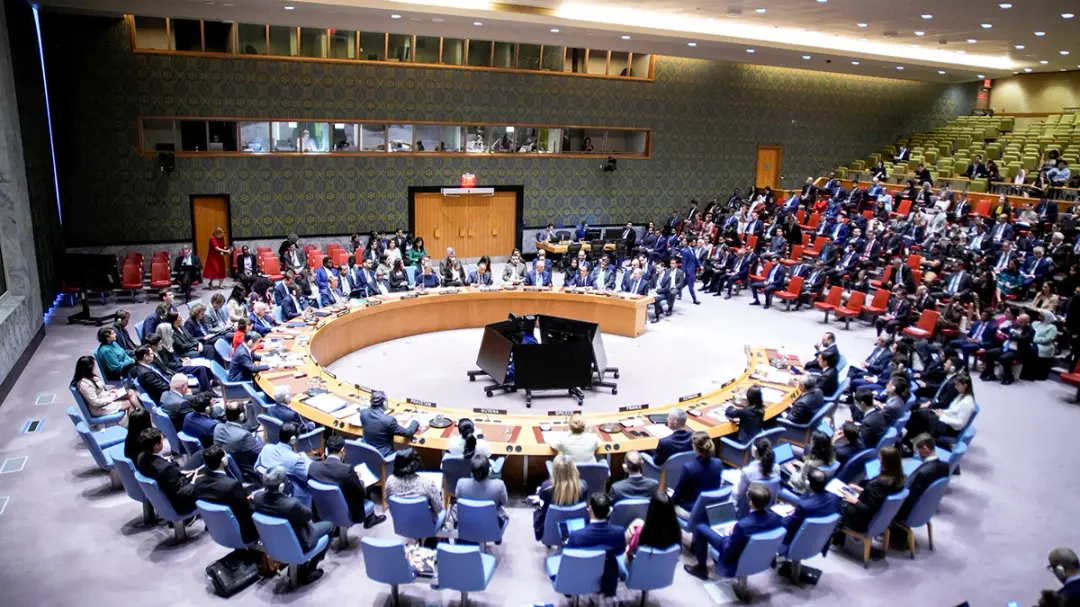
Gaza and Iran files test UN Security Council's effectiveness
An analysis by researcher Saima Afzal says the Gaza and Iran files are testing the UN Security Council's effectiveness. Resolution 2803, adopted in November 2025 by 13 votes with China and Russia abstaining, endorsed a plan to end the Gaza conflict. Under the Resolution 2231 process, earlier sanctions on Iran were re-applied on September 27, 2025. Pakistan, an elected member through end-2026, held the July 2025 presidency and sponsored Resolution 2788.
Source
UN Security Council · read the original report ↗
Desk check · some claims need care
What the desk checked (5)
- Resolution 2803, adopted November 2025 by 13 votes with China and Russia abstaining, endorsed a plan to end the Gaza conflict. — Figures and vote breakdown appear in the source; no external document cited.
- Under Resolution 2231 process, earlier UN sanctions were re-applied on September 27, 2025 and the 1737 sanctions list re-established. — Date and list number appear in the source; the source notes the process remains politically contested.
- Pakistan held the Council presidency in July 2025 and sponsored Resolution 2788, adopted unanimously. — Stated in source without external attribution.
- Pakistan serves as an elected Council member through the end of 2026 and has a population of more than 255 million. — Figures appear in the source; no source given for the population number.
- An August 2026 counterterrorism dialogue covered ISIS-K, al-Qaeda and the TTP; US financing linked to the Reko Diq project. — Asserted by the author without attribution.
Analysts’ view opinion
The Gaza and Iran files do not test whether the Security Council has authority — they test whether there is enough political consensus to convert that authority into action. Resolution 2803, adopted in November 2025 by 13 votes with China and Russia abstaining, created a legal framework, but implementation still depends on the parties and on states with leverage over them. On Iran, the re-application of earlier sanctions on September 27, 2025 under the Resolution 2231 process has become contested at the level of the Council's own machinery — a deeper institutional problem than a mere policy disagreement.
- Resolution 2803 supplies international legitimacy and a stabilization framework, but cannot guarantee compliance — showing both the Council's strength and its ceiling.
- Abstentions by China and Russia are not vetoes, but acquiescence without endorsement signals thin political backing at the implementation stage.
- The Iran file is the sharper risk because the dispute has migrated from policy to procedure; once the legal basis of collective measures is questioned, common action becomes harder.
- As an elected member through the end of 2026, Pakistan cannot override a permanent-member veto; its leverage lies in shaping draft language, building coalitions and linking Council diplomacy to regional actors.
- Resolution 2788, adopted unanimously during Pakistan's July 2025 presidency, illustrates what elected members can achieve where consensus still exists.
What to watch — Watch whether the Gaza stabilization framework acquires operational substance, and whether major-power contestation over the Iran sanctions process spreads into other Council files.
This is one researcher's analysis; the story does not establish the current state of implementation in Gaza, the practical effect of the Iran sanctions, or any outcome of Pakistan's diplomatic efforts.
Deep dive
Research brief · 8 facts · 5 dates · exam-readyThe brief
Context
An analysis by researcher Saima Afzal argues that the Gaza and Iran files are testing whether the UN Security Council can convert its formal legal authority into effective diplomacy when the major powers are divided. Resolution 2803, adopted in November 2025, endorsed the Comprehensive Plan to End the Gaza Conflict and authorized an international stabilization framework, but Gaza remains fragile. Separately, under the process set out in Resolution 2231, earlier UN sanctions provisions on Iran were re-applied on September 27, 2025, a step that remains politically contested. Pakistan, one of the Council's ten elected members serving through the end of 2026, is presented as a case study of what non-permanent members can and cannot do.
Key facts
- Resolution 2803 was adopted in November 2025 by 13 votes, with China and Russia abstaining.
- Resolution 2803 endorsed the Comprehensive Plan to End the Gaza Conflict and authorized an international stabilization framework.
- Under the process set out in Resolution 2231, earlier UN sanctions provisions on Iran were re-applied on September 27, 2025, and the 1737 sanctions list was re-established.
- Pakistan is serving through the end of 2026 as one of the Security Council's ten elected members.
- Pakistan held the rotating Security Council presidency in July 2025.
- The Council unanimously adopted Pakistan-sponsored Resolution 2788 in July 2025 on strengthening mechanisms for the peaceful settlement of disputes.
- The source cites Pakistan's population as more than 255 million, with access to the Arabian Sea and potential connectivity with Central Asia.
- US financing connected with the Reko Diq project is cited as an economic opening; an August 2026 counterterrorism dialogue covered ISIS-K, al-Qaeda and the TTP.
Timeline
- July 2025Pakistan holds the rotating Security Council presidency; the Council unanimously adopts Pakistan-sponsored Resolution 2788 on peaceful settlement of disputes.
- September 27, 2025Under the Resolution 2231 process, earlier UN sanctions provisions on Iran are re-applied and the 1737 sanctions list is re-established.
- November 2025Resolution 2803 adopted by 13 votes, China and Russia abstaining, endorsing the Comprehensive Plan to End the Gaza Conflict.
- August 2026Counterterrorism dialogue cited as showing continuing Pakistan-US overlap on ISIS-K, al-Qaeda and the TTP.
- End of 2026Pakistan's term as an elected member of the Security Council concludes.
Who has a stake
- UN Security Council — Retains primary responsibility for international peace and security, but its political effectiveness is tested when permanent members disagree on implementation.
- China and Russia — Abstained on Resolution 2803 and, as permanent members, can block or dispute the legal and political basis of collective measures.
- Pakistan — Elected member through end-2026; seeks influence through coalition-building, draft language and diplomatic access rather than coercive power.
- United States — Has interests in counterterrorism, connectivity and stability around Afghanistan, Iran and Central Asia, and in a stable, economically viable Pakistan.
- Iran — Subject of re-applied UN sanctions provisions from September 27, 2025 under the Resolution 2231 process.
- Parties to the Gaza conflict — Implementation of the Resolution 2803 framework depends on them and on states with leverage over them.
Why it matters
The Council can create legal frameworks and authorize mechanisms, but as Gaza shows, it cannot guarantee compliance; as Iran shows, major-power disagreement can extend into disputes over the Council's own procedures. That gap between formal authority and political effectiveness shapes how credible the UN remains as a manager of international peace and security. For elected members, the realistic test is whether they can preserve diplomatic space and keep channels open across competing blocs.
UPSC angle
Prelims pointers
- UNSC Resolution 2803 (November 2025): adopted 13-0 with China and Russia abstaining; endorsed the Comprehensive Plan to End the Gaza Conflict.
- UNSC Resolution 2231 process: framework under which earlier UN sanctions provisions on Iran were re-applied on September 27, 2025.
- UNSC Resolution 2788 (July 2025): Pakistan-sponsored, unanimously adopted, on peaceful settlement of disputes under the UN Charter.
- The Security Council has ten elected (non-permanent) members; Pakistan's term runs through the end of 2026; presidency rotates monthly.
- Council tools include binding resolutions, sanctions and peace operations; the 1737 sanctions list relates to Iran.
- Reko Diq project: linked to US financing in critical minerals, cited as an economic strand of Pakistan-US ties.
Mains framing
The Gaza and Iran files expose a structural problem in the UN Security Council: formal authority is not the same as political effectiveness. Resolution 2803, adopted in November 2025 by 13 votes with China and Russia abstaining, endorsed the Comprehensive Plan to End the Gaza Conflict and authorized an international stabilization framework, yet Gaza remains fragile because implementation depends on the parties and on states with diplomatic, economic or military leverage. The Iran case goes further: the re-application of earlier sanctions provisions on September 27, 2025 under the Resolution 2231 process, and the re-establishment of the 1737 list, has been politically contested, showing how great-power rivalry can move from policy disagreement into disputes over the interpretation and operation of the Council's own machinery — eroding the broad acceptance on which Council decisions rest. Elected members cannot overcome a permanent-member veto or fix these structural faults; their leverage lies in shaping draft language, building coalitions, convening debates and linking Council diplomacy to regional actors, as the unanimous adoption of Pakistan-sponsored Resolution 2788 in July 2025 illustrated. The realistic way forward, the analysis suggests, is incremental: using elected-member diplomacy to narrow differences, support workable compromises and keep channels open so that major-power rivalry does not make diplomacy impossible.
Key terms
- Resolution 2803
- November 2025 Security Council resolution endorsing the Comprehensive Plan to End the Gaza Conflict and authorizing an international stabilization framework.
- Resolution 2231
- Security Council resolution setting out the process under which earlier UN sanctions provisions on Iran were re-applied on September 27, 2025.
- Resolution 2788
- Pakistan-sponsored resolution unanimously adopted in July 2025 on strengthening mechanisms for peaceful settlement of disputes under the UN Charter.
- Elected members
- The ten non-permanent Security Council members; they can shape drafts and build coalitions but cannot override a permanent-member veto.
- Abstention
- A Council member declining to vote either way; China and Russia abstained on Resolution 2803, which still passed with 13 votes.
- Reko Diq project
- Pakistan project connected with US financing, cited as an example of opportunities in critical minerals, industry and technology.
Practice questions
- "The Security Council's formal authority is not the same as its political effectiveness." Examine this statement with reference to the Gaza and Iran files of 2025.
- What roles can elected (non-permanent) members of the UN Security Council realistically play when permanent members are divided? Illustrate with examples from the source.
- How does disagreement among major powers over the interpretation of Security Council procedures, as seen in the Iran sanctions case, affect the legitimacy of collective UN action?
Grounded only in the source report — figures and dates are the source's, not inferred.