
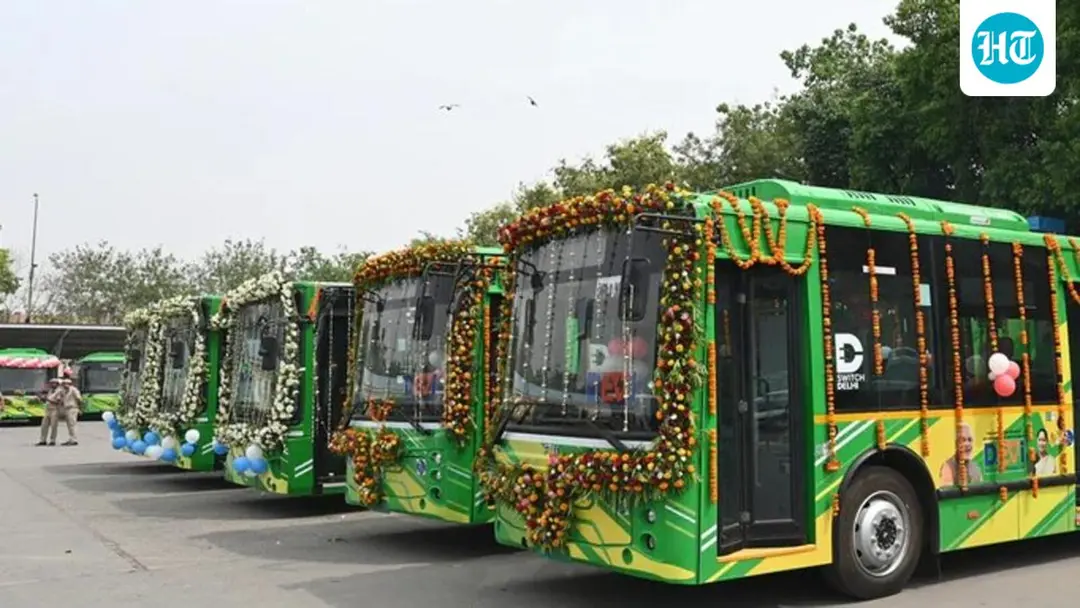
DTC retires last red AC low-floor bus in Delhi
The Delhi Transport Corporation retired its last red AC low-floor bus on Tuesday, the final bus wholly owned and operated by the state transport department. All DTC buses are now run by concessionaires under contract. Government bus service began in 1948 and came under DTC, set up in 1971. Between 2007 and 2011, about 3,700 low-floor CNG buses were inducted. By March 2026 the fleet had 4,338 electric buses, with 1,861 ageing CNG buses due for retirement this year.
Source
Hindustan Times — India · read the original report ↗
Desk check · compared with the source
What the desk checked (4)
- DTC retired its last red AC low-floor bus on Tuesday, the last bus wholly owned and operated by the state transport department. — Stated in source without named attribution; day reference 'Tuesday' is undated in the text.
- DTC was established in 1971, after the first government-run service began in 1948. — Historical detail as given in source; no source cited.
- Between 2007 and 2011, DTC inducted around 3,700 low-floor CNG buses. — Approximate figure appears in source; no agency attribution given.
- By March 2026, the DTC/transport fleet included 4,338 electric buses, with 1,861 ageing CNG buses to be retired this year. — Figures appear in source as unattributed data; expectation of retirement is stated without official quote.
Analysts’ view opinion
Retiring a bus is never just an operational footnote — this one marks the symbolic completion of Delhi's shift from a state-owned bus service to a contract-based concessionaire model. With the last wholly state-run bus gone, political accountability for fares, reliability and labour issues is now shared between the government and private operators. Just as earlier milestones — 1948, the 1971 creation of DTC, the CNG switch, the Commonwealth Games modernisation — were claimed by the governments of their day, expect a contest over who owns the electric-bus story.
- The full move from state ownership to contracted management gives ammunition both to efficiency arguments and to critics who frame it as privatisation of a public asset.
- The headline figure of 4,338 electric buses is potent campaign material on climate and modernisation credentials.
- The plan to retire the remaining 1,861 CNG buses within the year creates a delivery risk that opponents can exploit if service gaps appear.
- Under a concessionaire model, questions about drivers, marshals and union protections become politically sensitive terrain.
- When service falters, expect a blame loop: government pointing at operators, opposition pointing at the policy choice.
What to watch — Watch whether the pace of CNG retirements outruns electric bus inductions — any fleet gap is the most likely flashpoint.
The story does not establish how the contract model has affected costs, service quality or jobs, nor does it attribute the shift to any particular party or administration.
Deep dive
Research brief · 8 facts · 9 dates · exam-readyThe brief
Context
The Delhi Transport Corporation (DTC) retired its last red AC low-floor bus on Tuesday — also the last bus wholly owned and operated by the state transport department, meaning every DTC bus is now run by private concessionaires under contract. Delhi's public bus service dates back to 1948, was brought under DTC in 1971, and has passed through several transitions: high-floor yellow-and-green buses, a Supreme Court-directed diesel-to-CNG shift, low-floor CNG buses around the 2010 Commonwealth Games, the cluster bus scheme from 2011, and now electric buses. The red AC low-floor bus, inducted in the 2007-2011 modernisation, had dominated the city's public transport memory for over a decade.
Key facts
- DTC retired its last red AC low-floor bus on Tuesday; it was the last bus wholly owned and operated by the state transport department.
- All DTC buses are now under contract and managed by concessionaires.
- Delhi's first government-run bus service began in 1948; the Delhi Transport Service was later brought under DTC, established in 1971.
- The Supreme Court directed a transition from diesel to CNG buses in the late 1990s and early 2000s.
- Between 2007 and 2011, DTC inducted around 3,700 low-floor CNG buses, including green non-AC and red AC buses.
- The low-floor buses had automatic transmission, air suspension, wider doors and improved accessibility.
- The cluster bus scheme began in 2011, adding privately operated orange buses; dark-blue AC cluster buses followed.
- By March 2026 the DTC/transport fleet had 4,338 electric buses, while 1,861 ageing CNG buses are to be retired within this year.
Timeline
- 1948Delhi's first government-run public bus service begins.
- 1971Delhi Transport Corporation established; the Delhi Transport Service is brought under it.
- Late 1990s-early 2000sSupreme Court-directed transition of Delhi buses from diesel to CNG.
- 2007-2011DTC inducts around 3,700 low-floor CNG buses, including green non-AC and red AC variants.
- 2010Commonwealth Games in Delhi trigger substantial fleet modernisation.
- 2011Cluster bus scheme begins, bringing privately operated orange buses into the network.
- 2022DTC begins large-scale induction of light-blue electric buses with GPS, CCTV and passenger information systems.
- Tuesday (as reported)DTC retires its last red AC low-floor bus, the last wholly department-owned and operated bus.
- By March 2026Fleet includes 4,338 electric buses; 1,861 ageing CNG buses due for retirement this year.
Who has a stake
- Delhi Transport Corporation (DTC) — Moves from owning and operating buses itself to a model where all its buses are run by concessionaires under contract.
- Delhi state transport department — Has overseen repeated fleet transitions — high-floor to low-floor, diesel to CNG, CNG to electric — and now ends direct operation.
- Private concessionaires and cluster bus operators — Now manage all DTC buses under contract; cluster scheme operators run orange and dark-blue AC buses.
- Delhi commuters — Depend on accessibility features such as low floors, wider doors, AC, GPS, CCTV and passenger information systems.
- Supreme Court — Directed the diesel-to-CNG transition that reshaped Delhi's bus fleet.
Why it matters
The retirement marks the end of direct state ownership and operation of buses in Delhi, with service delivery now fully routed through contracted concessionaires — a structural change in how a major city runs public transport. It also caps a shift from diesel to CNG to electric propulsion that began with judicial intervention and is now driven by fleet electrification, with 4,338 electric buses in service by March 2026.
UPSC angle
Prelims pointers
- Delhi Transport Corporation (DTC) was established in 1971; government bus service in Delhi began in 1948.
- The diesel-to-CNG bus transition in Delhi followed Supreme Court directions in the late 1990s-early 2000s.
- Around 3,700 low-floor CNG buses (green non-AC, red AC) were inducted between 2007 and 2011, around the 2010 Commonwealth Games.
- Delhi's cluster bus scheme began in 2011 with privately operated orange buses; dark-blue AC cluster buses came later.
- Large-scale induction of light-blue electric buses by DTC began in 2022.
- By March 2026: 4,338 electric buses in the fleet; 1,861 ageing CNG buses due for retirement in the year.
Mains framing
Delhi's bus system illustrates how urban public transport is reshaped by judicial intervention, mega-events and technology transitions, and how the state's role shifts from operator to contractor. Judicial direction forced the diesel-to-CNG switch in the late 1990s and early 2000s; the 2010 Commonwealth Games spurred modernisation through some 3,700 low-floor CNG buses between 2007 and 2011 that improved accessibility via automatic transmission, air suspension and wider doors; the 2011 cluster scheme introduced private operators; and since 2022 electrification has taken over, with 4,338 electric buses by March 2026 and 1,861 CNG buses slated for retirement. The retirement of the last red AC low-floor bus — the last wholly department-owned and operated vehicle — means DTC now relies entirely on concessionaires, raising questions about accountability, service quality, contract oversight and institutional capacity within a state corporation that no longer runs buses itself. The way forward, on the evidence in the source, lies in ensuring that the new electric fleet's features (GPS, CCTV, passenger information systems, low-floor accessibility) translate into reliable service, and that the concession model is monitored as closely as departmental operations once were.
Key terms
- DTC (Delhi Transport Corporation)
- Delhi's public bus corporation, established in 1971, which absorbed the Delhi Transport Service.
- Low-floor bus
- Bus with a lower boarding height, automatic transmission, air suspension and wider doors for easier accessibility.
- Concessionaire model
- Arrangement under which private operators manage and run buses under contract instead of the transport department owning and operating them.
- Cluster bus scheme
- Scheme begun in 2011 that brought privately operated buses — orange, and later dark-blue AC — into Delhi's public transport network.
- Diesel-to-CNG transition
- Supreme Court-directed shift of Delhi's buses from diesel to compressed natural gas in the late 1990s and early 2000s.
Practice questions
- Trace the major transitions in Delhi's public bus service since 1948 and assess what each shift achieved for commuters.
- The retirement of DTC's last wholly owned bus completes a move to a concessionaire-run model. Discuss the accountability implications of contracting out public bus operations.
- Evaluate the role of judicial intervention and mega-events in driving cleaner urban transport fleets, using Delhi's diesel-CNG-electric trajectory as an example.
Grounded only in the source report — figures and dates are the source's, not inferred.