
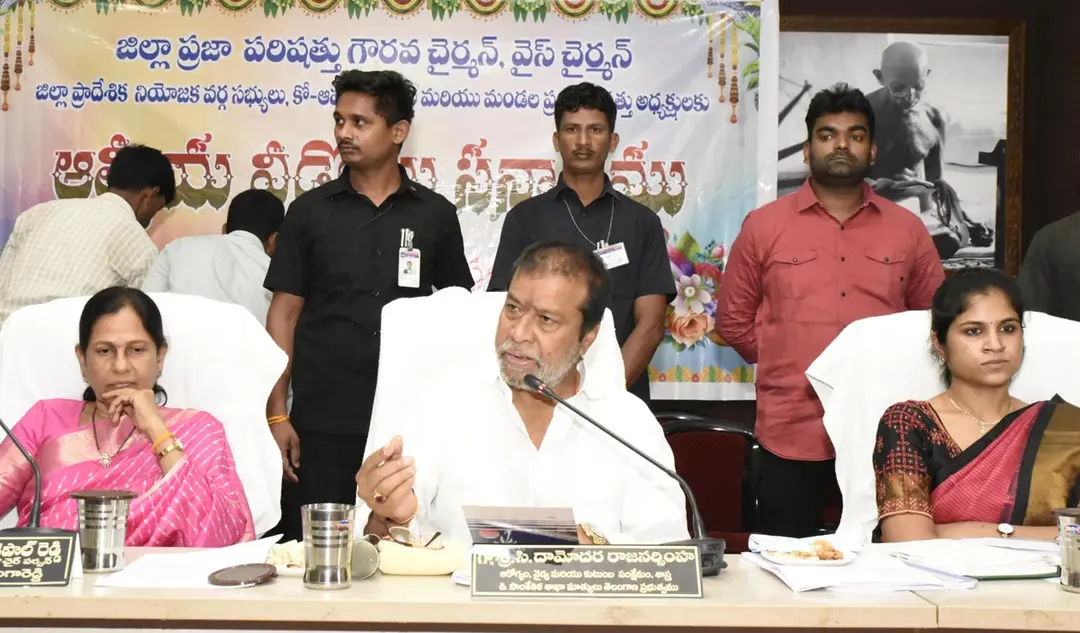
Minister criticises DMHO's reply on medicine shortage in Sangareddy
Telangana Health Minister Damodara Rajanarasimha expressed displeasure at Sangareddy DMHO Dr Gayathri's reply that there were no medicine stocks in district drug stores, at the Zilla Parishad general body meeting on Thursday. Narayankhed MLA Dr Sanjeeva Reddy had raised the shortage in government hospitals, saying only 20 per cent of medicine was available. The DMHO said an indent was sent but no medicines were received. The minister assured a dialysis centre at Sadasivapet and a community health centre for Tellapur.
Source
Sangareddy — health · read the original report ↗
Desk check · compared with the source
What the desk checked (5)
- Health Minister Damodara Rajanarasimha criticised DMHO Dr Gayathri and health officials over their reply on medicine stocks. — Attributed to the minister's remarks at the Zilla Parishad general body meeting in Sangareddy on Thursday, as reported in the source.
- DMHO said there were no stocks in district drug stores and that an indent was sent but medicines were not received. — Attributed directly to DMHO Dr Gayathri in the source; no supporting documentation cited.
- Only 20 per cent of medicine is available in government hospitals in the district. — Figure appears in the source, attributed to Narayankhed MLA Dr Sanjeeva Reddy; not independently corroborated.
- The minister assured a new dialysis centre at Sadasivapet CHC and a new community health centre for Tellapur municipality. — Assurance attributed to the minister in the source; no timeline or sanction order mentioned.
- The minister said he brought IIT-Hyderabad, JNTU-Sulthanpur and other institutes to Sangareddy as education minister in YS Rajasekhar Reddy's cabinet. — Self-claim by the minister as reported; source gives no independent verification.
Analysts’ view opinion
This looks like a single-district complaint, but it exposes a supply-chain governance gap. If an indent was raised and medicines still did not arrive, the routine escalation channel is not working — which is why the minister's instruction to "bring it to my notice immediately" is a workaround for a system failure rather than a fix for it. If the MLA's estimate of only 20 per cent stock availability is accurate, the cost shifts to poor patients buying from private pharmacies, which cuts against the purpose of a public health system.
- An official publicly conceding empty drug stores is healthy for accountability; visible displeasure at that admission risks discouraging candid reporting next time.
- The suggestion that medicines could be sourced from other drug stores in the State implicitly concedes there is no clear, pre-agreed protocol for redistributing stock between districts.
- The symptoms are familiar in centralised procurement models: delayed indent clearance, tender or payment lags, and the absence of real-time stock visibility.
- Infrastructure announcements such as a dialysis centre and a community health centre deliver visible outcomes, but new facilities underperform without recurring inputs like medicines and staff.
- That the gap surfaced at an elected body's general meeting suggests political forums are currently doing the monitoring work the department's own internal review should be doing.
What to watch — Watch whether stock availability in the district measurably improves after these assurances, and whether any review or procedural change follows on why the indent went unfilled.
The story does not establish whether the shortage is statewide or local, which medicines are missing or for how long, or where the indent stalled; the 20 per cent figure is the MLA's claim and is not independently verified here.
Deep dive
Research brief · 8 facts · 4 dates · exam-readyThe brief
Context
At a Zilla Parishad general body meeting in Sangareddy, Telangana, on Thursday (report published 4 July 2024), Health Minister Damodara Rajanarasimha publicly reprimanded the District Medical and Health Officer (DMHO) Dr Gayathri after she said there were no medicine stocks in the district's drug stores. The issue was flagged by Narayankhed MLA Dr Sanjeeva Reddy, who said only 20 per cent of required medicine was available in government hospitals in the district. The exchange highlighted gaps in the drug supply chain for public hospitals serving poor patients, and the minister announced new health facilities for Sadasivapet and Tellapur.
Key facts
- Telangana Health Minister Damodara Rajanarasimha criticised Sangareddy DMHO Dr Gayathri and health department officials for stating there were no medicine stocks in district drug stores.
- Narayankhed MLA Dr Sanjeeva Reddy said only 20 per cent of medicine was available in government hospitals in Sangareddy district.
- The DMHO said an indent had been sent but no medicines had been received so far.
- The minister said many drug stores exist across the State from which medicine could be obtained, and asked officials to report such issues to him immediately.
- The minister asked officials to report any shortage of staff, medicine or facilities so it could be resolved to avoid inconvenience to poor patients.
- He assured sanction of a new dialysis centre at the community health centre in Sadasivapet.
- He assured a new community health centre for Tellapur municipality.
- He felicitated ZPTCs and MPPs whose tenure is completed this month and urged them to continue in public service.
Timeline
- Earlier (date not stated in the source)Sangareddy district health office sent an indent for medicines but received no supplies.
- Thursday (report dated 4 July 2024)At the Zilla Parishad Sangareddy general body meeting, Narayankhed MLA Dr Sanjeeva Reddy raised medicine shortage; the DMHO said there were no stocks.
- Same meetingHealth Minister criticised the DMHO's reply, assured a dialysis centre at Sadasivapet CHC and a new community health centre for Tellapur municipality.
- This month (July 2024)Tenure of ZPTCs and MPPs completed; the minister felicitated them at the meeting.
Who has a stake
- Patients at government hospitals in Sangareddy — Face inconvenience as only 20 per cent of medicine is reportedly available; the minister framed it as an issue affecting poor people.
- DMHO Dr Gayathri and district health officials — Held accountable for not escalating stock-outs; told to report shortages of medicine, staff and facilities immediately.
- Health Minister Damodara Rajanarasimha — Political and administrative responsibility for drug supply and for the new facilities he announced.
- Narayankhed MLA Dr Sanjeeva Reddy — Raised the shortage on behalf of constituents relying on government hospitals.
- Zilla Parishad Sangareddy (Chairperson P Manjusri, Collector Valluru Kranthi) — Forum where district health grievances were aired and commitments made.
- Residents of Sadasivapet and Tellapur municipality — Promised a new dialysis centre at Sadasivapet CHC and a new community health centre at Tellapur.
- ZPTCs and MPPs of the district — Their tenure ends this month; urged to continue in public service.
Why it matters
Medicine stock-outs in government hospitals push poor patients towards costly private purchases, making drug supply chains a core test of public health delivery. The exchange shows that the problem was not merely non-availability but a failure of officials to escalate an unfulfilled indent, pointing to accountability gaps between district health offices and the State. The announcements of a dialysis centre and a community health centre also signal how district-level forums like the Zilla Parishad shape health infrastructure decisions.
UPSC angle
Prelims pointers
- DMHO — District Medical and Health Officer, the head of the health department at district level.
- Zilla Parishad general body meeting is the district-level panchayati raj forum where MLAs, ZPTCs, MPPs and the Collector discuss local issues.
- ZPTC = Zilla Parishad Territorial Constituency member; MPP = Mandal Parishad President — elected rural local body functionaries.
- Community Health Centre (CHC) is the referral unit above PHCs; the minister assured a new dialysis centre at Sadasivapet CHC.
- Sangareddy is a district in Telangana; its Narayankhed MLA is Dr Sanjeeva Reddy; Collector Valluru Kranthi; ZP Chairperson P Manjusri.
- Indent — a formal requisition for supplies; Sangareddy's indent for medicines reportedly went unmet.
Mains framing
The Sangareddy episode illustrates a recurring weakness in public health delivery: even where budget and procurement systems exist, last-mile drug availability can collapse when district indents go unfulfilled and officials do not escalate the gap. Here an MLA reported only 20 per cent medicine availability in government hospitals, while the DMHO cited empty district drug stores and an unmet indent; the Health Minister countered that stocks were available at other drug stores across the State, suggesting a distribution and information failure rather than absolute scarcity. The implications are direct — out-of-pocket expenditure and loss of trust among poor patients who depend on government facilities, and weakened credibility of free-medicine commitments. The way forward indicated in the source is administrative: immediate upward reporting of shortages of medicine, staff and facilities so they can be redressed quickly, combined with strengthening of facilities such as the promised dialysis centre at Sadasivapet CHC and a new community health centre at Tellapur. The Zilla Parishad forum's role in surfacing such grievances also underlines the value of local self-government oversight in health governance.
Key terms
- DMHO
- District Medical and Health Officer — the senior-most health administrator in a district, responsible for hospitals, staff and drug supply.
- Indent
- A formal requisition placed by a district or facility for supplies such as medicines from higher stores.
- Community Health Centre (CHC)
- A block-level referral health facility above the primary health centre in the public health system.
- Zilla Parishad general body meeting
- District panchayat assembly of elected members and officials where district development and service issues are reviewed.
- ZPTC / MPP
- Zilla Parishad Territorial Constituency member and Mandal Parishad President — elected rural local body representatives in Telangana.
- Dialysis centre
- Facility providing renal dialysis; one was assured at the Sadasivapet community health centre.
Practice questions
- Medicine stock-outs in government hospitals often reflect distribution and accountability failures rather than absolute scarcity. Discuss with reference to district-level health administration in India.
- How can panchayati raj institutions such as the Zilla Parishad strengthen oversight of public health service delivery at the district level?
- Examine the role of the District Medical and Health Officer in ensuring drug availability, and suggest measures to make supply chains in public hospitals more responsive.
Grounded only in the source report — figures and dates are the source's, not inferred.