
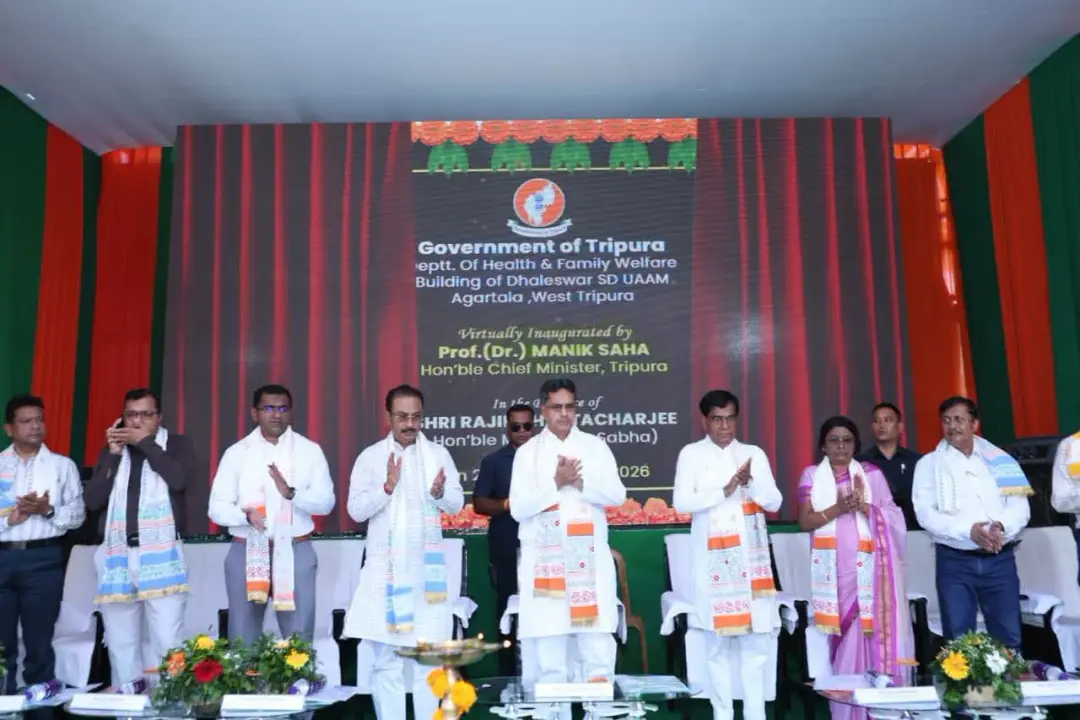
1,110 Arogya Mandirs set up in Tripura, says CM Manik Saha
Tripura Chief Minister Dr Manik Saha said 1,110 Arogya Mandirs have been set up across the state to provide basic medical services quickly. He virtually inaugurated a new polyclinic at Arundhatinagar and five Urban Arogya Mandirs at Radhanagar, Jagaharimura, Ujan Abhaynagar, Dhaleshwar and Ramakrishna Shivalaya Ashram on Thursday. The 12-room polyclinic in AD Nagar cost Rs 2.10 crore. Patients referred outside the state fell from 555 in 2023 to 161 so far in 2026.
Source
Tripura — CM & govt · read the original report ↗
Desk check · compared with the source
What the desk checked (5)
- 1,110 Arogya Mandirs have been set up across Tripura. — Attributed to Chief Minister Manik Saha in the source; no independent data cited.
- The 12-room urban polyclinic in AD Nagar cost Rs 2.10 crore. — Figure appears in source as reported detail; no department document cited.
- Referral patients sent outside the state fell from 555 in 2023 to 161 so far in 2026. — Quoted directly from the Chief Minister; comparison periods are uneven (full year vs part year) as stated in source.
- Five Urban Arogya Mandirs at Radhanagar, Jagaharimura, Ujan Abhaynagar, Dhaleshwar and Ramakrishna Shivalaya Ashram were inaugurated virtually on 24 September 2026. — Names and date appear in source; event described as virtual inauguration.
- A state-of-the-art telemedicine studio will be built at GBP Hospital. — Stated as a government plan by the Chief Minister; no timeline or cost given.
Analysts’ view opinion
Tripura's claim of 1,110 Arogya Mandirs is essentially a state-level execution of the national idea that strengthening the primary tier reduces pressure on tertiary hospitals. The Chief Minister's chosen yardstick — out-of-state referrals falling from 555 in 2023 to 161 so far in 2026 — is politically potent, because for people in the Northeast the cost and disruption of travelling out of state is a lived grievance. But what the story offers is largely infrastructure arithmetic; on staffing, drug supply and actual footfall it is silent, and that is what ultimately decides whether the policy works.
- Arogya Mandirs, satellite centres, telemedicine and e-Sanjivani together read as a hub-and-spoke design tailored to hilly and remote terrain where distance, not intent, is the binding constraint.
- The Rs 2.10 crore, 12-room AD Nagar polyclinic is a capital cost figure only; the recurring annual cost of staffing and running each facility is not stated, and that is the real long-term test.
- The emphasis on Urban Arogya Mandirs is notable, since urban primary care has historically been the under-served part of the system even where hospitals exist nearby.
- Whether the referral drop reflects better local capacity or changes in referral rules, reporting practice or an incomplete year of data is not clarified — a full-year comparison would be needed.
- The parallel ambitions of a 'health tourism hub' and an Integrated Health Medical System sit somewhat apart from basic primary-care expansion, raising a legitimate governance question about where resources are steered.
What to watch — Watch whether the government publishes utilisation data for these 1,110 centres — doctor and staff availability, medicine stocks, daily patient load — rather than only counts of facilities opened.
The story establishes how many centres have been set up, not how many are fully functional, how many posts are vacant, or what actually caused the referral decline; these are the Chief Minister's statements, not an independent assessment.
Deep dive
Research brief · 8 facts · 4 dates · exam-readyThe brief
Context
Tripura is expanding a network of "Arogya Mandirs" — primary-level health facilities meant to deliver basic medical services close to people's homes — alongside upgrades at district and referral hospitals. On 24 September 2026, Chief Minister Prof (Dr) Manik Saha virtually inaugurated a new 12-room urban polyclinic at Arundhatinagar (AD Nagar) and five Urban Arogya Mandirs. The state is projecting the expansion as the reason fewer patients now need to be referred outside Tripura for treatment.
Key facts
- Chief Minister Dr Manik Saha said 1,110 Arogya Mandirs have already been set up across Tripura.
- On Thursday, 24 September 2026, the CM virtually inaugurated a newly built polyclinic at Arundhatinagar and five more Urban Arogya Mandirs.
- The five Urban Arogya Mandirs are at Radhanagar, Jagaharimura, Ujan Abhaynagar, Dhaleshwar and Ramakrishna Shivalaya Ashram.
- The 12-room urban polyclinic in AD Nagar was built at a cost of Rs 2.10 crore.
- Patients referred from Tripura to outside the state fell from 555 in 2023 to 161 so far in 2026.
- A state-of-the-art telemedicine studio is to be built at GBP Hospital; the e-Sanjivani system is also in use.
- An Integrated Health Medical System (IHMS) has been developed to improve medical management in the state.
- Satellite health centres in hilly areas and ASHA workers in rural hospitals are cited as key to services in remote areas.
Timeline
- 2023Number of patients referred from Tripura to outside the state stood at 555.
- 2026 (so far)Referrals outside the state down to 161, as per the Chief Minister.
- 24 September 2026 (Thursday)CM Manik Saha virtually inaugurates the AD Nagar polyclinic and five Urban Arogya Mandirs, then visits the polyclinic.
- 25 September 2026Statement issued from Agartala detailing the inaugurations and health infrastructure claims.
Who has a stake
- Tripura state government / CM Prof (Dr) Manik Saha — Delivering on the promise of minimum medical services close to home and reducing out-of-state referrals.
- Residents of Agartala urban wards (Radhanagar, Dhaleshwar, Ujan Abhaynagar, etc.) — Access to new Urban Arogya Mandirs and a 12-room polyclinic for basic and specialist consultations.
- Patients needing advanced care — Whether improved in-state infrastructure spares them travel outside Tripura for treatment.
- Doctors, health workers and ASHA workers in rural hospitals — Front-line delivery of services; workload rises as the facility network expands.
- National Health Mission, Tripura (State Director Saju Wahid A) — Implementation and funding support for the health facility network.
- Agartala Municipal Corporation (Mayor and MLA Dipak Majumdar) — Urban health service delivery within city limits.
- GBP Hospital — Site of the proposed state-of-the-art telemedicine studio.
Why it matters
Out-of-state referrals impose heavy travel and out-of-pocket costs on patients from a small, hilly, geographically isolated state, so a fall from 555 to 161 referrals is being held up as evidence that decentralised primary care plus better district hospitals can retain patients within Tripura. The mix being deployed — Arogya Mandirs, satellite centres in hills, telemedicine, e-Sanjivani and an Integrated Health Medical System — is the template many small states are using to close the rural-urban care gap.
UPSC angle
Prelims pointers
- Arogya Mandir: primary-level health facility; 1,110 set up in Tripura as per CM Manik Saha (Sept 2026).
- AD Nagar (Arundhatinagar) urban polyclinic: 12 rooms, cost Rs 2.10 crore.
- Out-of-state referrals from Tripura: 555 in 2023 to 161 in 2026 (so far).
- e-Sanjivani: teleconsultation platform cited as effective in Tripura; telemedicine studio planned at GBP Hospital.
- IHMS (Integrated Health Medical System): Tripura initiative for better medical management.
- National Health Mission State Director for Tripura named in the source: Saju Wahid A.
Mains framing
Tripura's health strategy, as presented by the Chief Minister, rests on three legs: dense primary-care coverage through 1,110 Arogya Mandirs and satellite centres in hilly, remote pockets; strengthened secondary care at district and referral hospitals; and digital bridging through telemedicine, e-Sanjivani and an Integrated Health Medical System. The claimed outcome — out-of-state referrals dropping from 555 in 2023 to 161 in 2026 — points to the core welfare logic: each avoided referral saves a family travel, lodging and lost-wage costs that often exceed treatment costs. Yet the source itself flags dependence on human resources, since doctors, health workers and ASHA workers are named as the pivot of rural delivery, which raises the question of whether staffing and specialist availability keep pace with new buildings such as the Rs 2.10 crore AD Nagar polyclinic. The way forward implied by the state's own announcements is deepening digital infrastructure (the proposed GBP Hospital telemedicine studio), integrating data through IHMS, and leveraging combined tourism-health infrastructure to position Tripura as a health hub — with the credibility of the model resting on sustained quality, referral audits and transparent reporting rather than facility counts alone.
Key terms
- Arogya Mandir
- Health facility being set up across Tripura to provide minimum/basic medical services quickly; 1,110 established so far.
- Urban Arogya Mandir
- Town-based version of the Arogya Mandir; five inaugurated at Radhanagar, Jagaharimura, Ujan Abhaynagar, Dhaleshwar and Ramakrishna Shivalaya Ashram.
- Polyclinic
- Facility offering multiple outpatient/consultation services; the new AD Nagar one has 12 rooms and cost Rs 2.10 crore.
- e-Sanjivani
- Teleconsultation system the CM says is playing an effective role in delivering treatment in Tripura.
- IHMS (Integrated Health Medical System)
- System developed in Tripura to further improve medical management in the state.
- Referral patients
- Patients sent outside the state for better treatment; numbered 555 in 2023 and 161 so far in 2026.
Practice questions
- Decentralised primary health facilities can reduce out-of-state medical referrals only if matched by human resources. Discuss with reference to Tripura's Arogya Mandir expansion.
- How can telemedicine platforms such as e-Sanjivani and integrated digital health systems address healthcare access in hilly and remote regions of the North East?
- Evaluate the use of facility counts and referral numbers as indicators of health system performance. What additional indicators would give a fuller picture?
Grounded only in the source report — figures and dates are the source's, not inferred.