
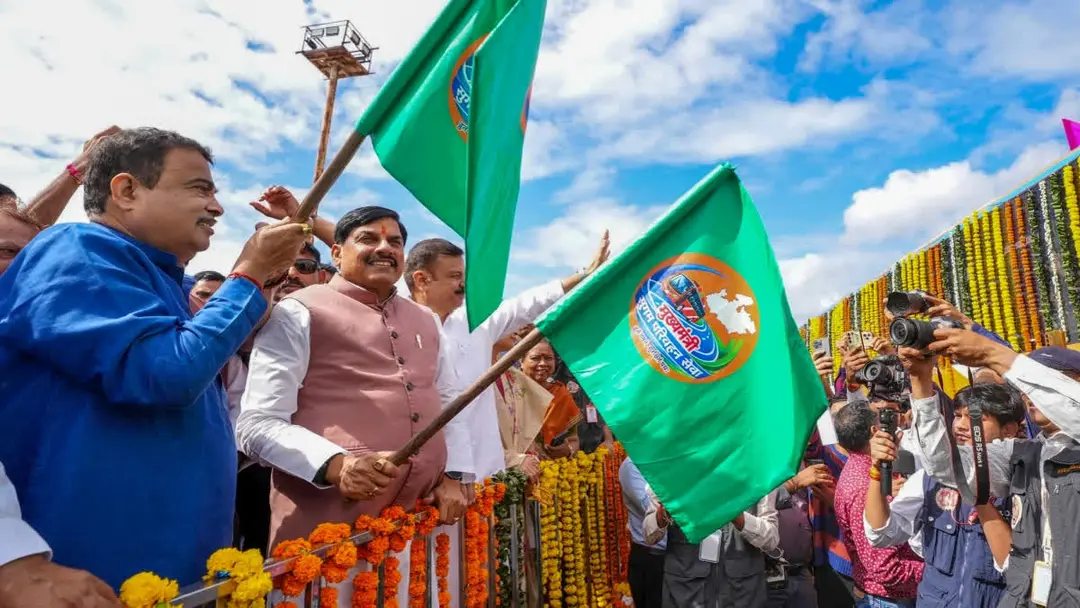
Madhya Pradesh revives public bus service after 21 years
Public bus services resumed in Madhya Pradesh after a gap of 21 years. Union Road Transport Minister Nitin Gadkari and Chief Minister Mohan Yadav launched the 'Mukhyamantri Sugam Parivahan Seva' and 'PM-eBus Sewa' in Bhopal on Friday, flagging off 351 buses in seven cities. The state has set a target of 1,500 buses in the first year and 15,000 by 2031. The MP Road Transport Corporation shut down in 2005. The buses have CCTV cameras and panic buttons.
Source
Road Transport — Nitin Gadkari · read the original report ↗
Desk check · compared with the source
What the desk checked (5)
- Gadkari and CM Mohan Yadav flagged off 351 buses in seven cities, reviving public bus service after 21 years. — Figure and attribution appear in source; headline says 350 while text says 351, a minor internal inconsistency.
- Madhya Pradesh Road Transport Corporation shut down in 2005, with wind-up process begun in 1995. — Stated in source without a named source; presented as background fact.
- Targets of 1,500 buses in the first year and 15,000 by 2031, with bus connectivity to 75% of gram panchayats. — Attributed to CM Yadav and unnamed officials in the source.
- Gadkari: India has two buses per 1,000 people against a world standard of eight; auto industry worth Rs 7 lakh crore employing 4.5 crore people. — Attributed to Gadkari; figures not independently sourced in the text.
- CM alleged Congress conspired to abolish the state bus service. — Political allegation attributed to Yadav; unverified.
Analysts’ view opinion
Relaunching a state bus service after 21 years is as much a political project as a transport one: the BJP government gets a visible, daily-use deliverable, and it gets to pin the 2005 shutdown on Congress. Choosing Deendayal Upadhyaya's birth anniversary for the flag-off, pairing the Chief Minister's scheme with a Prime Minister-branded central scheme, and bundling in announcements on jobs, BRTS barricades and Union Carbide waste signals a deliberate 'double-engine delivery' narrative. The political risk is equally visible: 351 buses today against a 15,000-bus promise by 2031 sets a scoreboard the opposition can check every year.
- Reviving a service shut in 2005 lets the BJP frame Congress as the party that dismantled public transport — the Chief Minister's 'conspiracy' charge is a political claim, not an established finding.
- Twin branding, the CM's Sugam Parivahan Seva alongside PM-eBus Sewa, spreads credit between Bhopal and Delhi and reinforces the BJP's centre-state 'double engine' pitch.
- The city spread — Bhopal, Indore, Jabalpur, Rewa, Dewas, Katni, Bhind — plus the stated goal of covering 75 per cent of gram panchayats, shows an attempt to balance urban visibility with rural reach ahead of future electoral cycles.
- Nitin Gadkari's framing of buses as manufacturing and employment, and the promise of one lakh government jobs, aim the launch at young and job-seeking voters as much as at commuters.
- The sharp attack on Rahul Gandhi, days after his Indore youth event, suggests the BJP sees Congress's youth outreach as worth answering directly rather than ignoring.
What to watch — Watch whether the first-year target of 1,500 buses is met on schedule and how the PPP operating model holds up on fares, routes and reliability — that is where Congress will most likely concentrate its attack.
The story records launch-day announcements and targets, not delivery: it does not establish costs, fare structures, who the private operators are, or any independent verification of the claim that Congress deliberately shut the corporation down.
Deep dive
Research brief · 8 facts · 5 dates · exam-readyThe brief
Context
Madhya Pradesh had no government-supervised public bus service since the Madhya Pradesh Road Transport Corporation shut down in 2005, a wind-up process that had begun in 1995, leaving passenger transport largely to private operators. On September 25, 2026, Union Road Transport and Highways Minister Nitin Gadkari and Chief Minister Mohan Yadav launched the state's 'Mukhyamantri Sugam Parivahan Seva' along with the Centre's 'PM-eBus Sewa' in Bhopal, flagging off 351 buses in seven cities. The services will run on a Public-Private Partnership model, with electric and other categories of buses added in phases. The launch date coincided with the birth anniversary of Pandit Deendayal Upadhyaya.
Key facts
- 351 buses were flagged off on September 25, 2026 at BHEL Dussehra Maidan, Bhopal, covering intercity and intracity routes in Bhopal, Indore, Jabalpur, Rewa, Dewas, Katni and Bhind.
- Public bus service returned to Madhya Pradesh after 21 years; the MP Road Transport Corporation shut down in 2005, with the wind-up process starting in 1995.
- State target: 1,500 buses in the first year, then 2,500-3,000 buses added annually, reaching 15,000 buses by 2031.
- The government aims to provide bus connectivity to 75 per cent of gram panchayats in Madhya Pradesh.
- Buses are fitted with CCTV cameras and panic buttons, and will run under a PPP model.
- Gadkari said India has two buses per 1,000 people against a world standard of eight per 1,000, and that the country intends to manufacture two lakh buses in three years.
- Gadkari said the automobile industry is worth Rs 7 lakh crore, employs 4.5 crore people, and India is now third in the auto sector after America and China, having surpassed Japan a year ago.
- CM Yadav announced that one lakh government posts would be filled and said more than 5 lakh km of roads had been built in Madhya Pradesh.
Timeline
- 1995Process to wind up the Madhya Pradesh Road Transport Corporation begins.
- 2005MP Road Transport Corporation shuts down, ending government-supervised bus services in the state.
- September 25, 2026Gadkari and CM Mohan Yadav launch 'Mukhyamantri Sugam Parivahan Seva' and 'PM-eBus Sewa' in Bhopal, flagging off 351 buses in seven cities.
- First year of operationTarget of 1,500 buses across the state.
- By 2031Target of 15,000 buses operating in Madhya Pradesh.
Who has a stake
- Madhya Pradesh government / CM Mohan Yadav — Delivering promised public transport revival, village-to-city connectivity and coverage of 75 per cent of gram panchayats.
- Union Ministry of Road Transport and Highways / Nitin Gadkari — Rolling out PM-eBus Sewa, raising India's low bus-per-1,000-people ratio and boosting bus manufacturing and employment.
- Commuters in Bhopal, Indore, Jabalpur, Rewa, Dewas, Katni, Bhind — Access to affordable, safer intercity and intracity buses with CCTV and panic buttons.
- Private operators under PPP — Contracts to run and expand electric and other bus fleets across cities and districts in phases.
- Rural residents and gram panchayats — Promised bus connectivity linking villages to schools, colleges and towns.
- Congress / opposition — CM alleged Congress conspired to abolish the state bus service; Yadav also attacked Rahul Gandhi over his Indore youth outreach event.
- Automobile industry — Demand for two lakh buses in three years; sector worth Rs 7 lakh crore employing 4.5 crore people.
Why it matters
Madhya Pradesh's two-decade absence of a state-run bus network left mobility for small towns and villages dependent on private operators; the relaunch tests whether a PPP model can restore mass public transport at scale. It also anchors the Centre's PM-eBus Sewa push for electric city buses at a time when India has only two buses per 1,000 people against a world standard of eight. Safety features such as CCTV and panic buttons, and the target of covering 75 per cent of gram panchayats, make it a test case for equitable and secure rural-urban connectivity.
UPSC angle
Prelims pointers
- PM-eBus Sewa is a central scheme to augment city bus operations with eco-friendly electric buses under a PPP model.
- 'Mukhyamantri Sugam Parivahan Seva' is Madhya Pradesh's state bus service launched on September 25, 2026.
- Madhya Pradesh Road Transport Corporation shut down in 2005; wind-up process began in 1995.
- 351 buses launched in seven cities: Bhopal, Indore, Jabalpur, Rewa, Dewas, Katni, Bhind.
- India has 2 buses per 1,000 people against the world standard of 8 per 1,000 (Gadkari).
- Launch coincided with the birth anniversary of Pandit Deendayal Upadhyaya, a founding member of Bharatiya Jana Sangh.
Mains framing
Madhya Pradesh's revival of public bus services after 21 years illustrates both the cost of dismantling state transport undertakings and the policy turn towards PPP-based, electric-first public mobility. The closure of the MP Road Transport Corporation in 2005, following a wind-up process begun in 1995, left a vacuum in affordable intercity and rural connectivity; the new 'Mukhyamantri Sugam Parivahan Seva', combined with the Centre's PM-eBus Sewa, seeks to fill it with 1,500 buses in year one, 2,500-3,000 added annually, and 15,000 by 2031, plus coverage of 75 per cent of gram panchayats. The design choices are notable: PPP operation to limit fiscal exposure, electric buses for emissions and fuel-cost reduction, and CCTV cameras with panic buttons for passenger safety, especially for women. Structural context reinforces the case: India's ratio of two buses per 1,000 people against a global norm of eight, and an automobile sector worth Rs 7 lakh crore employing 4.5 crore people that stands to gain from a stated plan to manufacture two lakh buses in three years. The way forward lies in contract enforcement and service reliability under PPP, charging and depot infrastructure for e-buses, viable fare and subsidy design for thin rural routes, and last-mile integration so that headline fleet targets translate into dependable everyday mobility.
Key terms
- Mukhyamantri Sugam Parivahan Seva
- Madhya Pradesh's newly launched state bus service, operated under a PPP model with intercity and intracity routes.
- PM-eBus Sewa
- Central scheme to augment city bus operations with eco-friendly electric buses under a Public-Private Partnership model.
- Madhya Pradesh Road Transport Corporation
- State transport undertaking that shut down in 2005; its wind-up process had begun in 1995.
- Public-Private Partnership (PPP)
- Model in which private operators run services under government supervision and contract, used for the new bus fleet.
- Bus Rapid Transit System (BRTS)
- Dedicated bus corridor system in Bhopal whose barricades the CM said were removed for causing public inconvenience.
- Gram panchayat
- Village-level local self-government unit; the state aims to give bus connectivity to 75 per cent of them.
Practice questions
- Discuss the implications of the closure and revival of state road transport undertakings for public mobility in India, using the Madhya Pradesh case.
- Examine whether the Public-Private Partnership model, as adopted under PM-eBus Sewa, can deliver affordable and reliable bus services in smaller cities and rural areas.
- India has two buses per 1,000 people against a world standard of eight. Analyse the causes of this deficit and suggest measures to bridge it.
Grounded only in the source report — figures and dates are the source's, not inferred.