
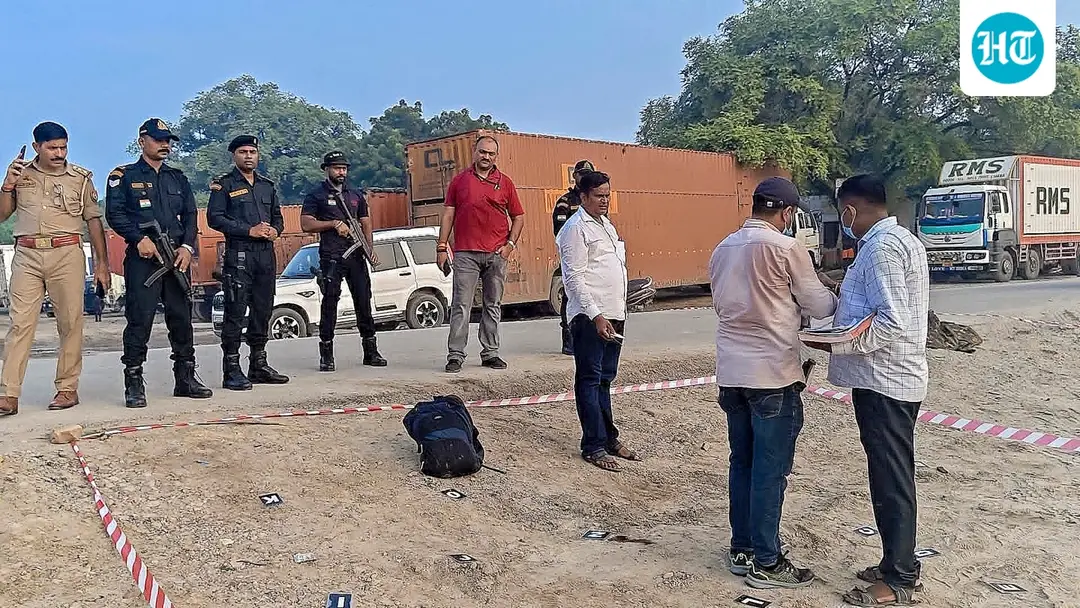
Maoist commander with ₹30 lakh reward killed in Varanasi encounter
Brijesh Ganjhu alias Gopal Singh Bhokta, commander of the banned Jharkhand-based Tritiya Sammelan Prastuti Committee, was shot dead in an encounter with the Uttar Pradesh ATS in Varanasi early on Sunday, police said. He carried a combined ₹30 lakh reward from the Jharkhand government and the NIA, and was wanted in 44 cases of murder, extortion and under UAPA. He opened fire when intercepted at Ramnagar; DSP Vipin Rai and a head constable were saved by bulletproof jackets. Two pistols and a carbine were recovered.
Source
Hindustan Times — India · read the original report ↗
Desk check · compared with the source
What the desk checked (5)
- Brijesh Ganjhu alias Gopal Singh Bhokta, TSPC commander, was shot dead in an encounter with UP ATS in Varanasi early Sunday. — Attributed to police officers and a UP Police release; also confirmed by Jharkhand Police IG (Operations) Narendra Singh.
- He carried a combined reward of ₹30 lakh from the Jharkhand government and the NIA. — Figure appears in source, attributed to police; not independently verifiable here.
- He was wanted in 44 cases of murder, extortion and under UAPA. — Source cites an ATS annexure listing 44 cases while noting some agencies counted 50; discrepancy is acknowledged in the text.
- DSP Vipin Rai and head constable Nitendra Krishna were hit but saved by bulletproof jackets; an associate escaped. — Attributed to the UP Police statement; associate unidentified per source.
- Two pistols and a carbine were recovered; DGP Rajeev Krishna announced ₹2 lakh reward for the ATS team. — Attributed to ADGP (Law and Order) Amitabh Yash and the DGP respectively.
Analysts’ view opinion
Whenever a person dies in police firing, the law prescribes a specific procedural path — and the gravity of the allegations against that person does not alter it. The ATS says Ganjhu faced 44 cases under UAPA, the Arms Act and the Explosive Substances Act, but the police themselves note that these allegations remain subject to investigation and adjudication — meaning he was not, in law, a convicted man. The legal question here is therefore not his record, but whether the use of force was independently established as necessary and proportionate self-defence.
- The accused's death effectively ends prosecution in the 44 cases against him personally, though cases involving co-accused and the NIA terror-financing matters can continue.
- Independent inquiry, a magisterial probe and post-mortem documentation are the standard expectations in India for deaths in police firing; the story does not state where any of that stands.
- The claim that bullets struck a DSP and a head constable but were stopped by bulletproof jackets, plus the two pistols and a carbine recovered, are the core evidentiary props of the retaliatory-fire account — forensic corroboration is what will test them.
- The reward money and the subsequent cash award for the team are administrative matters and are not a legal measure of whether the force used was justified.
- With cases registered in Jharkhand, the encounter in Uttar Pradesh and the NIA involved, jurisdiction and coordination of records become technically complex.
What to watch — Watch for the FIR on the incident itself, any magisterial or independent inquiry, the forensic and ballistic findings, and whether the escaped associate is identified.
The account of how the encounter unfolded rests at this stage on the police version alone; the story does not establish independent verification, forensic findings, or which inquiry has been initiated.
Deep dive
Research brief · 8 facts · 4 dates · exam-readyThe brief
Context
Brijesh Ganjhu, alias Gopal Singh Bhokta, was the commander of the Tritiya Sammelan Prastuti Committee (TSPC), a banned Jharkhand-based Maoist splinter outfit. He was killed in an encounter with the Uttar Pradesh Anti-Terrorist Squad (ATS) in Varanasi early on Sunday while travelling by motorcycle towards Mughalsarai. He carried a combined reward of ₹30 lakh announced by the Jharkhand government and the National Investigation Agency (NIA), and was wanted in at least 44 cases. The encounter comes amid intensified UP surveillance of Naxal movement through the Sonbhadra-Mirzapur corridor.
Key facts
- Brijesh Ganjhu alias Gopal Singh Bhokta, TSPC commander, was shot dead in an encounter with the UP ATS in Varanasi early on Sunday, police said.
- He carried a combined reward of ₹30 lakh on his arrest, announced by the Jharkhand government and the NIA.
- An ATS annexure lists 44 cases against him; some agencies counted 50 cases registered in Jharkhand's Latehar, Chatra, Palamu and Hazaribagh districts and adjoining areas.
- He was booked under the UAPA, the Arms Act and the Explosive Substances Act, apart from murder and extortion cases.
- Ganjhu was a resident of Lootu village in Chatra district, Jharkhand, and was earlier associated with the proscribed CPI-Maoist before emerging as a TSPC leader.
- The interception took place near Lanka Maidan under Ramnagar police station, as he rode from Tengra Mod towards Mughalsarai via Ramnagar.
- DSP Vipin Rai and head constable Nitendra Krishna of the ATS were hit by bullets but saved by their bulletproof jackets; Ganjhu's unidentified associate escaped.
- ADGP (Law and Order) Amitabh Yash said two pistols and a carbine were recovered; DGP Rajeev Krishna announced a ₹2 lakh reward for the ATS team.
Timeline
- Before the operationUP ATS received information about Ganjhu's movement towards Mughalsarai, adjoining Varanasi, acting on an informant's tip-off.
- Early Sunday morningATS team tried to intercept Ganjhu near Lanka Maidan, Ramnagar; he abandoned his motorcycle and opened fire at the police team.
- Same morningIn retaliatory firing Ganjhu was shot, taken to a nearby hospital and declared dead by doctors; his associate escaped.
- SundayJharkhand Police IG (Operations) Narendra Singh confirmed the operation; UP DGP Rajeev Krishna announced a ₹2 lakh reward for the ATS team.
Who has a stake
- Uttar Pradesh ATS — Conducted the interception and encounter; has been monitoring movement of Naxal ultras through the Sonbhadra-Mirzapur corridor.
- Jharkhand government and Jharkhand Police — Had announced part of the ₹30 lakh reward; IG (Operations) confirmed the neutralisation of a commander wanted in dozens of cases in the state.
- National Investigation Agency (NIA) — Had announced part of the reward and is pursuing two cases involving alleged TSPC-linked terror financing and violent activities.
- Tritiya Sammelan Prastuti Committee (TSPC) — Banned outfit loses its commander, described by the ATS as involved in extortion, cadre recruitment and armed violence.
- DSP Vipin Rai and head constable Nitendra Krishna — Were hit by bullets during the encounter and survived because of their bulletproof jackets.
- Courts and investigating agencies — Police noted that allegations and cases attributed to Ganjhu remain subject to investigation and adjudication by courts.
Why it matters
The killing of a ₹30-lakh reward commander of a banned outfit in Varanasi shows that Maoist splinter networks are moving beyond their Jharkhand base into Uttar Pradesh, where the ATS is watching the Sonbhadra-Mirzapur corridor. It also underlines the role of inter-state police coordination and central agencies like the NIA in tracking terror financing and armed violence. At the same time, police themselves note that the 44 cases attributed to him remain subject to trial, keeping due-process questions around encounters in focus.
UPSC angle
Prelims pointers
- Tritiya Sammelan Prastuti Committee (TSPC) is a banned Jharkhand-based outfit; its commander Brijesh Ganjhu carried a ₹30 lakh combined reward.
- The reward was announced jointly by the Jharkhand government and the National Investigation Agency (NIA).
- Ganjhu faced cases under UAPA, the Arms Act and the Explosive Substances Act.
- The encounter took place near Lanka Maidan under Ramnagar police station in Varanasi, UP.
- UP ATS monitors Naxal movement through the Sonbhadra-Mirzapur corridor.
- Weapons recovered: two pistols and a carbine, per ADGP (Law and Order) Amitabh Yash.
Mains framing
The Varanasi encounter illustrates how left-wing extremism has fragmented into splinter formations such as the TSPC, whose cadres originate in the CPI-Maoist and sustain themselves through extortion, cadre recruitment and armed violence, as the ATS alleges in Ganjhu's case. The fact that a commander wanted in 44 cases across Latehar, Chatra, Palamu and Hazaribagh was intercepted in Uttar Pradesh points to cross-border mobility along the Sonbhadra-Mirzapur corridor and the consequent need for inter-state intelligence sharing, which here involved the UP ATS, Jharkhand Police STF and the NIA's terror-financing cases. Reward schemes and specialised units clearly aid such operations, but the police statement that allegations "remain subject to investigation and adjudication by courts" is a reminder that the credibility of counter-insurgency depends on procedural rigour, transparent inquiry into encounter deaths and the protection of personnel through equipment such as bulletproof jackets, which saved two officers here. A sustainable way forward combines intelligence-led policing and financial disruption of extortion networks with governance and rehabilitation in the affected districts, so that leadership decapitation is not followed by fresh recruitment.
Key terms
- Tritiya Sammelan Prastuti Committee (TSPC)
- A banned Jharkhand-based Maoist outfit; Brijesh Ganjhu was its commander, having earlier been with the proscribed CPI-Maoist.
- UAPA
- Unlawful Activities (Prevention) Act, the anti-terror law under which Ganjhu was booked along with the Arms Act and Explosive Substances Act.
- Anti-Terrorist Squad (ATS)
- Specialised Uttar Pradesh police unit that intercepted Ganjhu and monitors Naxal movement through the Sonbhadra-Mirzapur corridor.
- National Investigation Agency (NIA)
- Central agency that had announced part of the ₹30 lakh reward and is pursuing two cases on alleged TSPC-linked terror financing.
- CPI-Maoist
- Proscribed Maoist organisation with which Ganjhu was earlier associated before emerging as a TSPC leader.
Practice questions
- Discuss how the fragmentation of the CPI-Maoist into splinter outfits such as the TSPC has changed the nature of the left-wing extremism challenge in India.
- Examine the role of inter-state coordination and central agencies like the NIA in countering extortion and terror-financing networks of banned outfits.
- Encounter deaths raise questions of accountability even when the deceased faces dozens of criminal cases. Critically analyse in light of due process requirements.
Grounded only in the source report — figures and dates are the source's, not inferred.