
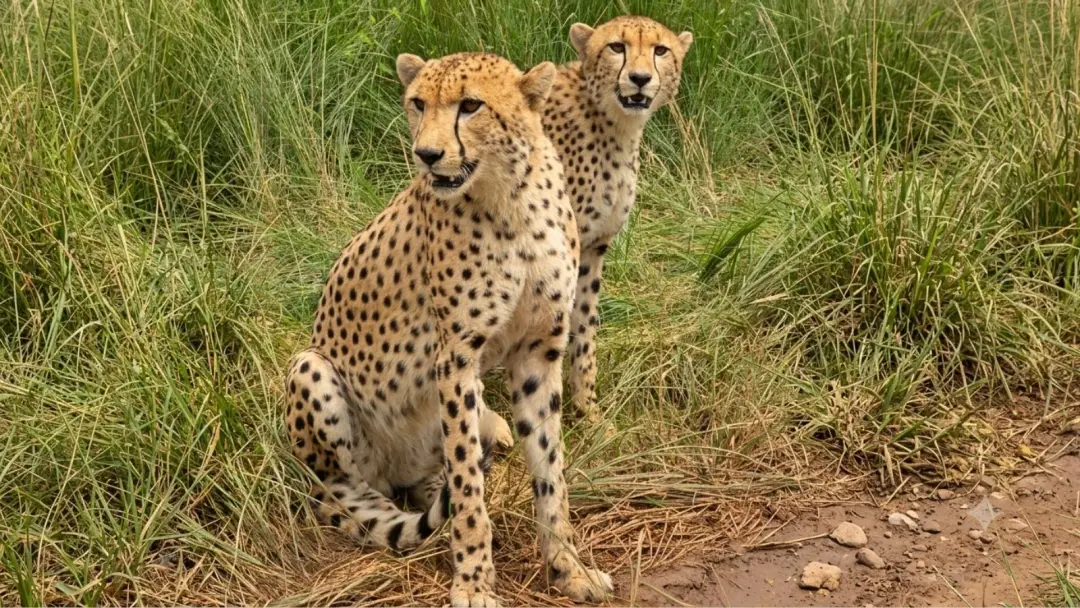
Rare cheetah coalition of India, Botswana males formed at Kuno
Two unrelated male cheetahs have formed a rare coalition at Kuno National Park in Madhya Pradesh, officials said. KNG23, born to a cheetah named Nirva, and CCB4, which arrived from Botswana on February 28, hunt together, share kills and back each other, park director Uttam Kumar Sharma said. Aged six to seven months apart, they remain in a large enclosure and are not yet released. Project cheetah numbers 52 – 49 at Kuno, three at Gandhi Sagar – including 32 born in India.
Source
Indian Express — India · read the original report ↗
Desk check · compared with the source
What the desk checked (5)
- Unrelated males KNG23 (born March this year to Nirva) and CCB4 (arrived from Botswana on February 28) have formed a coalition at Kuno. — Attributed to Kuno director Uttam Kumar Sharma and park officials; source text itself gives conflicting ages for KNG23 (born March this year, yet about 16 months old around March) — editor should note the inconsistency.
- The pair share kills, groom each other and supported each other against a rival coalition. — Attributed to Kuno officials and an unnamed wildlife official.
- Project cheetah population is 52 – 49 at Kuno and three at Gandhi Sagar, including 32 born in India. — Figures attributed to Kuno officials; arithmetic within source is internally consistent.
- Seventeen of Kuno's 49 cheetahs live in the wild, the rest in soft-release enclosures. — Figure appears in source, attributed to Kuno officials.
- The two males are in a large enclosure and have not yet been released into the wild or encountered major predators. — Directly quoted from Sharma.
Analysts’ view opinion
Project Cheetah has always been as much a prestige project as a conservation one, which is why even a story about a "rare coalition" of two male cheetahs lands as a feel-good marker on the initiative's fourth anniversary. The official numbers — 52 in all, 32 of them born in India — give both the Centre and the Madhya Pradesh government a usable metric to argue the project has moved from survival to settling in. At the same time, the park director's own admission that these two males are still in a large enclosure and not yet released gives critics room to argue the messaging is running ahead of the proof.
- The rising count of India-born cheetahs (32) is the strongest political talking point available to the project's defenders, since it suggests declining dependence on imported animals.
- The 49-at-Kuno versus three-at-Gandhi Sagar split signals the beginning of a second-site expansion, something likely to be projected as a Centre-state coordination success.
- Surfacing a behavioural milestone precisely at the four-year mark points to careful narrative management by the administrative side of the project.
- The officially stated fact that only 17 of Kuno's 49 are currently in the wild, with the rest in soft-release enclosures, is the number sceptics are most likely to seize on.
- For Madhya Pradesh the project carries wildlife-tourism and regional-prestige upside, but any setback tends to generate political cost on the same scale.
What to watch — Watch the timing of the decision to release these two males into the wild, and how official messaging frames the stated next goal of mating, births and cub survival in the wild.
The story records no political reaction, government statement or criticism — it rests on park officials' accounts, so the political read here is inference, not reported fact.
Deep dive
Research brief · 8 facts · 7 dates · exam-readyThe brief
Context
India's Project Cheetah, launched four years ago, brought African cheetahs to Kuno National Park in Madhya Pradesh in an attempt to reintroduce the species. Four years on, the focus has shifted from survival of imported animals to India-born cheetahs dispersing and establishing territories. At Kuno, two unrelated males — KNG23, born in India to a cheetah named Nirva, and CCB4, brought from Botswana — have formed a coalition, a social arrangement usually seen only among sibling males.
Key facts
- KNG23 was born at Kuno National Park in March this year to a cheetah named Nirva; CCB4 arrived from Botswana on February 28 this year.
- The two males are unrelated and differ in age by around six to seven months, which Kuno director Uttam Kumar Sharma calls "a very rare phenomenon".
- Around March, KNG23, then about 16 months old, was isolated from its mother and siblings after an injury; CCB4 had arrived without its sisters.
- KNG23 was released into the wild with its mother, brother and sister on May 30; by late July it was injured again and returned to the enclosure.
- The pair hunt together, share kills, groom each other, call to each other when out of sight, and on at least one occasion backed each other against a rival coalition.
- Kuno also has a five-male coalition (three older, two younger males), a coalition of Jwala's two male cubs, and two of Asha's three male cubs staying together.
- Project cheetah population stands at 52 — 49 at Kuno and three at Gandhi Sagar — including 32 born in India.
- Seventeen of Kuno's 49 cheetahs are currently living in the wild; the rest are in soft-release enclosures. KNG23 and CCB4 are still in a large enclosure.
Timeline
- Four years ago (project launch)India's cheetah project launched, with the first cheetahs brought from Africa to Kuno National Park.
- February 28, this yearCCB4 arrives at Kuno from Botswana, without its sisters.
- March, this yearKNG23 born to Nirva at Kuno; separately, KNG23 (the older individual, then about 16 months) isolated after an injury and housed across a fence from CCB4.
- May 30KNG23 released into the wild along with its mother, brother and sister; the family stays together for weeks.
- Late JulyKNG23 injured again and brought back to the enclosure; its sisters had dispersed. The fence between KNG23 and CCB4 is removed.
- After the fence removalThe two share a kill without aggression, then progressively move, hunt, groom and defend together — a coalition takes shape.
- Fourth year of the project (present)Focus shifts to cheetahs establishing territories; officials report population of 52 and emerging natural ecology at Kuno.
Who has a stake
- Kuno National Park administration and director Uttam Kumar Sharma — Responsible for monitoring the coalition, deciding on release into the wild, and demonstrating that the reintroduction is producing natural cheetah behaviour.
- Project Cheetah (India's cheetah reintroduction programme) — Its credibility now rests on wild mating, wild births and wild cub survival rather than only on imported animals surviving.
- Botswana — Source country of CCB4, one of the African partners supplying cheetahs to India's reintroduction effort.
- Gandhi Sagar sanctuary (Madhya Pradesh) — Second site of the project, currently holding three of the 52 cheetahs, as the programme expands beyond Kuno.
- The cheetahs KNG23 and CCB4 — Their survival depends on how the coalition holds up against rival males, predators, territory and food competition once released.
- Wildlife scientists and conservationists — The case tests how flexible cheetah social behaviour is, with implications for managing translocated and orphaned individuals.
Why it matters
Coalitions among male cheetahs are normally formed by siblings, so a bond between an India-born male and an unrelated Botswana-born male suggests cheetah social behaviour is more flexible than assumed — useful knowledge for managing translocated and isolated animals. It also marks a shift in Project Cheetah's fourth year from mere survival and captive breeding to territory formation and natural ecology. The real test remains whether such animals can mate, breed and survive in the wild without protective management.
UPSC angle
Prelims pointers
- Kuno National Park is in Madhya Pradesh; Gandhi Sagar is the project's second cheetah site in the same state.
- Project cheetah population as reported: 52 total — 49 at Kuno, 3 at Gandhi Sagar — of which 32 were born in India.
- 17 of Kuno's 49 cheetahs are in the wild; the rest are in soft-release enclosures.
- CCB4 was translocated from Botswana on February 28; KNG23 was born at Kuno in March to the cheetah Nirva.
- Male cheetah 'coalitions' are typically sibling groups; Kuno also hosts a five-male coalition and coalitions of Jwala's and Asha's male cubs.
- Uttam Kumar Sharma is the director of Kuno National Park.
Mains framing
The formation of a coalition between an India-born male cheetah (KNG23) and an unrelated Botswana-born male (CCB4) at Kuno illustrates both the opportunities and the unfinished business of India's cheetah reintroduction. The bond arose incidentally — both animals had been isolated, one after repeated injuries, the other having arrived without its sisters — and after a fence was removed they began hunting together, sharing kills, grooming and jointly confronting a rival coalition. Ecologically, coalitions improve hunting success and defence against rivals, so such flexibility could help managers place orphaned or singly translocated males. But as park director Uttam Kumar Sharma cautions, older males are usually less accepting of unrelated males, and this pair remains in a large enclosure, untested against leopards, rival males, territorial competition and access to females. The wider project has moved through phases — survival, breeding, cub survival, release — and in year four is focused on territory establishment, with 52 cheetahs (49 at Kuno, 3 at Gandhi Sagar), 32 India-born and 17 in the wild at Kuno. The way forward, as officials themselves define it, is wild mating, wild births and wild cub survival, with minimal restriction on the animals' movement in the forest, monitored closely as they face genuine wild pressures.
Key terms
- Coalition (cheetahs)
- A stable group of male cheetahs that move, hunt, share kills and defend territory together, usually formed among siblings.
- Project cheetah
- India's reintroduction programme, launched four years ago, bringing cheetahs from Africa to Kuno National Park and later Gandhi Sagar.
- Soft-release enclosure
- A large fenced area where cheetahs are acclimatised and monitored before being released into the open wild; most Kuno cheetahs are still in these.
- KNG23
- India-born male cheetah, born at Kuno in March to the cheetah Nirva, repeatedly injured and returned to an enclosure.
- CCB4
- Male cheetah translocated to Kuno from Botswana on February 28 this year, arriving without its sisters.
- Dispersal
- The process by which young cheetahs leave their mother and siblings to establish their own ranges, as KNG23's sisters did.
Practice questions
- Discuss the ecological and management significance of male cheetah coalitions, with reference to the unrelated India-Botswana coalition at Kuno National Park.
- "The harder milestone for Project Cheetah is not producing cheetahs in India but producing cheetahs that survive in the wild." Examine this statement in light of the project's progress over four years.
- Evaluate the challenges of translocation-based species reintroduction in India, using the experience of Kuno National Park and Gandhi Sagar.
Grounded only in the source report — figures and dates are the source's, not inferred.