
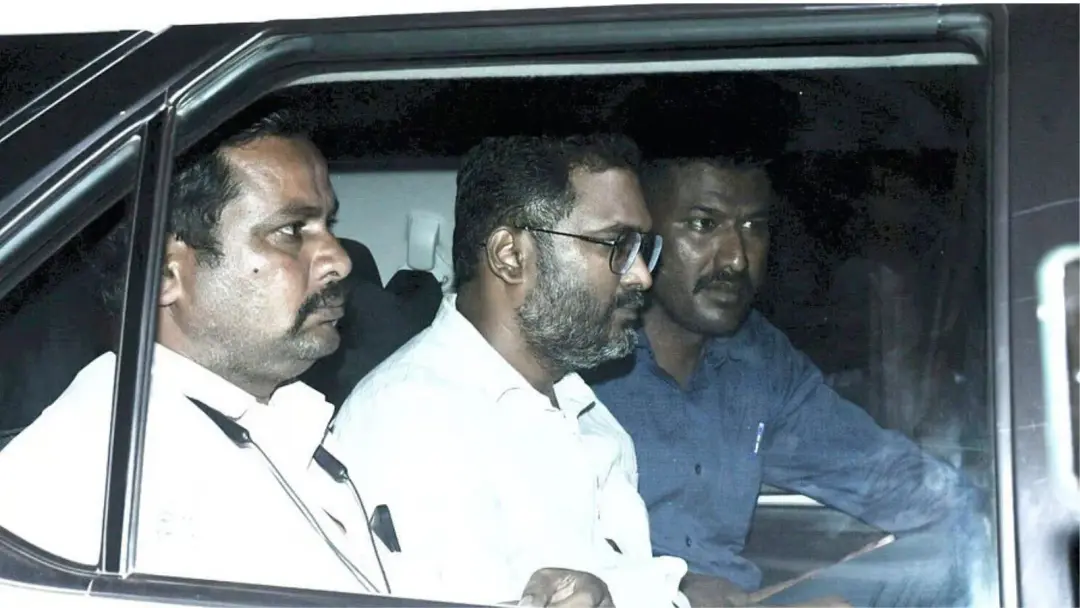
Dharwad tahsildar arrested taking Rs 50 lakh bribe: Lokayukta
Karnataka Lokayukta officials arrested Dharwad tahsildar Sacchidanand Kuchanoor around 9.30 pm on Wednesday while he accepted a Rs 50 lakh bribe. A landowner with 33 acres had sought approval to declare 13 acres unfit for farming for a residential layout, and Kuchanoor allegedly demanded Rs 1 crore in cash and one acre of land. The 13-acre plot in Yerikoppa village is valued at nearly Rs 15 crore. The cash was seized and he was remanded to judicial custody.
Source
Indian Express — Cities · read the original report ↗
Desk check · compared with the source
What the desk checked (5)
- Dharwad tahsildar Sacchidanand Kuchanoor was arrested around 9.30 pm on Wednesday while accepting a Rs 50 lakh bribe. — Attributed to Karnataka Lokayukta officials in the source; figure and timing appear in source.
- Kuchanoor allegedly demanded Rs 1 crore in cash and one acre of land to approve declaring 13 acres unfit for farming. — Attributed to a Lokayukta police officer; framed as an allegation in the source.
- The complainant owns 33 acres and sought approval for 13 acres to form a residential layout in Yerikoppa village, 12 km from Dharwad. — Figures and location appear in source, sourced to Lokayukta police.
- Land rates near the site rose from Rs 30-40 lakh per acre a decade ago to about Rs 1.5 crore per acre, valuing the plot at nearly Rs 15 crore. — Estimates attributed to officials in the source; approximate figures, not independently verifiable.
- Upa Lokayukta Justice B Veerappa registered a suo motu case on September 9 over a politician's birthday event at Arakere primary health centre in Mandya. — Dates and names appear in source; based on a Mandya district Lokayukta report of September 5.
Analysts’ view opinion
This is a textbook trap case: the complainant approached the Lokayukta police first, and the cash was handed over under official supervision. Under anti-corruption law, the prosecution's real burden is proving both demand and acceptance — recovery of cash alone has repeatedly been held insufficient. The arrest, production before a magistrate and remand to judicial custody suggest the statutory steps were followed, but the allegations remain allegations.
- Courts have consistently stressed that in trap cases the demand must be independently established, making the complainant's testimony, any recorded evidence and corroborating witnesses decisive.
- Production before a magistrate and a remand order after arrest are mandatory safeguards flowing from Article 22 and the criminal procedure code.
- Judicial custody is not punishment; the accused retains the right to seek bail, the right to counsel and the presumption of innocence.
- Because declaring land unfit for farming is an official function, demanding consideration to perform it is what would bring the case squarely within anti-corruption provisions, as the prosecution would argue.
- The separate suo motu case over the Mandya health centre event illustrates the Upa Lokayukta's power to act without a complaint — an administrative-oversight track distinct from a criminal trap prosecution.
What to watch — Watch for the bail application, the filing of the chargesheet, any required prosecution sanction, and departmental suspension proceedings — plus the October 5 hearing in the Mandya matter.
The story rests on allegations and official accounts; guilt has not been established and no response or defence from the accused is recorded here.
Deep dive
Research brief · 8 facts · 9 dates · exam-readyThe brief
Context
Karnataka Lokayukta police laid a trap and arrested Dharwad tahsildar Sacchidanand Kuchanoor late on a Wednesday night as he accepted Rs 50 lakh in cash from a landowner. The bribe was sought to grant approval declaring 13 acres of the complainant's 33-acre holding as unfit for farming, a step needed to form a residential layout. The land, in Yerikoppa village near Dharwad, has appreciated sharply due to proximity to IIT Dharwad and the Dharwad bench of the Karnataka High Court. Separately, the Upa Lokayukta has taken suo motu cognisance of a politician's birthday celebration held inside a Mandya primary health centre.
Key facts
- Dharwad tahsildar Sacchidanand Kuchanoor was arrested around 9.30 pm on Wednesday by Karnataka Lokayukta officials while accepting Rs 50 lakh in cash.
- The complainant owned 33 acres and sought approval to declare 13 acres unfit for farming to form a residential layout.
- Kuchanoor allegedly demanded Rs 1 crore in cash plus one acre of land to execute the approval.
- The land lies in Yerikoppa village, 12 km from Dharwad along the Pune-Bengaluru highway.
- Land rates rose from Rs 30-40 lakh per acre a decade ago to about Rs 1.5 crore per acre, due to proximity to IIT Dharwad and the Karnataka High Court's Dharwad bench.
- Officials valued the 13-acre plot slated for approval at nearly Rs 15 crore.
- Cash was seized at the spot; Kuchanoor was produced before a magistrate and remanded to judicial custody.
- Upa Lokayukta Justice B Veerappa registered a suo motu case on September 9 against the Mandya district health officer and Arakere PHC doctors over an August 21 birthday celebration on the medical campus.
Timeline
- August 21Health officials hold the birthday celebration of former MLA Vijayalakshmi Bandisiddegowda at Arakere primary health centre, Mandya, before media personnel.
- September 5Mandya district Lokayukta submits a report on the health centre event.
- September 9Upa Lokayukta Justice B Veerappa registers a suo motu case in the Mandya PHC matter.
- Wednesday afternoonThe landowner files a bribery complaint with Lokayukta police against the Dharwad tahsildar.
- Wednesday 5.30 pmPlanned meeting with Kuchanoor as directed by officials; he was unavailable.
- Wednesday about 8.30 pmKuchanoor leaves festival preparations and asks the complainant to meet him near Karnataka Arts College, Dharwad.
- Wednesday about 9.30 pmKuchanoor arrives by car, collects the cash and is arrested; money seized on the spot.
- ThursdayKuchanoor had organised a Ganesha festival, Satya Narayana pooja and a ritual feast near the tahsildar office.
- October 5Next hearing scheduled before the Upa Lokayukta in the Mandya health centre case.
Who has a stake
- Sacchidanand Kuchanoor, Dharwad tahsildar — Arrested in a trap case, remanded to judicial custody; faces prosecution and loss of office.
- Karnataka Lokayukta police — Executed what the source calls one of the major Lokayukta traps in the state; credibility of anti-corruption enforcement.
- The complainant landowner (33 acres) — Sought lawful approval to convert 13 acres for a residential layout; faced a demand of Rs 1 crore and one acre of land.
- Upa Lokayukta Justice B Veerappa — Registered suo motu case over misuse of a public health facility for a political celebration.
- Mandya district health and family welfare officer and Arakere PHC doctors — Under Lokayukta scrutiny for allowing a politician's birthday event and use of a doctor's chamber as a makeup room.
- Revenue department land-conversion applicants in Dharwad — Discretion over declaring farmland unfit for agriculture creates scope for rent-seeking in a fast-appreciating land market.
Why it matters
A single revenue officer's signature on a land-conversion file was priced at a share of a Rs 15 crore plot, showing how discretionary powers at the tahsildar level become extortion points where peri-urban land values are rising fast. The trap also shows that citizen complaints to the Lokayukta can produce same-day action, while the parallel suo motu case on a political event inside a primary health centre points to wider misuse of public institutions.
UPSC angle
Prelims pointers
- Karnataka Lokayukta is the state anti-corruption ombudsman; the Upa Lokayukta is its deputy, here Justice B Veerappa.
- A tahsildar heads a taluk-level revenue administration and handles land-related approvals such as declaring land unfit for farming.
- Bribe amount accepted and seized: Rs 50 lakh; total demand alleged: Rs 1 crore plus one acre of land.
- Yerikoppa village is 12 km from Dharwad on the Pune-Bengaluru highway; land now about Rs 1.5 crore per acre.
- Suo motu case in the Mandya PHC matter registered September 9 after a district Lokayukta report of September 5; next hearing October 5.
- IIT Dharwad and the Dharwad bench of the Karnataka High Court are cited as drivers of land price appreciation.
Mains framing
The Dharwad case illustrates how discretionary, single-window powers in land administration convert routine regulatory approvals into markets for bribes. Declaring agricultural land unfit for farming is a precondition for residential layouts, and where land values have jumped from Rs 30-40 lakh to around Rs 1.5 crore per acre because of institutional anchors such as IIT Dharwad and the High Court's Dharwad bench, the official's rent-seeking was pegged to the asset's value itself: Rs 1 crore in cash plus one acre from a plot worth nearly Rs 15 crore. The implications are threefold: higher transaction costs for legitimate landowners, distorted urban land markets, and erosion of trust in the revenue machinery. The counterweight visible here is institutional: a same-day complaint, a planned trap, seizure of cash and judicial remand, and, in the Mandya instance, suo motu action by the Upa Lokayukta against health officials for allowing a politician's birthday celebration inside a primary health centre. The way forward, on the evidence of this story, lies in reducing face-to-face discretion in land-conversion approvals, time-bound and traceable processing, and sustained, well-resourced Lokayukta capacity so that trap cases are followed by conviction rather than merely arrest.
Key terms
- Lokayukta
- State-level anti-corruption ombudsman institution; its police wing conducts trap operations and raids against public servants in Karnataka.
- Upa Lokayukta
- Deputy to the Lokayukta, empowered to register and hear cases; here Justice B Veerappa acted suo motu.
- Tahsildar
- Taluk-level revenue officer responsible for land records and approvals, including certifying land as unsuitable for agriculture.
- Trap case
- Operation where a complainant hands over marked bribe money under anti-corruption officials' watch so the demand is caught in the act.
- Suo motu case
- Proceeding initiated by an authority on its own motion, without a formal complaint from an aggrieved party.
- Land unfit for farming (conversion)
- Official declaration that agricultural land is unsuitable for farming, enabling non-agricultural use such as a residential layout.
Practice questions
- Discretionary powers in land administration are a persistent source of corruption. Examine with reference to the Dharwad tahsildar trap case and suggest procedural reforms.
- Evaluate the role of state Lokayukta and Upa Lokayukta institutions in checking administrative corruption and misuse of public facilities, using recent Karnataka examples.
- How does rapid appreciation of peri-urban land values, driven by public institutions and infrastructure, shape rent-seeking in the revenue bureaucracy? Discuss.
Grounded only in the source report — figures and dates are the source's, not inferred.