
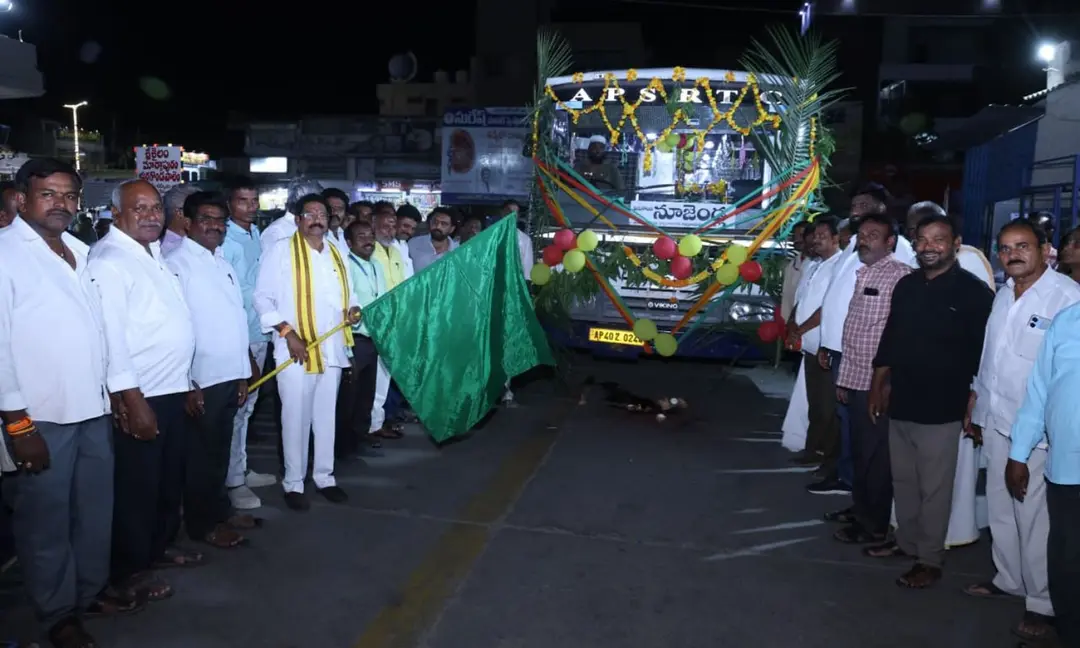
New RTC bus service launched between Vinukonda and Nujendla
Government Chief Whip and Vinukonda MLA GV Anjaneyulu said RTC services are being extended to rural areas so that transport problems do not hinder students' education. He launched a new bus service from Vinukonda to Nujendla, running via Jangalapalli, Madamanchipadu, Tripurapuram, Gollapalem, Obanapalem, Reddipalem and Kammavaripalem. Timings have been set to suit school hours, benefiting students of Nujendla Model School and KGBV. He said 32 new buses were given to the Vinukonda depot after the coalition government took office, and electric buses are being prioritised.
Source
Vinukonda — MLA & నియోజకవర్గం · read the original report ↗
Desk check · compared with the source
What the desk checked (5)
- A new RTC bus service from Vinukonda to Nujendla was launched by GV Anjaneyulu. — Stated in source as an event attended by the MLA; no independent confirmation available.
- The service runs via Jangalapalli, Madamanchipadu, Tripurapuram, Gollapalem, Obanapalem, Reddipalem and Kammavaripalem. — Route details attributed to the MLA's statement at the launch.
- Bus timings have been aligned with school hours to benefit students of Nujendla Model School, KGBV and other schools on the route. — Attributed to the MLA; no operational schedule cited in source.
- 32 new buses were provided to the Vinukonda RTC depot after the coalition government was formed. — Figure appears in source, attributed to the MLA; not independently sourced.
- The government is prioritising electric buses as part of eco-friendly transport statewide. — Policy claim attributed to the MLA; no documentation cited.
Analysts’ view opinion
A single new bus route looks like small news, but at constituency level this is high-value political currency. By foregrounding the figure of "32 new buses since the coalition government came in", Vinukonda MLA and Government Chief Whip GV Anjaneyulu is visibly booking local delivery to his own account. Framing it around students — particularly Model School and KGBV girls — makes it politically hard to attack, which is precisely its strength.
- Pairing the party-discipline post of Chief Whip with visible local delivery fits the familiar strategy of shoring up one's own seat.
- Naming all seven villages along the route is classic micro-politics: a "your village hasn't been forgotten" message to rural voters.
- Claiming a rural transport gap is now being filled implicitly suggests it existed earlier, which invites a response from the opposition.
- The framing of safe transport for girls' education aligns with a broader political pitch to women voters.
- The nod to electric buses ties a local ribbon-cutting to the state government's wider record and image.
What to watch — Watch whether the service actually runs consistently to school timings as promised, and whether similar launches are replicated across other constituencies.
The story rests on the MLA's own statements; the 32-bus figure, ridership, service reliability and any opposition reaction are not independently established here.
Deep dive
Research brief · 8 facts · 2 dates · exam-readyThe brief
Context
In Vinukonda constituency of Andhra Pradesh, a new APSRTC bus service was launched between Vinukonda and Nujendla, aimed primarily at students who lack safe and timely transport to reach schools in rural areas. The service was inaugurated by Government Chief Whip and Vinukonda MLA GV Anjaneyulu, who framed it as part of the coalition government's push to extend public transport to villages. The route timings have been aligned with school hours to serve students of Nujendla Model School, the KGBV and other schools along the way.
Key facts
- A new RTC bus service from Vinukonda to Nujendla was launched by Government Chief Whip and Vinukonda MLA GV Anjaneyulu.
- The service runs via Jangalapalli, Madamanchipadu, Tripurapuram, Gollapalem, Obanapalem, Reddipalem and Kammavaripalem.
- Bus timings have been set in line with school hours to help students travelling to schools along the route.
- Students of Nujendla Model School and the KGBV, besides several other schools on the route, are the intended beneficiaries.
- 32 new buses have been provided to the Vinukonda RTC depot after the coalition government took office, the MLA said.
- The MLA said the government is prioritising electric buses as part of environment-friendly transport and improving public transport statewide.
- The stated objective is that transport problems should not become an obstacle to students' education.
- The MLA said schooling requires not just a school building but also safe transport facilities.
Timeline
- After the coalition government took office (date not stated in the source)32 new buses provided to the Vinukonda RTC depot.
- Day of the report (exact date not stated in the source)GV Anjaneyulu launches the new Vinukonda–Nujendla RTC bus service.
Who has a stake
- Students of Nujendla Model School, KGBV and other schools on the route — Gain a school-timed, safe bus service, reducing transport as a barrier to attendance.
- GV Anjaneyulu, Government Chief Whip and Vinukonda MLA — Launched the service; credits the coalition government for expanding rural RTC connectivity.
- APSRTC Vinukonda depot — Received 32 new buses and now operates the extended rural route.
- Residents of Jangalapalli, Madamanchipadu, Tripurapuram, Gollapalem, Obanapalem, Reddipalem, Kammavaripalem — Villages on the route get direct bus connectivity to Vinukonda and Nujendla.
- State government — Committed to improving public transport statewide and prioritising electric buses.
Why it matters
Lack of dependable rural transport is a common reason for school dropouts and irregular attendance, especially for girls travelling to Model Schools and KGBVs. Aligning bus timings with school hours is a low-cost intervention that links transport policy directly to education outcomes. The stated shift towards electric buses also connects local service expansion to wider goals of cleaner public transport.
UPSC angle
Prelims pointers
- KGBV stands for Kasturba Gandhi Balika Vidyalaya, residential schools for girls, named as a beneficiary institution here.
- The new RTC service links Vinukonda to Nujendla through seven named habitations.
- Vinukonda RTC depot received 32 new buses after the coalition government took office.
- GV Anjaneyulu is Government Chief Whip and MLA of Vinukonda.
- The state government is prioritising electric buses as part of environment-friendly public transport.
Mains framing
Rural transport deficits translate directly into educational exclusion: even where a school or hostel exists, children cannot reach it safely or on time, a gap the Vinukonda–Nujendla RTC service seeks to close by matching bus timings to school hours. The case illustrates how state road transport undertakings serve a social-obligation role rather than a purely commercial one, running thin-demand rural routes that private operators avoid; the addition of 32 buses to a single depot shows fleet augmentation as the enabling condition for such route expansion. Implications include improved attendance and retention, particularly for girl students of Model Schools and KGBVs, and reduced dependence on unsafe informal transport. The stated preference for electric buses adds an environmental dimension, though the source does not specify targets or timelines. The way forward, on the evidence available, lies in sustaining route viability, periodic timetable review against school calendars, and integrating transport planning with education department needs rather than treating bus launches as one-off announcements.
Key terms
- RTC
- Road Transport Corporation, the state-run public bus service operating the new Vinukonda–Nujendla route.
- KGBV
- Kasturba Gandhi Balika Vidyalaya, a residential school for girls; its Nujendla students benefit from the new service.
- Model School
- Government school of a designated model category; Nujendla Model School is a named beneficiary here.
- Government Chief Whip
- Ruling party's floor manager in the legislature; the post held by Vinukonda MLA GV Anjaneyulu.
- Depot
- RTC operational unit that houses and maintains buses and runs services; Vinukonda depot got 32 new buses.
- Electric buses
- Battery-powered buses being prioritised by the government as environment-friendly public transport.
Practice questions
- How does the availability of safe and school-timed public transport affect enrolment and retention in rural schools? Discuss with reference to recent local initiatives.
- State road transport corporations run loss-making rural routes as a social obligation. Examine this role and how it can be sustained alongside fleet electrification.
- Evaluate the case for integrating education department school timings with state transport route planning in rural constituencies.
Grounded only in the source report — figures and dates are the source's, not inferred.