
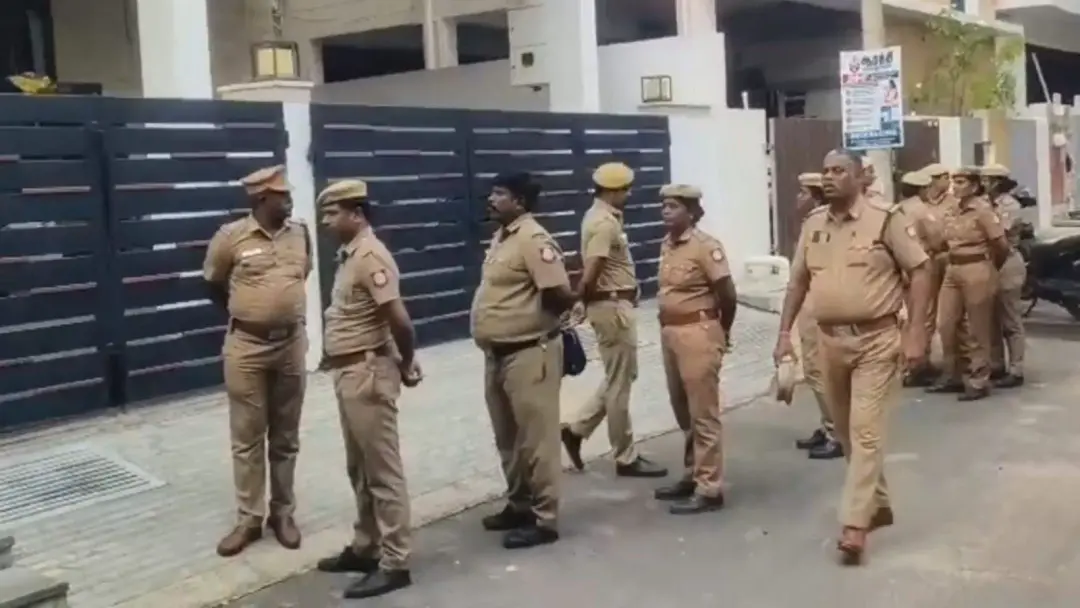
Police search former DMK minister Anbil Mahesh's Tiruchi home
A Central Crime Branch team from Chennai on Wednesday searched the Tiruchi residence of former Tamil Nadu School Education Minister Anbil Mahesh Poyyamozhi. The five-member team began the search around 7.30 am at his Thennur Anna Nagar house. Police sources said six other locations in Chennai and Tiruchi were also searched. The case concerns allegations that around Rs 100 crore was collected from private-school managements for clearances during the previous DMK government; B T Arasakumar was earlier arrested.
Source
Indian Express — India · read the original report ↗
Desk check · some claims need care
What the desk checked (5)
- A five-member Central Crime Branch team searched Anbil Mahesh Poyyamozhi's Tiruchi residence from around 7.30 am on Wednesday. — Reported by the correspondent with specific timing; source of the detail not individually attributed.
- Searches were also conducted at six locations in Chennai and Tiruchi linked to the former minister. — Attributed in the source to unnamed police sources.
- B T Arasakumar was earlier arrested and is accused of collecting around Rs 100 crore from private-school managements. — Figure appears in the source as an allegation in a registered case; not independently verifiable here.
- Arasakumar ran an unregistered body called the Tamil Nadu Private Schools Association. — Stated in the source without specific attribution.
- Former minister K N Nehru was denied entry to the residence during the search. — Reported as fact in the source; no official confirmation cited.
Analysts’ view opinion
This remains a search-stage development: the story does not establish that an FIR names Anbil Mahesh Poyyamozhi or that he has been made an accused. The Central Crime Branch has already registered a case and arrested B T Arasakumar, so these searches are best read as evidence-gathering within that existing investigation. Mahesh's tenure as School Education Minister supplies context, but holding a portfolio is not by itself an offence — the burden of establishing a link between money allegedly collected and official decisions rests entirely on the investigators.
- A search is an evidence-collection step, not a finding of guilt and not yet a charge sheet.
- The legality of such searches usually turns on procedural safeguards — warrant or authorisation, presence of witnesses, a proper seizure memo — none of which are detailed in this story.
- Simultaneous searches at seven locations suggest a strategy aimed at securing documents and digital material before they can be dispersed.
- Allegations of money collected for recognition, upgradation and building-plan approvals, if proved, would fall within the ambit of corruption, cheating and criminal-conspiracy provisions.
- Denying K N Nehru entry while the search was under way is consistent with ordinary procedural control of a search site, though a person being searched retains the ability to seek legal assistance on their rights.
What to watch — Watch whether the searches lead to Mahesh being named as an accused or summoned for questioning, or whether his side moves the Madras High Court challenging the legality of the operation.
The story does not establish whether any charge stands against Mahesh, what if anything was seized, or how he or the DMK has responded — and all allegations remain untested.
Deep dive
Research brief · 8 facts · 4 dates · exam-readyThe brief
Context
The Central Crime Branch (CCB) of Chennai City Police is investigating an alleged multi-crore fraud in which money was said to have been collected from private-school managements in Tamil Nadu in exchange for promises of official clearances during the previous DMK government. On Wednesday, September 16, 2026, a CCB team searched the Tiruchi residence of former School Education Minister Anbil Mahesh Poyyamozhi, who held the portfolio when the alleged transactions took place. The CCB had earlier registered a case and arrested B T Arasakumar, accused of collecting around Rs 100 crore from school managements through an unregistered body called the Tamil Nadu Private Schools Association.
Key facts
- A five-member Central Crime Branch (Chennai City) team began searching Anbil Mahesh Poyyamozhi's Thennur Anna Nagar residence in Tiruchi at around 7.30 am on Wednesday, September 16, 2026.
- Police sources said searches were also conducted at six other locations in Chennai and Tiruchi linked to the former minister.
- The case involves allegations that money was collected from private-school managements with promises of securing official clearances.
- The promised clearances included upgrading schools, obtaining permanent recognition and approvals for building plans.
- The CCB had earlier registered a case and arrested B T Arasakumar, accused of collecting around Rs 100 crore from private-school managements.
- Arasakumar operated an unregistered organisation called the Tamil Nadu Private Schools Association.
- Poyyamozhi held the School Education portfolio when the alleged transactions took place.
- Veteran DMK leader and former minister K N Nehru was denied permission to enter Poyyamozhi's residence while the search was under way.
Timeline
- During the previous DMK government (exact dates not stated in the source)Alleged collection of large sums from private-school managements for promised clearances, while Poyyamozhi held the School Education portfolio.
- Earlier (date not stated in the source)Central Crime Branch registered a case and arrested B T Arasakumar, accused of collecting around Rs 100 crore.
- Wednesday, September 16, 2026, around 7.30 amFive-member CCB team begins search at Poyyamozhi's Thennur Anna Nagar residence in Tiruchi; six other locations in Chennai and Tiruchi searched.
- Same day, during the searchFormer minister K N Nehru denied permission to enter the residence.
Who has a stake
- Anbil Mahesh Poyyamozhi, former Tamil Nadu School Education Minister — His Tiruchi residence was searched; he held the School Education portfolio when the alleged transactions occurred.
- Central Crime Branch, Chennai City Police — Investigating agency that registered the case, made the arrest and conducted the searches.
- B T Arasakumar — Arrested and accused of collecting around Rs 100 crore from private-school managements.
- Private-school managements in Tamil Nadu — Alleged to have paid large sums for clearances such as upgradation, permanent recognition and building-plan approvals.
- DMK — The allegations relate to its previous government; senior leader K N Nehru was turned away from the search site.
- Directorate of Vigilance and Anti-Corruption — Named in the photo caption as conducting a raid at the former minister's residence in Tiruchirappalli.
Why it matters
The case links a state education portfolio to allegations that statutory clearances for private schools — recognition, upgradation and building approvals — were traded for money running to about Rs 100 crore. It raises questions about regulatory discretion in school approvals and the role of an unregistered association acting as an intermediary. Searches at a former minister's home also make this a politically charged test of investigative independence in Tamil Nadu.
UPSC angle
Prelims pointers
- Central Crime Branch (CCB), Chennai City Police, is the agency that registered the case and conducted the September 16, 2026 searches.
- Anbil Mahesh Poyyamozhi was Tamil Nadu's School Education Minister in the previous DMK government.
- B T Arasakumar is accused of collecting around Rs 100 crore from private-school managements.
- Tamil Nadu Private Schools Association was an unregistered organisation operated by Arasakumar.
- Clearances allegedly promised: school upgradation, permanent recognition and building-plan approvals.
- Directorate of Vigilance and Anti-Corruption is referenced in connection with the raid at the Tiruchirappalli residence.
Mains framing
The Tiruchi searches point to a familiar pattern in Indian regulatory governance: where approvals such as permanent recognition, upgradation and building-plan sanction for private schools rest on discretionary administrative clearance, rent-seeking intermediaries can emerge. Here an unregistered body, the Tamil Nadu Private Schools Association, is alleged to have collected around Rs 100 crore from school managements on the promise of securing such clearances, with the then School Education Minister's premises now under search by the Chennai Central Crime Branch. The implications run in two directions — for the integrity of school regulation, where fees paid as bribes are ultimately recovered from parents and may allow substandard institutions to be recognised, and for public trust in political accountability, since the accused minister belonged to the previous ruling party. A credible way forward, on the evidence available, lies in transparent, time-bound and preferably online clearance processes with published criteria, mandatory registration and audit of school associations that interface with government, and an investigation that follows the money trail to its conclusion while respecting due process; the source does not state any remedial measures actually announced.
Key terms
- Central Crime Branch (CCB)
- Specialised crime investigation wing of the Chennai City Police, which registered this case and led the searches.
- Directorate of Vigilance and Anti-Corruption (DVAC)
- Tamil Nadu's anti-corruption agency, named in the story's photo caption as raiding the former minister's residence.
- Tamil Nadu Private Schools Association
- An unregistered organisation operated by B T Arasakumar, through which money was allegedly collected from school managements.
- Permanent recognition
- Official clearance certifying a private school's continued right to operate; one of the approvals allegedly sold for money.
- School upgradation
- Government approval allowing a school to add higher classes or levels; also allegedly promised in exchange for payments.
Practice questions
- Discretionary administrative clearances often become sites of corruption. Examining the alleged private-school clearance scam in Tamil Nadu, discuss how procedural transparency can reduce rent-seeking in education regulation.
- What institutional safeguards exist in India to investigate allegations of corruption against sitting or former ministers, and what challenges do investigating agencies face in such cases?
- Unregistered associations frequently act as intermediaries between private institutions and the state. Critically examine the regulatory gap this creates, with reference to the case involving the Tamil Nadu Private Schools Association.
Grounded only in the source report — figures and dates are the source's, not inferred.