
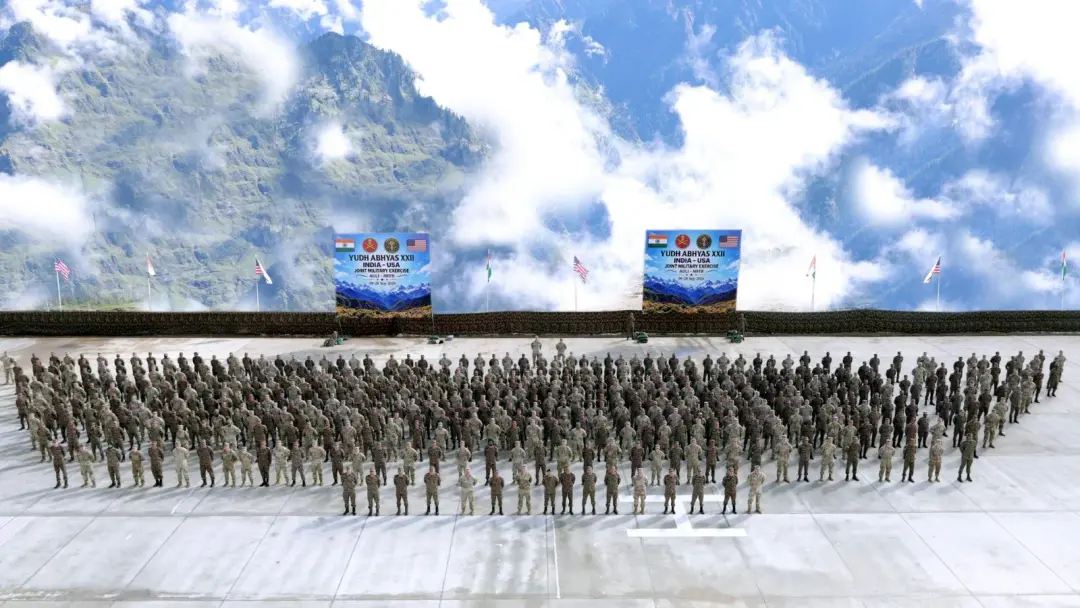
India, US begin 22nd Yudh Abhyas exercise with 600 troops each
The Indian and US armies have begun the 22nd edition of their annual bilateral exercise Yudh Abhyas at the Auli Foreign Training Node in Uttarakhand and the Mahajan Field Firing Range in Bikaner, Rajasthan, with 600 personnel from each side. Major General Amaresh Gunjan and Colonel Benjamin Jackman addressed contingents at Tuesday's opening ceremony at Auli. The Defence Ministry said the drill focuses on Integrated Battle Groups, infantry operations, drones, autonomous systems and long-range precision fires.
Source
Indian Express — India · read the original report ↗
Desk check · compared with the source
What the desk checked (5)
- The 22nd edition of Yudh Abhyas is underway at Auli Foreign Training Node, Uttarakhand, and Mahajan Field Firing Range, Bikaner, Rajasthan. — Stated in source; venues and edition number appear as reported facts without direct attribution beyond the ministry context.
- 600 personnel from each side are participating. — Figure appears in source in connection with the opening ceremony.
- The opening ceremony was held Tuesday at Auli, addressed by Major General Amaresh Gunjan and Colonel Benjamin Jackman. — Names, ranks and appointments as given in source; no external verification possible.
- Technology infusion, drones and autonomous systems for surveillance and reconnaissance are focus areas. — Attributed to the Ministry of Defence statement.
- The Army operationalised its first Integrated Battle Group under XVII MSC in July. — Stated in source without attribution to a named official or document.
Analysts’ view opinion
The 22nd edition of Yudh Abhyas is not just a drill — it is a political signal about how durable the India-US defence relationship has become. By staging it in the Uttarakhand mountains and focusing on Integrated Battle Groups, drones and long-range precision fires, India is publicly advertising its military modernisation priorities. With 600 personnel from each side and venues in two states, this carries more visibility than a routine annual exercise.
- Reaching a 22nd consecutive edition suggests the partnership is now institutional rather than dependent on any single government or party.
- The choice of a high-altitude node in Uttarakhand alongside a desert firing range in Rajasthan will be read as a deliberate strategic message.
- The US bringing its 11th Airborne Division, its primary extreme cold-weather unit, and the 3rd Multi-Domain Task Force with long-range precision fires signals a shift in the character of the engagement.
- Focusing the exercise on Integrated Battle Groups soon after the Army operationalised its first IBG in July helps the government build domestic political backing for military reform.
- Such exercises invite varied regional interpretations, though the story frames this purely as bilateral training and names no third country as a target.
What to watch — Watch whether the exercise is followed by any further announcements on technology cooperation or multi-domain warfare collaboration once it concludes.
The story establishes nothing about wider diplomatic or strategic negotiations, arms deals, or any intent directed at a third country.
Deep dive
Research brief · 8 facts · 3 dates · exam-readyThe brief
Context
Yudh Abhyas is the annual bilateral military exercise between the Indian Army and the US Army, aimed at improving their ability to conduct joint operations in difficult terrain. The 22nd edition is being held at the Auli Foreign Training Node in Uttarakhand and the Mahajan Field Firing Range in Bikaner, Rajasthan, with 600 personnel from each side. This edition focuses on Integrated Battle Groups (IBGs) in mountainous and semi-mountainous terrain, infantry-dominated operations, drones and autonomous systems, and long-range precision fires. The Indian Army had operationalised its first IBG from two divisions under the XVII MSC in July.
Key facts
- The 22nd edition of Yudh Abhyas, the annual India-US bilateral military exercise, is under way at the Auli Foreign Training Node in Uttarakhand and the Mahajan Field Firing Range in Bikaner, Rajasthan.
- Each side has fielded 600 personnel in the participating contingents.
- The opening ceremony was held on Tuesday at Auli.
- Major General Amaresh Gunjan, General Officer Commanding of the 14 Infantry Division, addressed the contingents at the opening ceremony.
- Colonel Benjamin Jackman, Commander of the 1st Infantry Brigade Combat Team, 11th Airborne Division, US Army, also addressed the contingents.
- The US Army's 11th Airborne Division, nicknamed the 'Arctic Angels', is its primary unit for extreme cold-weather and Arctic operations.
- The US Army's 3rd Multi-Domain Task Force (3MDTF) is taking part, bringing advanced long-range precision fires and integrated command-and-control systems into the bilateral framework.
- The Indian Army operationalised its first Integrated Battle Group from two divisions operating under the XVII MSC in July.
Timeline
- JulyThe Indian Army operationalised its first Integrated Battle Group (IBG) from two divisions operating under the XVII MSC.
- Tuesday (this week)Opening ceremony of the 22nd edition of Yudh Abhyas held at the Auli Foreign Training Node, Uttarakhand.
- CurrentlyExercise under way at Auli (Uttarakhand) and Mahajan Field Firing Range (Bikaner, Rajasthan), with drone, autonomous systems and weapon system demonstrations.
Who has a stake
- Indian Army — Tests employment of Integrated Battle Groups in mountainous terrain and absorbs technology and best practices from a partner army.
- US Army (11th Airborne Division, 1st IBCT) — Brings extreme cold-weather and Arctic operations expertise and builds interoperability with Indian infantry formations.
- Ministry of Defence, India — Frames the exercise objectives - interoperability, joint planning and execution, technology infusion and multi-domain warfare exchange.
- US Army's 3rd Multi-Domain Task Force (3MDTF) — Introduces long-range precision fires and integrated command-and-control systems into the bilateral exercise framework.
- Major General Amaresh Gunjan, GOC 14 Infantry Division, and Colonel Benjamin Jackman — Command-level leaders addressing and overseeing the participating contingents.
Why it matters
Yudh Abhyas has become the main platform where India and the US test joint operations in high-altitude and semi-mountainous terrain, which is India's most demanding operational environment. This edition's stress on Integrated Battle Groups, drones, autonomous systems and long-range precision fires shows how both armies are adapting to technology-driven, multi-domain warfare. It also comes soon after the Indian Army operationalised its first IBG, making the drill a live test of a new war-fighting structure.
UPSC angle
Prelims pointers
- Yudh Abhyas is the annual India-US bilateral army exercise; the 22nd edition is being held in 2025 at Auli (Uttarakhand) and Mahajan Field Firing Range, Bikaner (Rajasthan).
- Participation: 600 personnel from each of the Indian and US armies.
- US Army's 11th Airborne Division is nicknamed the 'Arctic Angels' and is its primary extreme cold-weather and Arctic operations unit.
- The US Army's 3rd Multi-Domain Task Force (3MDTF) contributes long-range precision fires and integrated command-and-control systems.
- The Indian Army operationalised its first Integrated Battle Group (IBG) from two divisions under the XVII MSC in July.
- Indian side led at the opening ceremony by Major General Amaresh Gunjan, GOC, 14 Infantry Division.
Mains framing
The 22nd Yudh Abhyas reflects a shift in India-US defence cooperation from symbolic joint drills to capability-building for terrain-specific, technology-intensive warfare. The choice of venues is instructive: Auli offers high-altitude, mountainous conditions while Mahajan Field Firing Range allows live demonstration of contemporary weapon systems in semi-desert terrain, together covering the spectrum of Indian operational environments. The exercise's stated aims - employing Integrated Battle Groups in mountainous and semi-mountainous terrain, infantry-dominated operations, interoperability, exchange of tactics, techniques and procedures, and joint planning and execution - dovetail with the Indian Army's own restructuring, having operationalised its first IBG under the XVII MSC in July. Technology infusion is the second axis: drones and autonomous systems for surveillance and reconnaissance, expert exchanges on emerging technologies and multi-domain warfare, and the participation of the US 3rd Multi-Domain Task Force with long-range precision fires and integrated command-and-control. The way forward lies in converting such episodic learning into institutional doctrine - absorbing lessons on IBG employment, unmanned systems and networked fires into Indian training and procurement, while retaining strategic autonomy in how partnerships are leveraged.
Key terms
- Yudh Abhyas
- Annual bilateral military exercise between the Indian and US armies; the 22nd edition is currently under way.
- Integrated Battle Group (IBG)
- Agile, self-contained combat formation designed for swift operations; India operationalised its first IBG in July under the XVII MSC.
- Auli Foreign Training Node
- Indian Army training facility in Uttarakhand used for high-altitude and mountain warfare training with foreign armies.
- Mahajan Field Firing Range
- Large firing range in Bikaner, Rajasthan, used in this exercise for demonstrations of contemporary weapon systems.
- 11th Airborne Division ('Arctic Angels')
- US Army's primary unit for extreme cold-weather and Arctic operations; its 1st Infantry Brigade Combat Team is participating.
- 3rd Multi-Domain Task Force (3MDTF)
- US Army formation providing long-range precision fires and integrated command-and-control across multiple warfighting domains.
Practice questions
- Discuss how joint exercises such as Yudh Abhyas contribute to India's operational preparedness in high-altitude and mountainous terrain.
- The Indian Army's move to Integrated Battle Groups marks a structural shift in land warfare. Examine its rationale and the challenges of implementation.
- Technology infusion - drones, autonomous systems and long-range precision fires - is reshaping modern land warfare. Analyse the implications for India's military modernisation.
Grounded only in the source report — figures and dates are the source's, not inferred.