
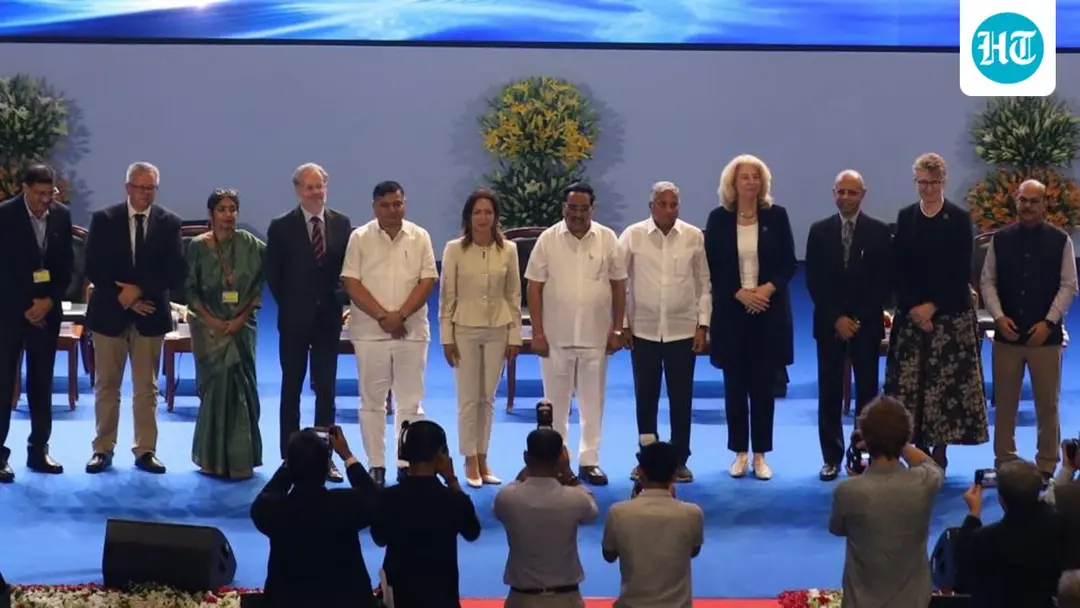
Climate change demands stronger water monitoring, early warnings: Patil
Climate change is rapidly shifting global water cycles and raising risks for ecosystems such as the Himalayas, Union Jal Shakti minister CR Patil said on Tuesday. In his inaugural speech at the 9th India International Water Week 2026, he called for better science, stronger monitoring, timely early warnings and improved preparedness. He said rural households with tap water rose from about 3.24 crore in 2019 to nearly 16 crore now, adding water security was a shared responsibility.
Source
Hindustan Times — India · read the original report ↗
Desk check · compared with the source
What the desk checked (4)
- Climate change is rapidly altering the water cycle and raising risks in ecosystems such as the Himalayas. — Attributed to Union Jal Shakti minister CR Patil in his inaugural speech.
- About 3.24 crore rural households had tap water access in 2019, now nearly 16 crore. — Figures appear in the source and are attributed to Patil; no independent data cited.
- The remarks were made at the 9th India International Water Week 2026 on the theme 'Climate Resilient Water Management'. — Event name, edition and theme stated in the source.
- India's water security is a foundation of the Viksit Bharat@2047 vision. — Attributed statement of government policy position, not independently verified.
Analysts’ view opinion
CR Patil's speech does two jobs at once: it projects a responsible, science-first voice on climate at an international forum, while foregrounding Jal Jeevan Mission numbers as a government achievement. The jump he cited — from about 3.24 crore rural households with tap water in 2019 to nearly 16 crore now — is politically potent, speaking directly to rural voters and especially women. Equally telling is his own framing that the next challenge is not connections but regular, safe supply: that both pre-empts criticism and spreads responsibility to villages and states.
- Tying tap-water numbers to the Viksit Bharat@2047 vision converts welfare delivery into a long-horizon political narrative rather than a one-off scheme claim.
- The line that "water security is a shared responsibility" reads both as cooperative federalism and as a frame that shares accountability for future maintenance failures with states and local bodies.
- Opposition parties are likely to shift the argument from connections given to water actually flowing, quality and continuity — a vulnerability the minister himself named first.
- Flagging Himalayan ecosystems and early warning systems reflects how climate-linked disasters have become a governance and political test, not just an environmental one.
- Offering to share India's experience abroad is a familiar play of turning a domestic programme into a foreign-policy and soft-power asset.
What to watch — Watch upcoming budget allocations, Centre–state bargaining over operation and maintenance costs, and whether the opposition presses on functionality data rather than connection counts.
The story reports only what the minister said; it does not establish independent verification of the figures, how many connections deliver water regularly, or any new funding or policy commitment.
Deep dive
Research brief · 8 facts · 3 dates · exam-readyThe brief
Context
India International Water Week (IIWW) is a periodic global gathering on water management convened under the Union Ministry of Jal Shakti. Its 9th edition, held in 2026, is themed "Climate Resilient Water Management". Inaugurating it on Tuesday, Union Jal Shakti minister CR Patil argued that climate change is rapidly altering the water cycle and raising risks for fragile ecosystems such as the Himalayas, and pressed for better science, monitoring, early warnings and preparedness. He tied water security to the government's Viksit Bharat@2047 vision and cited the Jal Jeevan Mission's expansion of rural tap water as evidence of scale.
Key facts
- Union Jal Shakti minister CR Patil delivered the inaugural speech at the 9th India International Water Week 2026, themed "Climate Resilient Water Management".
- Patil said rural households with tap water access rose from about 3.24 crore in 2019 to nearly 16 crore now, citing the Jal Jeevan Mission.
- He called for "better science, stronger monitoring, timely early warnings and better preparedness" to deal with emerging water risks.
- He said climate change is altering the water cycle: some areas get excessive rainfall, others too little, and rain sometimes fails when most needed.
- Patil described the Himalayas as an example of a vulnerable ecosystem facing heightened risk from shifting water cycles.
- He said India's water security is a key foundation for the Viksit Bharat@2047 vision, covering efficient use, source protection, groundwater recharge and future demand.
- He said real-time data, satellite information, improved forecasting and artificial intelligence can strengthen decisions on floods, groundwater, reservoirs and irrigation.
- He said the next challenge is not merely tap connections but regular, safe and adequate water through source protection, operation and maintenance, and village participation.
Timeline
- 2019About 3.24 crore rural households had access to tap water, per Patil.
- Now (as stated at the event)Rural households with tap water reach nearly 16 crore.
- Tuesday, during the 9th India International Water Week 2026Patil's inaugural address calls for stronger monitoring, early warnings and international cooperation on water.
Who has a stake
- Union Ministry of Jal Shakti / CR Patil — Leads India's water security agenda and is positioning India to both share and learn from global experience.
- Rural households — Beneficiaries of tap connections under Jal Jeevan Mission; now need regular, safe and adequate supply, not just connections.
- Village communities / gram-level bodies — Expected to take greater part in source protection and operation and maintenance of water systems.
- States and other ministries — Patil said water challenges cannot be solved by any one ministry, state or country, implying shared responsibility.
- Himalayan and other vulnerable ecosystems — Face heightened risk as climate change shifts water cycles.
- Other countries and regions — Invited to exchange experiences on managing emerging water risks; India offers to share its own.
Why it matters
Water is India's most climate-exposed resource: erratic rainfall, floods and groundwater stress hit agriculture, drinking water and fragile mountain ecosystems at once. The minister's framing shifts the policy test from counting tap connections to sustaining regular, safe supply through source protection, data-driven forecasting and community participation. It also signals that India sees water security as transboundary and central to its Viksit Bharat@2047 goal.
UPSC angle
Prelims pointers
- 9th India International Water Week 2026 theme: Climate Resilient Water Management; inaugurated by Union Jal Shakti minister CR Patil.
- Jal Jeevan Mission: rural tap water households up from about 3.24 crore (2019) to nearly 16 crore (now), per the minister.
- Viksit Bharat@2047: government vision for which water security was described as a key foundation.
- Technologies flagged for water decision-making: real-time data, satellite information, improved forecasting and artificial intelligence.
- Patil's four-point call: better science, stronger monitoring, timely early warnings, better preparedness.
Mains framing
Climate change is reordering India's hydrology — excess rainfall in some regions, deficits in others, and rain arriving out of season — while vulnerable ecosystems such as the Himalayas bear amplified risk. The policy response outlined at the 9th India International Water Week 2026 rests on three legs: stronger scientific capacity (monitoring, forecasting, early warning systems, use of real-time and satellite data and artificial intelligence for flood, groundwater, reservoir and irrigation decisions); a shift from access to service quality, since the Jal Jeevan Mission's rise from about 3.24 crore rural tap-water households in 2019 to nearly 16 crore now must now be sustained through source protection, operation and maintenance and village-level participation; and cooperative federalism plus international exchange, given that rivers cross boundaries and groundwater links communities, making water security a shared responsibility no single ministry, state or country can discharge alone. The caution offered is important: technology alone is insufficient unless science is connected with society and tools are matched to local needs, keeping people's participation at the centre — an approach the minister linked to water security as a foundation of Viksit Bharat@2047.
Key terms
- India International Water Week (IIWW)
- Global water conference held under the Union Ministry of Jal Shakti; its 9th edition in 2026 was themed Climate Resilient Water Management.
- Jal Shakti Ministry
- Union ministry handling water resources and drinking water; headed by minister CR Patil in the story.
- Jal Jeevan Mission
- Government programme to provide tap water to rural households, cited as taking coverage from about 3.24 crore (2019) to nearly 16 crore.
- Viksit Bharat@2047
- Government's developed-India-by-2047 vision, for which water security was described as a key foundation.
- Early warning systems
- Monitoring and forecasting arrangements that give timely alerts on water-related hazards such as floods.
- Groundwater recharge
- Replenishing underground aquifers; listed among focus areas beyond mere water availability.
Practice questions
- "Water security is a shared responsibility." Examine how climate change is altering India's water cycle and what institutional arrangements are needed for an integrated response.
- The Jal Jeevan Mission has expanded rural tap water coverage from about 3.24 crore households in 2019 to nearly 16 crore. Discuss the challenges of moving from access to regular, safe and adequate supply.
- Assess the role of real-time data, satellite information and artificial intelligence in flood, groundwater and irrigation management, and explain why technology alone may be insufficient.
Grounded only in the source report — figures and dates are the source's, not inferred.