
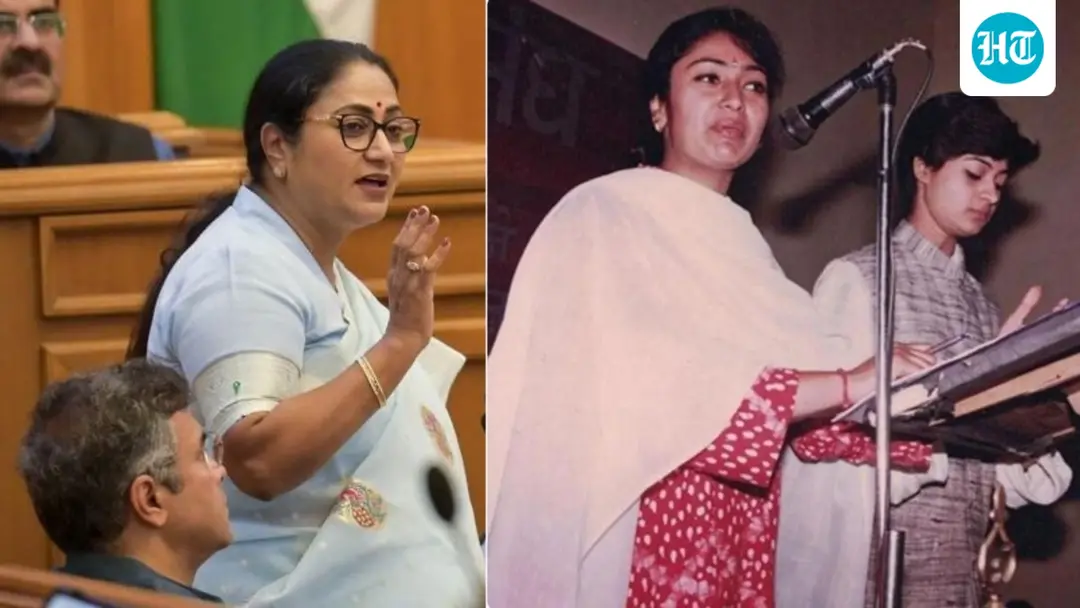
Rekha Gupta's path from DUSU president to Delhi chief minister
Delhi Chief Minister Rekha Gupta studied B.Com at Daulat Ram College from 1992 to 1995 and joined the ABVP during college. She was DUSU general secretary in 1995-96 and president in 1996-97, working alongside Alka Lamba, elected DUSU president in 1995 from the NSUI. Gupta joined the BJP in 2002, was a councillor in 2007 and 2012 and later mayor. She won Shalimar Bagh in 2025. In the latest DUSU polls, ABVP took three of four central panel posts.
Source
Hindustan Times — India · read the original report ↗
Desk check · compared with the source
What the desk checked (5)
- Rekha Gupta was DUSU president in 1996-97 and general secretary in 1995-96. — Figures and years appear consistently in the source; presented as background fact without documentary citation.
- Gupta studied B.Com at Daulat Ram College from 1992 to 1995 and joined ABVP during college. — Stated in source; no external source cited.
- Alka Lamba was elected DUSU president in 1995 from NSUI while Gupta was ABVP general secretary. — Attributed to Lamba's own social media post quoted in the source.
- Gupta and Jindal travelled between colleges on her white scooter and his Bajaj Chetak. — Attributed to Rajneesh Jindal via Indian Express.
- ABVP won three of four central panel posts in the latest DUSU polls; independent Deepanshu Shokeen won vice-president with 30,615 votes. — Vote figure appears in source; result attribution not sourced to the election authority.
Analysts’ view opinion
Rekha Gupta's trajectory is a textbook illustration of the ABVP-to-BJP cadre pipeline. The slow climb over three decades — campus union, councillor twice, mayor, then chief minister — suggests organisational grooming rather than a sudden elevation. Her decision to frame the latest DUSU result, where the ABVP took three of four central panel posts, through her own biography sends a message of generational continuity in the party's Delhi dominance, even as an independent's vice-presidential win after 17 years shows that dominance is not total.
- Gupta's career shows student politics functions for the BJP less as ideological theatre and more as a leadership recruitment system.
- Her early focus on bread-and-butter issues — campus security, buses, an academic calendar — maps neatly onto the municipal, delivery-oriented politics she later practised.
- Working alongside NSUI's Alka Lamba in the 1995 union is a rare cross-party anecdote that is politically useful to both women today.
- A sitting chief minister personally reacting to a students' union result is itself a strategic act that elevates the contest to state-level significance.
- The independent's win after being denied an NSUI ticket points to the cost of candidate-selection missteps for the Congress-affiliated outfit.
What to watch — Watch whether the BJP converts the ABVP sweep into a broader youth-outreach pitch in Delhi, and whether the NSUI revisits how it allots tickets after losing a seat to a rejected aspirant.
The story does not establish that DUSU outcomes track assembly or general election behaviour, and it offers no data on turnout, rival vote shares, or the chief minister's record in office.
Deep dive
Research brief · 8 facts · 9 dates · exam-readyThe brief
Context
Delhi Chief Minister Rekha Gupta, who took office in February 2025 after winning the Shalimar Bagh seat in the 2025 Delhi Assembly election, began her political career in student politics at Delhi University in the 1990s. A B.Com student at Daulat Ram College, she rose through the RSS-affiliated ABVP to become Delhi University Students' Union (DUSU) general secretary in 1995-96 and president in 1996-97. Her past has resurfaced after she congratulated the ABVP for winning three of four DUSU central panel posts in the latest election, recalling her own campus years. DUSU has long been a nursery for national politicians, with ABVP and the Congress-linked NSUI as the main rivals.
Key facts
- Rekha Gupta studied B.Com at Daulat Ram College, Delhi University, from 1992 to 1995.
- She joined the ABVP during her college years and became general secretary of the Daulat Ram College Students' Union in 1994.
- She was DUSU general secretary in 1995-96 and was elected DUSU president in 1996-97.
- Alka Lamba was elected DUSU president in 1995 on an NSUI ticket while Gupta was general secretary from the ABVP; the two took oath together in 1995.
- Gupta joined the BJP in 2002, was elected an MCD councillor in 2007 and 2012, and later served as mayor of the South Delhi Municipal Corporation.
- In the 2025 Delhi Assembly election she won the Shalimar Bagh constituency and was chosen Delhi chief minister in February 2025.
- In 1995 she led a movement seeking an academic calendar with at least 150 proper working academic days, and pushed for more U-Special buses and better women's safety on North Campus.
- Her proposal to make North Campus a compact or closed campus for security was not implemented.
Timeline
- 1992-1995Gupta studies B.Com at Daulat Ram College and joins the ABVP.
- 1994Becomes general secretary of the Daulat Ram College Students' Union.
- 1995Takes oath as DUSU general secretary alongside NSUI's Alka Lamba, elected DUSU president; leads campaign for 150 working academic days.
- 1995-96Serves as DUSU general secretary.
- 1996-97Elected president of the Delhi University Students' Union.
- 2002Joins the BJP after remaining active in the ABVP.
- 2007 and 2012Elected councillor in the Municipal Corporation of Delhi; later becomes mayor of South Delhi Municipal Corporation.
- February 2025Becomes Delhi Chief Minister after winning Shalimar Bagh in the Delhi Assembly election; Alka Lamba shares their 1995 oath photograph.
- Latest DUSU election (recent)ABVP wins three of four central panel posts; independent Deepanshu Shokeen wins vice-president with 30,615 votes.
Who has a stake
- Rekha Gupta — Delhi Chief Minister whose political legitimacy and appeal are linked to her rise from DUSU president to the state's top office.
- ABVP — Student wing whose latest sweep of three of four DUSU central panel posts reinforces its campus dominance and pipeline to BJP politics.
- NSUI — Congress-linked student body that lost ground; its decision not to give Deepanshu Shokeen a ticket preceded his independent win.
- Alka Lamba — Former NSUI DUSU president (1995) whose recollections highlight cross-party coexistence in student politics.
- Deepanshu Shokeen — Independent vice-president-elect whose 30,615-vote win is the first independent entry to the DUSU central panel in 17 years.
- Delhi University students — Beneficiaries or victims of the campus issues Gupta once raised: academic calendar, campus security, women's safety and U-Special bus transport.
Why it matters
Gupta's trajectory shows how DUSU functions as a training ground and recruitment channel for mainstream party politics, especially for the ABVP-BJP ecosystem. It also illustrates that campus issues such as working academic days, women's safety and student transport can shape long political careers. The latest results, including the first independent win in 17 years, signal both continuity of organisational dominance and pockets of student discontent with party tickets.
UPSC angle
Prelims pointers
- DUSU: Delhi University Students' Union; Rekha Gupta was general secretary 1995-96 and president 1996-97.
- ABVP is the student organisation Gupta joined in college; NSUI is the rival body from which Alka Lamba won DUSU president in 1995.
- Rekha Gupta won the Shalimar Bagh constituency in the 2025 Delhi Assembly election and became Chief Minister in February 2025.
- She was an MCD councillor in 2007 and 2012 and later mayor of the South Delhi Municipal Corporation.
- Latest DUSU central panel: Yash Dabas (president), Riya Chhawadi (secretary), Lakshya Raj Singh (joint secretary) from ABVP; Deepanshu Shokeen (independent) vice-president with 30,615 votes.
- U-Special buses are the dedicated Delhi bus services for university students that Gupta sought to expand.
Mains framing
Rekha Gupta's journey from Daulat Ram College union office-bearer in 1994 to DUSU president in 1996-97 and Delhi Chief Minister in February 2025 illustrates how university student unions serve as structured entry points into party politics in India. The ABVP's organisational depth on Delhi University's North Campus, reflected again in its winning three of four central panel posts in the latest election, provides sustained leadership supply to the BJP, just as the NSUI historically did for the Congress; Gupta and Alka Lamba, elected to the same 1995 panel from rival outfits, exemplify both ideological competition and functional cooperation within a union. The issues Gupta campaigned on - an academic calendar with at least 150 working days, more U-Special buses, and women's safety including an unimplemented proposal for a compact North Campus - show that student politics is substantively about governance of everyday campus life, even as it is judged largely by its electoral theatre. The independent victory of Deepanshu Shokeen with 30,615 votes, the first in 17 years and following denial of an NSUI ticket, suggests space for candidate-led mobilisation outside party machines. A way forward lies in strengthening accountability for elected student leaders on the academic and safety mandates they seek votes on, so that campus democracy delivers outcomes and not only careers.
Key terms
- DUSU
- Delhi University Students' Union, the central students' body of Delhi University with a four-member central panel.
- ABVP
- Akhil Bharatiya Vidyarthi Parishad, the student organisation Gupta joined in college; it won three of four central panel posts in the latest DUSU poll.
- NSUI
- National Students' Union of India, the rival student outfit from which Alka Lamba won the DUSU presidency in 1995.
- Central panel
- The four top DUSU posts - president, vice-president, secretary and joint secretary - elected university-wide.
- U-Special buses
- Dedicated bus services for Delhi University students; Gupta campaigned to increase their number.
- Compact or closed campus
- Proposal Gupta pushed to restrict access to North Campus for better security; it was not implemented.
Practice questions
- Discuss the role of university student unions such as DUSU as recruitment channels for mainstream political parties in India. Illustrate with examples from the given account.
- Rekha Gupta's student-era demands included a 150-day academic calendar, better women's safety and expanded student transport. Examine why such campus governance issues often remain unresolved.
- What does the first independent victory in the DUSU central panel in 17 years suggest about the relationship between party machinery and student voters?
Grounded only in the source report — figures and dates are the source's, not inferred.