
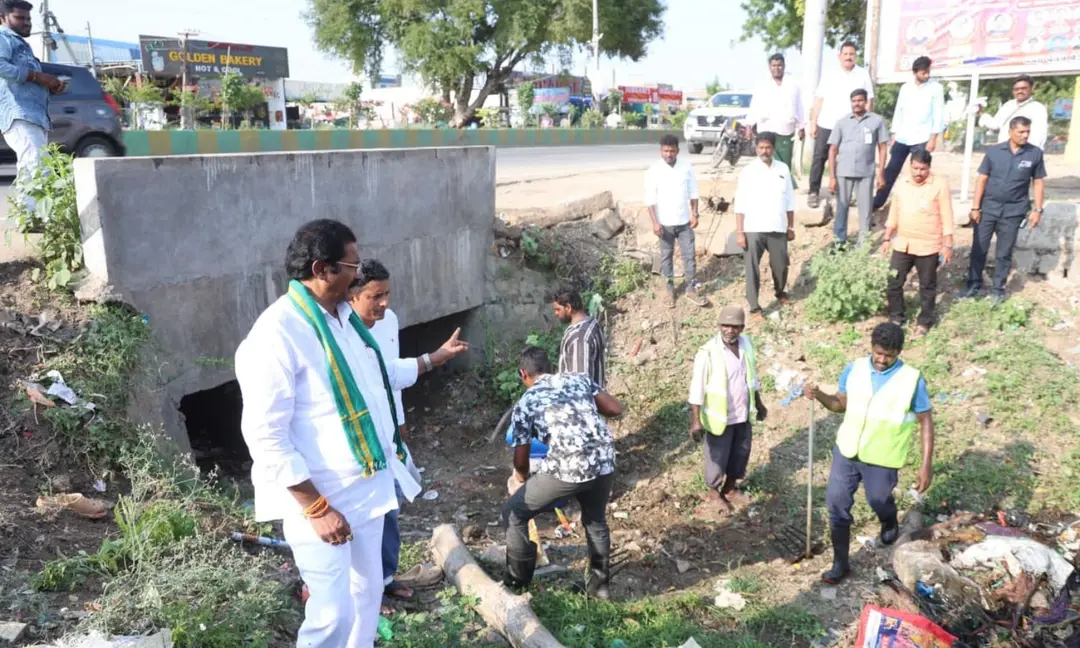
Chief Whip GV Anjaneyulu responds to social media post on canal garbage
Government Chief Whip and MLA GV Anjaneyulu responded to a social media post on garbage and sewage accumulated around the NSP canal in Vinukonda town. He directed municipal officials to resolve the issue immediately and visited the canal himself to inspect sanitation conditions. Staff carried out special measures and cleared the accumulated garbage. He asked officials to focus on sanitation, drainage and drinking water. Locals thanked him.
Source
Vinukonda — MLA & నియోజకవర్గం · read the original report ↗
Desk check · compared with the source
What the desk checked (4)
- Government Chief Whip and MLA GV Anjaneyulu responded to a social media post about garbage and sewage near the NSP canal in Vinukonda. — Stated in source as the central event; no post author or date given.
- He directed municipal officials to resolve the issue immediately and inspected the canal surroundings himself. — Attributed to the MLA in the source; no independent confirmation available.
- Sanitation staff removed accumulated garbage and cleaned the canal surroundings. — Reported in source without figures or official statement.
- Locals thanked the Chief Whip for the prompt response. — Generalised claim in source; no named residents quoted.
Analysts’ view opinion
On the surface this is a routine sanitation drive; politically it is a textbook "responsive MLA" branding exercise. By treating a social media post as a legitimate grievance channel, ordering officials to act and then showing up at the canal himself, GV Anjaneyulu placed himself at the centre of the complaint-to-solution chain. For a leader who also holds the government office of Chief Whip, that speed of response reinforces both his grip on local administration and the ruling alliance's image.
- Responding directly to a social media post means the government side absorbed the grievance before the opposition could turn it into a campaign talking point.
- By publicly warning officials against negligence, the MLA drew a line where failure belongs to the bureaucracy and the fix belongs to the elected representative.
- A Chief Whip being physically seen at a canal in his own constituency signals to voters that a state-level post has not loosened his local grip.
- Sanitation, drainage and drinking water are the bread-and-butter issues that decide municipal-level voting, so focusing on them reads as long-term electoral investment.
- The story notes alliance leaders were present, suggesting an attempt to route the credit not only to the individual but to the coalition as a whole.
What to watch — Whether follow-through continues on drainage and drinking water beyond this one clean-up, or attention returns only with the next viral post, will determine the real political value of this intervention.
The story does not establish how long the problem had persisted, what permanent remedy if any was ordered, or how rivals responded — and gratitude from a few residents is not a measure of broader public opinion.
Deep dive
Research brief · 8 facts · 4 dates · exam-readyThe brief
Context
In Vinukonda town (Palnadu region, Andhra Pradesh), residents living near the Nagarjuna Sagar Project (NSP) canal complained of garbage and sewage piling up around the canal, and the grievance surfaced through a social media post. Government Chief Whip and local MLA GV Anjaneyulu saw the post and directed municipal officials to act at once. He then visited the canal himself to inspect sanitation conditions, after which sanitation staff carried out special cleaning work and cleared the accumulated garbage. The episode is an instance of social media functioning as an informal grievance-redressal channel in urban local body sanitation.
Key facts
- Garbage and sewage accumulated around the NSP canal in Vinukonda town caused difficulties for local residents, as flagged in a social media post.
- Government Chief Whip and MLA GV Anjaneyulu responded immediately after seeing the social media post and directed municipal officials to resolve the problem.
- Anjaneyulu personally visited the NSP canal site to inspect sanitation conditions.
- Sanitation staff took up special sanitation measures, removed the accumulated garbage and cleaned the canal surroundings.
- He instructed officials not to be negligent in solving public problems and to respond immediately.
- He directed special attention to basic amenities in the town — sanitation, drainage and drinking water.
- He said sanitation measures must be taken up from time to time so that public health is not affected.
- Local residents thanked the Chief Whip; local alliance (kootami) leaders, municipal officials and sanitation staff took part in the programme.
Timeline
- Before the visitA social media post highlights garbage and sewage accumulated around the NSP canal in Vinukonda.
- Immediately after seeing the postChief Whip and MLA GV Anjaneyulu directs municipal officials to resolve the issue at once.
- Same occasionHe visits the NSP canal to inspect sanitation conditions; sanitation staff carry out special cleaning and clear the garbage.
- After the clean-upLocals thank the Chief Whip; officials are told to focus on sanitation, drainage and drinking water.
Who has a stake
- Residents near the NSP canal, Vinukonda — Relief from garbage, sewage and related health risks; they thanked the MLA after the clean-up.
- GV Anjaneyulu, Government Chief Whip and MLA — Accountability as local representative; responsiveness to citizen grievances raised online.
- Vinukonda municipal officials — Directed to resolve the issue immediately and to focus on sanitation, drainage and drinking water.
- Sanitation staff — Executed the special sanitation drive and removed the accumulated garbage.
- Local alliance (kootami) leaders — Participated in the inspection and clean-up programme.
Why it matters
Uncleared garbage and stagnant sewage beside an irrigation canal is both a public health hazard and a water-quality risk for a town. The episode shows how a single social media post can trigger municipal action, but also how routine sanitation in small towns often depends on political intervention rather than regular systems.
UPSC angle
Prelims pointers
- NSP canal refers to the Nagarjuna Sagar Project canal network; the affected stretch here is in Vinukonda town.
- GV Anjaneyulu is Government Chief Whip and MLA, and led the sanitation inspection at Vinukonda.
- Chief Whip is a ruling-party functionary who manages party discipline and attendance in the legislature.
- Municipal officials were directed to focus on three basic amenities: sanitation, drainage and drinking water.
- Sanitation, drainage and drinking water are core functions of urban local bodies.
Mains framing
The Vinukonda canal clean-up illustrates a recurring pattern in Indian urban governance: solid waste and sewage management in small and medium towns is reactive rather than routine. Municipal bodies are the constitutional agencies for sanitation, drainage and drinking water, yet here action followed a social media post and a legislator's personal visit rather than a scheduled system of waste collection and canal maintenance. Causes include weak capacity and monitoring in small municipalities, dumping along canal banks, and the absence of grievance-tracking mechanisms accessible to residents. The implications are significant: garbage and stagnant sewage near an irrigation canal raise the risk of vector-borne disease and contamination of water used downstream, while dependence on political intervention makes redressal uneven across wards. The way forward, as the Chief Whip's own instructions suggest, lies in making sanitation, drainage and drinking water a continuous administrative priority — regular sanitation rounds, accountability for officials who neglect complaints, and formal, time-bound citizen grievance channels so that citizen reporting, including on social media, feeds into a documented system rather than a one-off drive.
Key terms
- NSP canal
- Nagarjuna Sagar Project canal; the stretch passing through Vinukonda town where garbage and sewage had accumulated.
- Chief Whip
- Ruling party's senior floor manager in the legislature, responsible for discipline, attendance and voting coordination.
- Vinukonda
- Andhra Pradesh town where the canal sanitation problem and the clean-up drive took place.
- Special sanitation measures
- One-time intensive cleaning drive by municipal sanitation staff to clear accumulated garbage and clean surroundings.
- Kootami leaders
- Local alliance/coalition party leaders who participated in the inspection programme.
Practice questions
- How can urban local bodies move from reactive, politically triggered sanitation drives to institutionalised waste management? Discuss with reference to small towns.
- Examine the role of social media as a citizen grievance-redressal channel in local governance. What are its strengths and limits?
- Dumping of solid waste and sewage into irrigation canals threatens both public health and water security. Suggest measures to prevent it.
Grounded only in the source report — figures and dates are the source's, not inferred.