
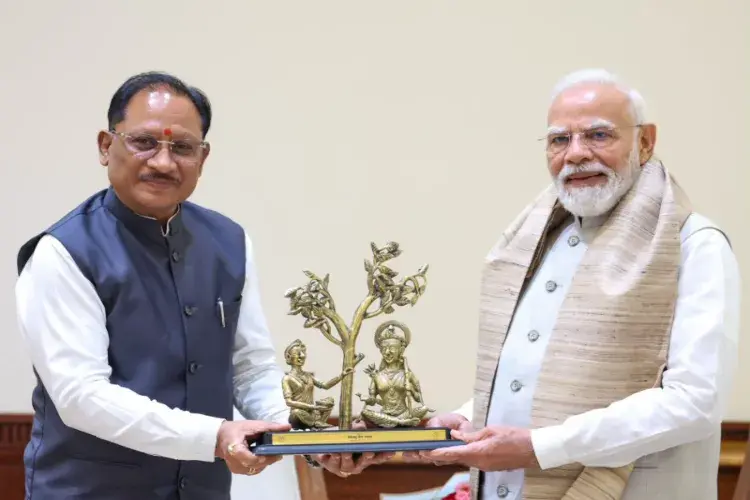
Chhattisgarh CM meets PM Modi, presents Bastar development roadmap
Chhattisgarh Chief Minister Vishnu Deo Sai met Prime Minister Narendra Modi at Parliament House on Friday and presented a roadmap for the holistic development of the Bastar region. He sought early approval for a Rs 10,500-crore gas-based urea project in Rajnandgaon, special assistance to connect 461 villages in security-sensitive areas to the power grid, and faster consideration of an All India Institute of Ayurveda in Raipur or Bastar. He said 421 closed schools have reopened and 34 lakh people screened for health.
Source
Chhattisgarh — CM & govt · read the original report ↗
Desk check · compared with the source
What the desk checked (5)
- CM Vishnu Deo Sai met PM Narendra Modi at Parliament House on Friday — Stated in source, sourced to the Chief Minister's Office; date given only as 'Friday'.
- Early approval sought for a Rs 10,500-crore gas-based urea project in Rajnandgaon — Figure appears in source, attributed to the Chief Minister's request to the PM.
- Special central assistance sought to connect 461 villages in security-sensitive areas to the power grid — Figure appears in source, attributed to the Chief Minister.
- Chhattisgarh has attracted investment proposals worth nearly Rs 8 lakh crore since the Industrial Development Policy 2024-30 — Claim made by the Chief Minister; no independent data cited in source.
- 10.42 lakh women made Lakhpati Didis; 421 reopened schools; 34 lakh screened under Mukhyamantri Swasth Bastar Abhiyan — All figures appear in source as statements by the Chief Minister, unverified externally.
Analysts’ view opinion
This was less a routine file-submission than a joint exercise in narrative-building: Bastar being repositioned from an insurgency headline to a development showcase. By placing his governance numbers directly before the Prime Minister, Vishnu Deo Sai strengthens his standing in Delhi while making the 'double-engine government' case at home. The three asks — a urea plant, power for 461 villages, an Ayurveda institute — map neatly onto farmers, tribal voters and the urban middle class.
- Figures like 421 reopened schools and 34 lakh health screenings serve as political proof that a security gain is being converted into a governance gain.
- Seeking fast approval for the Rs 10,500-crore Rajnandgaon urea project is a farmer-facing demand, and stressing that land and state clearances are done shifts the onus visibly to the Centre.
- Asking for grid connectivity in 461 security-sensitive villages doubles as infrastructure request and as a signal that state capacity is now reaching areas once beyond reach.
- Offering Raipur or Bastar as options for the All India Institute of Ayurveda looks like a deliberate way to avoid an intra-state tug-of-war over the site.
- Inviting the Prime Minister to a 2027 Lakhpati Didi conference points to a longer-horizon play for women voters.
What to watch — Watch whether the urea project, the grid assistance and the Ayurveda institute show up in central budget lines or cabinet decisions — movement there would be a significant political boost for the Sai government.
All progress figures here come from the Chief Minister's Office, and the story does not establish that the Centre approved any of the proposals or how the Prime Minister responded.
Deep dive
Research brief · 8 facts · 4 dates · exam-readyThe brief
Context
Chhattisgarh Chief Minister Vishnu Deo Sai met Prime Minister Narendra Modi at Parliament House on Friday to seek central support for state development projects, chiefly a 'Bastar Vision' roadmap. Bastar division, long affected by Left Wing Extremism, is being pushed as an infrastructure and welfare delivery priority through state initiatives such as 'Niyad Nellanar 2.0' and 'Bastar Muhim'. The CM's asks included a gas-based urea plant, grid power for security-sensitive villages and an All India Institute of Ayurveda, while he also showcased investment, governance and fiscal numbers.
Key facts
- CM Sai sought early approval for a Rs 10,500-crore gas-based urea project in Rajnandgaon; land is allotted and all state-level approvals are complete.
- He sought special central assistance to connect 461 villages in security-sensitive areas, currently on off-grid power systems, to the permanent electricity grid.
- He urged expedited consideration of an All India Institute of Ayurveda (AIIA) at Raipur or Bastar.
- 'Niyad Nellanar 2.0' and 'Bastar Muhim' cover all 5,542 villages of Bastar division, benefiting nearly 39 lakh people.
- 421 schools closed in Naxal-affected areas have been reopened; Education Cities are being developed at Orchha and Jagargunda on the Dantewada model.
- Over 34 lakh people screened under the Mukhyamantri Swasth Bastar Abhiyan; super-speciality hospital in Jagdalpur and medical college in Gidam are operational.
- Infrastructure cited: Rs 3,513-crore Jagdalpur-Raoghat railway line under construction, final phase of Raipur-Visakhapatnam Expressway, and a proposed Indravati River barrage to irrigate nearly 32,000 hectares.
- Since the Industrial Development Policy 2024-30, the state reports investment proposals worth nearly Rs 8 lakh crore; GST collections up a record 18 per cent.
Timeline
- 2024-30 (policy period)Chhattisgarh's Industrial Development Policy launched; state reports nearly Rs 8 lakh crore in investment proposals since then.
- 2026State enacts the Ease of Doing Business Act, 2026, described as the country's first legal framework for risk-based regulation, self-certification and time-bound approvals.
- Friday (date not stated in the source)CM Vishnu Deo Sai meets PM Modi at Parliament House and presents the Bastar development roadmap and three key proposals.
- 2027 (proposed)Lakhpati Didi Conference proposed in Raipur, with PM Modi invited as Chief Guest.
Who has a stake
- Chhattisgarh Chief Minister Vishnu Deo Sai / state government — Seeking central approvals and funds for the urea plant, village electrification and AIIA; showcasing Bastar turnaround and investment record.
- Prime Minister Narendra Modi / Union Government — Decision-maker on the three proposals; also invited as Chief Guest to the 2027 Lakhpati Didi Conference in Raipur.
- Residents of 461 security-sensitive villages — Dependent on off-grid power; grid connectivity would mean reliable supply and better quality of life.
- Farmers in and around Rajnandgaon — The Rs 10,500-crore gas-based urea project is projected to ensure steady fertiliser supply and spur industrial growth.
- Bastar division population (nearly 39 lakh across 5,542 villages) — Delivery of central schemes, reopened schools, health screening, roads, rail and air connectivity.
- Women SHG members in Chhattisgarh — 10.42 lakh already made Lakhpati Didis; next phase targets 14 lakh more women becoming financially self-reliant.
Why it matters
Bastar has been one of India's most persistent Left Wing Extremism theatres, and the state is now framing it as a case of security gains converting into schools, hospitals, roads and grid power. The specific asks — a Rs 10,500-crore urea plant, electrification of 461 villages and a national Ayurveda institute — show how state development priorities depend on Centre-state coordination and central clearances. For readers, it is a live example of cooperative federalism in a conflict-affected region.
UPSC angle
Prelims pointers
- 'Niyad Nellanar 2.0' and 'Bastar Muhim' are Chhattisgarh initiatives covering all 5,542 villages of Bastar division (nearly 39 lakh people).
- Proposed gas-based urea project at Rajnandgaon: Rs 10,500 crore; Jagdalpur-Raoghat railway line: Rs 3,513 crore.
- Chhattisgarh ranked first in the Regulatory and Institutional Environment category of NITI Aayog's Investment Friendliness Index.
- Chhattisgarh enacted the Ease of Doing Business Act, 2026 — claimed as India's first legal framework for risk-based regulation and time-bound approvals.
- Auctions for the country's first tin and lithium blocks were conducted in Chhattisgarh.
- 'Seva Setu' portal offers 528 services across 36 departments online; CM Helpline number is 1076; State AI Mission is Rs 500 crore.
Mains framing
The Bastar roadmap presented to the Prime Minister illustrates the classic sequencing problem in India's Left Wing Extremism-affected regions: security consolidation must be followed quickly by state presence in the form of schools, health services, power and connectivity, or gains reverse. The state's claims — 421 reopened schools, 34 lakh health screenings, Education Cities at Orchha and Jagargunda modelled on Dantewada, and delivery of PDS, Ayushman Bharat, Jan Dhan, Forest Rights Act benefits and PMAY to remote hamlets — indicate a welfare-saturation approach, while the Rs 3,513-crore Jagdalpur-Raoghat rail line, the Raipur-Visakhapatnam Expressway and the Indravati barrage (32,000 hectares of irrigation) represent the infrastructure leg. Yet the requests themselves reveal dependency: 461 villages still lack grid power and remain on off-grid systems, and a Rs 10,500-crore urea project with land and state clearances in place still awaits central approval, underlining how state-level readiness alone cannot unlock outcomes. The way forward the story suggests is faster central decision-making on pending proposals, pairing industrial investment (nearly Rs 8 lakh crore in proposals, sunrise sectors, first tin and lithium block auctions) with human development, and institutionalising governance reforms such as the Ease of Doing Business Act, 2026, Seva Setu and the Rs 500-crore State AI Mission so that delivery is not personality-dependent.
Key terms
- Niyad Nellanar 2.0
- Chhattisgarh flagship initiative for saturation delivery of welfare schemes in Bastar's villages, including remote and previously inaccessible areas.
- Bastar Muhim
- State campaign, alongside Niyad Nellanar 2.0, to implement government welfare schemes across all 5,542 villages of Bastar division.
- All India Institute of Ayurveda (AIIA)
- Proposed national-level Ayurveda institute the state wants set up in Raipur or Bastar to strengthen healthcare and traditional medicine.
- Mukhyamantri Swasth Bastar Abhiyan
- State health screening campaign in Bastar under which more than 34 lakh people have been screened.
- Lakhpati Didi
- Initiative to make women financially self-reliant; Chhattisgarh reports 10.42 lakh Lakhpati Didis and targets 14 lakh more.
- Investment Friendliness Index (NITI Aayog)
- NITI Aayog index in which Chhattisgarh claims top rank in the Regulatory and Institutional Environment category.
Practice questions
- Examine how development interventions in Left Wing Extremism-affected regions such as Bastar depend on Centre-state coordination. Illustrate with the proposals placed before the Prime Minister.
- Off-grid systems still serve 461 villages in security-sensitive Chhattisgarh. Discuss the challenges of last-mile grid electrification in conflict-affected and forested areas.
- Do state-level regulatory reforms such as Chhattisgarh's Ease of Doing Business Act, 2026 and risk-based regulation translate into actual investment? Critically analyse.
Grounded only in the source report — figures and dates are the source's, not inferred.