
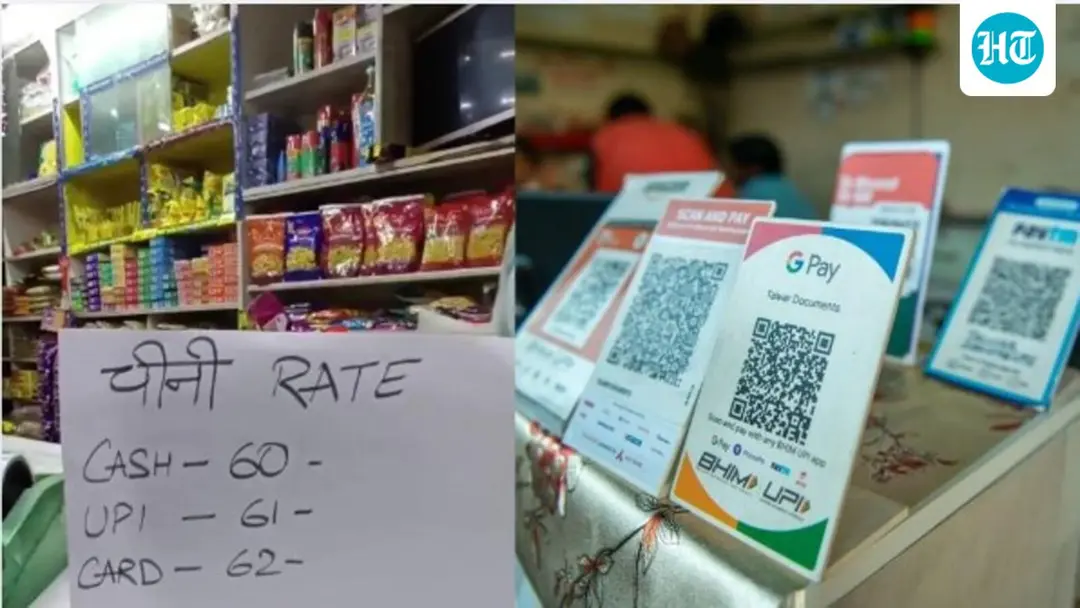
Ghaziabad traders to refuse UPI from October 15 over 0.4% MDR
Following guidelines imposing a 0.4% Merchant Discount Rate (MDR) on UPI payments above ₹2,000, traders in Ghaziabad say they will stop accepting UPI from October 15. Grocery shop owner Sanjay Bindal has put up a poster to that effect at his shop. Vipin Sharma, president of the diesel-petrol dealer association, said payments above ₹2,000 will not be accepted. NPCI announced the fee on Tuesday, capped at ₹300 per transaction, with no charge on customers.
Source
Hindustan Times — India · read the original report ↗
Desk check · compared with the source
What the desk checked (5)
- NPCI announced a 0.4% fee on UPI transactions above ₹2,000 for certain merchants, capped at ₹300 per transaction. — Attributed in source to NPCI announcement made on Tuesday; figures appear in source.
- Customers will not pay any fee under the revised system. — Attributed to NPCI clarification in the source.
- Grocery shop owner Sanjay Bindal has put up a poster saying he will not accept UPI from October 15. — Directly quoted and named; Bindal identified as state president of Rashtriya Vyapari Kalyan Sangh.
- Ghaziabad diesel-petrol dealer association will not accept UPI payments above ₹2,000 from October 15. — Attributed to association president Vipin Sharma by quote.
- Noida unit of a traders' association sent a communication to the Union finance minister via local administration. — Claim made by Bindal; no independent confirmation in source.
Analysts’ view opinion
This is a classic incidence fight: the 0.4% MDR is levied on merchants, not consumers, so the question is who ultimately absorbs it. Thin-margin retailers like grocers and fuel dealers — where ticket sizes routinely cross ₹2,000 and net margins can be a fraction of turnover — have the loudest case, and their stated response is either to refuse UPI, trim discounts, or raise prices. The threat to stop accepting UPI from October 15 is, economically, a bargaining move as much as a business decision, because cash handling carries its own costs and customers have grown used to digital convenience.
- The fee is structured to fall on merchants with a ₹300 per-transaction cap, so large-ticket sellers are shielded at the top end while mid-value transactions carry the full 0.4% bite.
- Fuel retail is the sharpest pressure point: per-litre margins are slim and transaction values often exceed ₹2,000, so a percentage-of-value fee lands heavily relative to earnings.
- Traders themselves concede the cost will show up as lower discounts or higher prices, which means a share of the burden is likely to reach consumers indirectly even though NPCI says they pay no fee.
- The gainers are banks and payment service providers, who have carried processing and infrastructure costs through the zero-fee era; the trade-off is that monetisation could slow the digital payment habit at the small-merchant end.
- A shift back to cash would raise merchants' own handling and reconciliation costs and reduce the transaction trail, which cuts against both the cashless-economy push and formalisation of small business turnover.
What to watch — Watch whether the October 15 refusal actually holds beyond a few days of posters, whether merchant categories and turnover thresholds are clarified or relaxed, and whether any relief or offset is offered in response to the representations traders say they have sent.
The story does not establish how many merchants will actually stop accepting UPI, which merchant categories are covered by the 0.4% charge, or any official response to the traders' objections.
Deep dive
Research brief · 8 facts · 3 dates · exam-readyThe brief
Context
The National Payments Corporation of India (NPCI) has announced that from October 15, Person-to-Merchant (P2M) UPI transactions above ₹2,000 will attract a 0.4% Merchant Discount Rate (MDR), capped at ₹300 per transaction, payable by certain merchants and not by customers. MDR is the fee merchants pay banks and payment service providers for processing digital payments; UPI had so far operated largely on a zero-fee basis for merchants. In Ghaziabad, traders, grocery shop owners and fuel pump dealers say they will stop accepting UPI (or UPI above ₹2,000) from October 15 because they must absorb the cost themselves.
Key facts
- NPCI announced on Tuesday a 0.4% fee on UPI transactions to certain merchants where transaction value exceeds ₹2,000.
- The MDR charge will not exceed ₹300 for a single transaction.
- NPCI clarified customers will not pay any fee for UPI payments under the revised system.
- The new MDR rules apply to Person-to-Merchant (P2M) UPI payments above ₹2,000.
- Ghaziabad traders and associations are contemplating action starting October 15.
- Sanjay Bindal, a grocery shop owner in Vijay Nagar sector-9 and state president of Rashtriya Vyapari Kalyan Sangh, has put up a poster saying he will not accept UPI from October 15.
- Vipin Sharma, president of the Ghaziabad diesel-petrol dealer association, said payments above ₹2,000 will not be accepted through UPI from October 15.
- The traders' association's Noida unit has sent a communication to the Union finance minister through the local administration.
Timeline
- Tuesday (as stated in the source)NPCI announces a 0.4% fee on UPI transactions above ₹2,000 for certain merchants, capped at ₹300, with no charge on customers.
- Days after the guidelines were issuedGhaziabad traders, associations and fuel pump dealers raise concerns; posters refusing UPI appear at shops; Noida unit writes to the Union finance minister.
- October 15New MDR regime takes effect; Ghaziabad traders say they will stop accepting UPI, fuel dealers will refuse UPI above ₹2,000.
Who has a stake
- NPCI (National Payments Corporation of India) — Operates UPI and has announced the 0.4% MDR on P2M transactions above ₹2,000; must sustain the payments system without charging customers.
- Small traders and grocery shop owners (e.g., Sanjay Bindal) — Must bear the MDR cost as they cannot pass it on to customers; some threaten to refuse UPI entirely from October 15.
- Fuel pump dealers (Ghaziabad diesel-petrol dealer association) — High-value transactions make them vulnerable to MDR; decided not to accept UPI payments above ₹2,000 from October 15.
- Customers — Pay no fee under the revised system, but may be forced to use cash if merchants refuse UPI.
- Banks and payment service providers — Receive the MDR fee for processing digital payments from merchants.
- Union finance ministry — Has received representations from traders via local administration; faces the policy trade-off between cashless economy goals and merchant costs.
Why it matters
UPI's mass adoption was built on zero cost to both customers and most merchants; introducing MDR shifts a cost onto shopkeepers who say they cannot pass it on. If traders in cities like Ghaziabad revert to cash for transactions above ₹2,000, it could dent the digital payments push and, as traders themselves note, run contrary to the idea of a cashless economy.
UPSC angle
Prelims pointers
- MDR (Merchant Discount Rate): fee merchants pay banks/payment service providers for processing digital payments.
- NPCI announced 0.4% MDR on P2M UPI transactions above ₹2,000, effective October 15.
- MDR cap: maximum ₹300 per single transaction.
- Customers pay no fee under the revised UPI system; the merchant bears the MDR.
- NPCI is the operator of the Unified Payments Interface (UPI).
- MDR quantum depends on payment method, merchant type, transaction value and inter-business agreement.
Mains framing
The reintroduction of MDR on high-value UPI merchant payments marks a shift from India's zero-fee digital payments model, which drove rapid UPI adoption but left processing costs unrecovered. NPCI's 0.4% levy on P2M transactions above ₹2,000, capped at ₹300 and borne solely by merchants, seeks to make the system commercially sustainable without burdening consumers. However, the incidence falls on small and thin-margin traders—grocers, fuel dealers and market shops—who, as Ghaziabad traders argue, must either absorb the cost, cut discounts or raise prices; some are responding by refusing UPI or capping it at ₹2,000, effectively pushing consumers back to cash. This creates a policy tension between financial viability of the payments infrastructure and the stated goal of a cashless economy, especially where offline retailers already face competition from online trade. A way forward lies in reconciling these objectives through consultation with trader bodies—representations have already gone to the Union finance minister—and clarity on which merchant categories are covered, so that the cost of digital public infrastructure is shared without eroding acceptance at the last mile.
Key terms
- MDR (Merchant Discount Rate)
- The fee a merchant pays to banks or payment service providers for processing a digital payment.
- UPI (Unified Payments Interface)
- India's real-time digital payment system, operated by NPCI.
- NPCI
- National Payments Corporation of India, which operates UPI and announced the 0.4% merchant fee.
- P2M transaction
- Person-to-Merchant payment; the category on which the 0.4% MDR above ₹2,000 applies.
- Rashtriya Vyapari Kalyan Sangh
- A traders' welfare body; Sanjay Bindal is its state president and has protested against the MDR.
Practice questions
- Critically examine the implications of levying a Merchant Discount Rate on high-value UPI transactions for India's digital payments ecosystem.
- Who bears the cost of the 0.4% MDR announced by NPCI on UPI payments above ₹2,000, and why are small traders resisting it?
- Discuss how the sustainability of digital public infrastructure like UPI can be balanced against the goal of a cashless economy.
Grounded only in the source report — figures and dates are the source's, not inferred.