
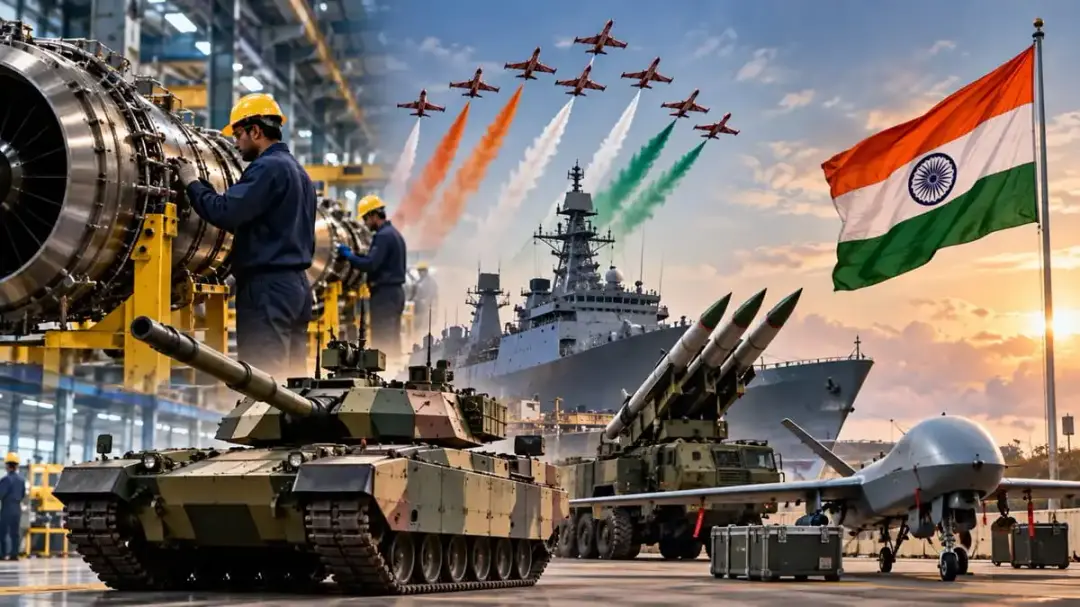
India's defence production reaches record Rs 1.78 lakh crore
India's defence production reached a record Rs 1.78 lakh crore in FY2025-26, the Ministry of Defence said, a 15.6% rise from Rs 1.54 lakh crore a year earlier and 110% above the Rs 84,643 crore of FY2020-21. The private sector's share rose from 22% to 24%, or about Rs 42,000 crore. Exports climbed 62.66% to Rs 38,424 crore, reaching over 80 countries. Minister of State Sanjay Seth cited the figures in Meerut after the Suryakiran air show.
Source
Ministry of Defence · read the original report ↗
Desk check · compared with the source
What the desk checked (5)
- India's defence production reached a record Rs 1.78 lakh crore in FY2025-26, up 15.6% from Rs 1.54 lakh crore. — Attributed to the Ministry of Defence, figure reported on June 17; appears consistently twice in the source.
- Defence exports stood at Rs 38,424 crore in FY2025-26, a 62.66% rise from Rs 23,622 crore, reaching over 80 countries. — Attributed to the Ministry of Defence; arithmetic consistent with the stated percentage.
- Private sector contributed about Rs 42,000 crore, or 24% of production, up from 22% a year earlier. — Attributed to the Ministry of Defence; source notes public sector accounted for about 76%.
- Around 50,000 people watched nine Hawk Mk-132 aircraft of the Suryakiran team perform for about 30 minutes in Meerut. — Attendance figure attributed to organisers, not independently verified in the source.
- Srijan platform had over 41,000 vendors and 2.7 lakh products listed as of May 2026. — Attributed to a Press Information Bureau factsheet; source cautions listings do not indicate active suppliers or order value.
Analysts’ view opinion
Defence production at Rs 1.78 lakh crore, up 15.6% year-on-year, is a strong headline number — but economically the more interesting line is exports. A 62.66% jump to Rs 38,424 crore suggests the domestic industry is starting to earn from external demand rather than relying only on government procurement. At the same time, the private sector's share moved just from 22% to 24% (about Rs 42,000 crore), meaning most of this growth still sits with public-sector entities.
- The taxpayer remains the main payer for defence procurement, so a shift toward domestic production keeps more of that spending circulating at home as jobs and supply-chain activity.
- Exports reaching more than 80 countries diversifies the order book and can improve factory utilisation, which typically lowers unit costs while adding foreign exchange earnings.
- The private share rose only two percentage points, so public-sector dominance persists and the cost discipline that competition usually brings is still limited.
- The Srijan portal's 41,000-plus vendors and 2.7 lakh listed products indicate ecosystem breadth, but as the story itself notes, listings do not prove active suppliers or order value.
- Production and export figures are gross values and do not answer the key economic questions of domestic value addition, reduced import dependence or improved profitability.
What to watch — Watch whether the export surge holds across coming quarters rather than reflecting one-off large orders, and whether the private sector's share pushes meaningfully beyond 24%.
The story establishes gross production and export values only — it offers no evidence on domestic value addition, import-component dependence, employment generated or company profitability.
Deep dive
Research brief · 8 facts · 7 dates · exam-readyThe brief
Context
India's Ministry of Defence has reported that domestic defence production hit a record Rs 1.78 lakh crore in FY2025-26, part of a decade-long push under the government's "Aatmanirbhar Bharat" and "Swadeshi" framing to build a self-reliant arms industry. The output is split between defence public sector undertakings (DPSUs) and a growing private sector, while exports have become a parallel market. Minister of State for Defence Sanjay Seth cited these figures in Meerut after watching the Suryakiran air show. The source notes that headline production and export numbers alone do not reveal domestic value addition, import dependence for components or profitability.
Key facts
- Defence production reached a record Rs 1.78 lakh crore in FY2025-26, per the Ministry of Defence.
- This is a 15.6% rise over Rs 1.54 lakh crore in FY2024-25 and 110% above Rs 84,643 crore in FY2020-21.
- Indigenous defence production is just over four times its FY2013-14 level of Rs 43,746 crore.
- DPSUs and other public-sector entities accounted for about 76% of FY2025-26 production; private sector 24%, up from 22%.
- The private sector's contribution was around Rs 42,000 crore, its highest level.
- Defence exports were Rs 38,424 crore in FY2025-26, up 62.66% from Rs 23,622 crore the previous year.
- Indian defence equipment reached more than 80 countries in FY2025-26.
- The Srijan Defence Equipment Empowerment Platform had over 41,000 vendors and 2.7 lakh products listed as of May 2026 (PIB factsheet).
Timeline
- FY2013-14Indigenous defence production stood at Rs 43,746 crore.
- FY2020-21Defence production was Rs 84,643 crore.
- FY2024-25Production Rs 1.54 lakh crore; exports Rs 23,622 crore; private sector share 22%.
- FY2025-26Production Rs 1.78 lakh crore; exports Rs 38,424 crore to over 80 countries; private share 24% (about Rs 42,000 crore).
- May 2026PIB factsheet records over 41,000 vendors and 2.7 lakh products on the Srijan portal.
- June 17Ministry of Defence releases the record production figure.
- Sunday (second day of the Meerut air show)Nine Hawk Mk-132 aircraft of the Suryakiran team fly for about 30 minutes before around 50,000 people; Sanjay Seth cites the figures.
Who has a stake
- Ministry of Defence — Owns the production and export data and the self-reliance targets used to judge policy success.
- Defence public sector undertakings (DPSUs) — Still account for about 76% of production, but face a rising private share.
- Private defence manufacturers — Share rose from 22% to 24%, about Rs 42,000 crore, their highest contribution so far.
- MSMEs and component suppliers — Over 41,000 vendors listed on the Srijan platform seek indigenisation orders.
- Sanjay Seth, Minister of State for Defence — Publicly linking the numbers to Swadeshi, Aatmanirbhar Bharat and a self-reliant India by 2047.
- Buyer countries (80-plus) — Depend on Indian defence equipment supplies as exports grow 62.66%.
- Youth and aspirants to the armed forces — Seth said the air show would encourage young people to consider armed forces careers.
Why it matters
Defence manufacturing is a test case for India's wider industrial self-reliance push: a Rs 1.78 lakh crore output with 24% private participation signals a widening industrial base beyond state-owned units. Exports of Rs 38,424 crore to more than 80 countries also position India as a supplier rather than only a buyer of arms. But as the source itself cautions, gross production and export values do not by themselves prove domestic value addition, lower import dependence or profitability.
UPSC angle
Prelims pointers
- Record defence production FY2025-26: Rs 1.78 lakh crore (up 15.6% from Rs 1.54 lakh crore).
- Defence exports FY2025-26: Rs 38,424 crore, up 62.66% from Rs 23,622 crore; reached 80+ countries.
- Private sector share of defence production: 24% in FY2025-26, up from 22%; about Rs 42,000 crore.
- FY2013-14 indigenous production base: Rs 43,746 crore; FY2020-21: Rs 84,643 crore.
- Srijan Defence Equipment Empowerment Platform: 41,000+ vendors, 2.7 lakh products listed as of May 2026.
- Suryakiran Aerobatic Team flies Hawk Mk-132 aircraft; nine aircraft performed at Meerut.
Mains framing
India's defence production rising to a record Rs 1.78 lakh crore in FY2025-26, 110% above FY2020-21 and over four times the FY2013-14 level of Rs 43,746 crore, reflects a decade of policy emphasis on Swadeshi and Aatmanirbhar Bharat in military manufacturing. The structural shift is visible in two ways: the private sector's share climbing from 22% to 24% (about Rs 42,000 crore) alongside DPSUs' 76%, and exports surging 62.66% to Rs 38,424 crore across more than 80 countries, giving domestic producers scale beyond captive government demand. A supplier ecosystem is also being formalised, with the Srijan portal listing over 41,000 vendors and 2.7 lakh products as of May 2026. Yet, as the source stresses, such listings do not establish the number of active suppliers or order values, and gross production and export figures do not measure domestic value addition, reduced dependence on imported components or profitability. The way forward, therefore, lies in tracking value-addition and component-level indigenisation metrics rather than headline turnover, deepening MSME participation, and converting vendor registrations into actual orders so that the 2047 self-reliance goal rests on capability rather than accounting aggregates.
Key terms
- DPSU
- Defence public sector undertaking; state-owned defence manufacturers that made up about 76% of FY2025-26 production.
- Aatmanirbhar Bharat
- The government's self-reliance framing, cited by the minister as the basis for strengthening defence capability.
- Swadeshi
- Emphasis on domestically made goods, invoked by Sanjay Seth for defence production.
- Srijan Defence Equipment Empowerment Platform
- Government portal listing defence vendors and products; 41,000+ vendors and 2.7 lakh products as of May 2026.
- Suryakiran Aerobatic Team
- Indian Air Force display team; nine Hawk Mk-132 aircraft performed for about 30 minutes in Meerut.
- Domestic value addition
- Share of a product's value created within India; the source notes production figures alone do not establish it.
Practice questions
- India's defence production has more than doubled since FY2020-21, yet questions remain on indigenous value addition. Critically examine.
- Discuss the changing balance between DPSUs and private manufacturers in India's defence industrial base, using recent production data.
- How do rising defence exports, from Rs 23,622 crore to Rs 38,424 crore in a year, alter India's position in the global arms market? Analyse.
Grounded only in the source report — figures and dates are the source's, not inferred.