
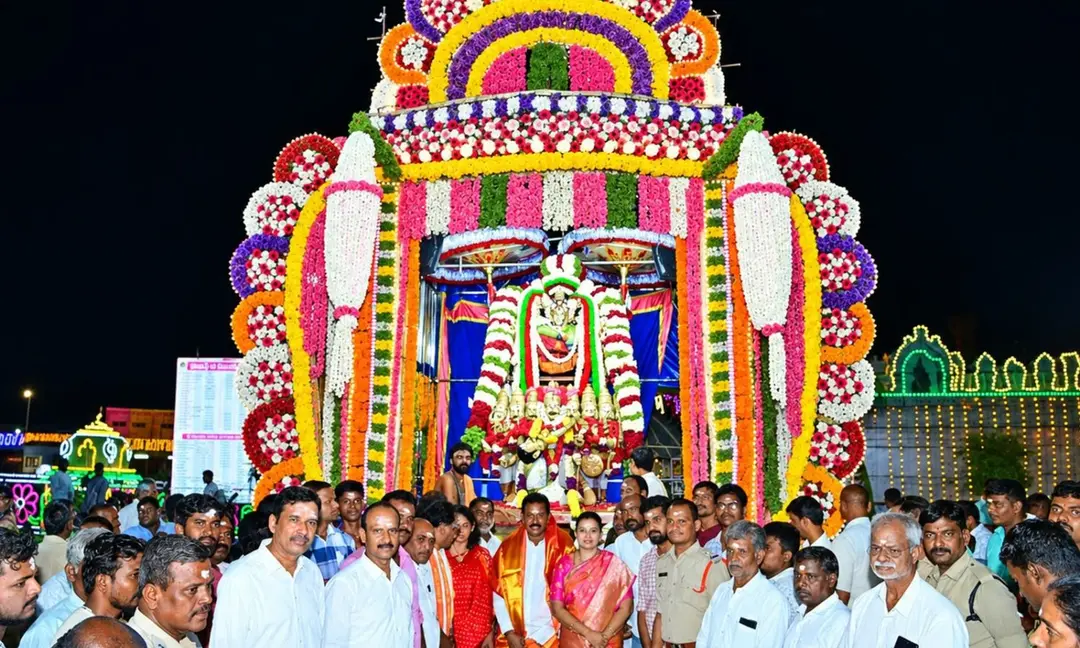
Vinayaka taken out on Ravanabrahma Vahanam at Kanipakam Brahmotsavams
As part of the annual Brahmotsavams at the Sri Swamy temple, Vishwaroopa Vinayaka was presented to devotees on the Ravanabrahma Vahanam on Friday night. Special pujas with dhupa, deepa and naivedyam were held for the deity with Siddhi and Buddhi in the Kalyana Mandapam, after which he was brought in a palanquin and seated on the vahanam decorated with fragrant flowers and electric lights. Priests said devotees who took darshan would be blessed with health and eightfold prosperity. EO Penchala Kishore, ubhayadarulu, devotees and police personnel participated.
Source
Chittoor — స్థానికం · read the original report ↗
Desk check · compared with the source
What the desk checked (4)
- On Friday night, Vinayaka was taken in procession on the Ravanabrahma Vahanam as part of the annual Brahmotsavams. — Stated as reported fact in the source; no official attribution given.
- Special pujas with dhupa, deepa and naivedyam were performed for the deity with Siddhi and Buddhi in the temple's Kalyana Mandapam. — Descriptive detail present in source; not independently attributable.
- Temple priests said devotees who view the deity on the Ravanabrahma Vahanam are blessed with health and eightfold prosperity. — Attributed in source to temple priests; a religious belief, not a verifiable claim.
- Temple EO Penchala Kishore, ubhayadarulu, devotees and police personnel took part. — Name and role appear in the source text as given.
Analysts’ view opinion
On its face this is a devotional report from the Kanipakam Brahmotsavams, with no politician named and no political event described. But temple festivals of this scale are never politically neutral spaces in Andhra Pradesh: the state-run endowments machinery organises them, an executive officer fronts the arrangements, and crowd management by police becomes an implicit test of administrative competence. The most telling political fact here is an absence — no minister, MLA or party figure appears in the account, which is itself worth noting in a state where such processions are routinely used for visibility.
- The visible official face is the temple EO, Penchala Kishore, which frames the event as administration-led rather than politician-led in this particular account.
- Major Brahmotsavams are prestige events for whichever government controls the endowments department, since smooth darshan and orderly processions reflect on the ruling dispensation.
- The absence of any named political leader in this report means no party can be credited or blamed on the basis of this story alone.
- Street processions with large devotee turnout carry incidental political value — they create audiences that parties in Andhra Pradesh have long sought to be seen among.
- Police participation signals the security and crowd-safety dimension, the area where governments face the sharpest criticism if anything goes wrong during a festival.
What to watch — Watch whether ministers, local MLAs or party leaders appear at later days of the Brahmotsavams and how the endowments administration is credited once the festival concludes.
This story establishes only the religious proceedings and the officials present; it does not report any political attendance, statement, controversy or policy decision.
Deep dive
Research brief · 8 facts · 3 dates · exam-readyThe brief
Context
The Sri Varasiddhi Vinayaka Swamy temple at Kanipakam in Chittoor district of Andhra Pradesh holds annual Brahmotsavams, a multi-day festival during which the presiding deity is taken in procession on a different vahanam (divine mount) each day. On Friday night, as part of this year's Brahmotsavams, the deity was presented to devotees as Vishwaroopa Vinayaka seated on the Ravanabrahma Vahanam. The source describes only this one day's rituals and procession, not the full festival calendar.
Key facts
- On Friday night, Vishwaroopa Vinayaka gave darshan to devotees on the Ravanabrahma Vahanam as part of the temple's annual Brahmotsavams.
- Special pujas with dhupa, deepa and naivedyam were performed for the deity along with Siddhi and Buddhi in the temple's Kalyana Mandapam.
- The deity was brought in a palanquin with melam and thalam (traditional musical accompaniment) before being seated on the vahanam.
- The Ravanabrahma Vahanam was decorated with assorted fragrant flowers and electric lighting.
- Temple priests performed pujas on the vahanam and offered harathis to devotees.
- Priests said devotees who took darshan of the deity on the Ravanabrahma Vahanam would be granted good health (ayurarogyalu) and eightfold prosperity (ashta aishwaryalu).
- The procession through the town streets featured mangala vaidyas, melathalas and kolatam performances.
- Temple Executive Officer (EO) Penchala Kishore, ubhayadarulu, devotees and police personnel took part in the event.
Timeline
- Friday night (date not stated in the source)Special pujas with dhupa, deepa and naivedyam for the deity with Siddhi and Buddhi in the Kalyana Mandapam.
- Friday night, after the pujasDeity brought in a palanquin with music and seated on the flower- and light-decorated Ravanabrahma Vahanam; priests performed pujas and gave harathi.
- Friday night, laterProcession through the town streets with mangala vaidyas, melathalas and kolatam; devotees took darshan.
Who has a stake
- Sri Swamy temple, Kanipakam (Chittoor) — Conducts the annual Brahmotsavams and the daily vahana sevas; responsible for rituals and devotee darshan.
- Temple Executive Officer Penchala Kishore — Administrative head overseeing the conduct of the festival event; participated in the programme.
- Temple priests (archakas) — Perform the special pujas, harathi and communicate the religious significance of the Ravanabrahma Vahanam darshan.
- Ubhayadarulu (ritual sponsors/donors) — Sponsor and participate in the seva, a traditional role in temple festivals.
- Devotees — Seek darshan on the vahanam, believed by priests to confer health and eightfold prosperity.
- Police personnel — Handle crowd management and security during the night procession through town streets.
Why it matters
Brahmotsavams at major temples such as Kanipakam draw large crowds and require coordinated ritual, administrative and policing arrangements, making them significant local governance and crowd-management events as much as religious ones. The vahana seva tradition, where the deity appears on a different mount each day, is a living element of temple culture and temple economy in Andhra Pradesh.
UPSC angle
Prelims pointers
- Kanipakam temple, associated with Vinayaka, is located in Chittoor district, Andhra Pradesh.
- Brahmotsavam: annual multi-day temple festival featuring daily processions of the deity on different vahanams.
- Ravanabrahma Vahanam is one of the vahanams used during the Kanipakam Brahmotsavams.
- Siddhi and Buddhi are the consorts shown with Vinayaka during the special pujas.
- Dhupa, deepa and naivedyam are the ritual offerings named in the source.
- The temple's Executive Officer (EO) is the administrative head overseeing such festivals; Penchala Kishore held the post.
Mains framing
Temple festivals like the Kanipakam Brahmotsavams illustrate how religious tradition, public administration and local economy intersect. The ritual core — special pujas in the Kalyana Mandapam, the palanquin procession, the vahana seva on the Ravanabrahma Vahanam and the harathi to devotees — is sustained by a formal administrative apparatus headed by an Executive Officer, with ubhayadarulu sponsoring sevas and police deployed for the night procession through town streets. Such events concentrate large numbers of pilgrims in a short window, raising practical questions of crowd safety, queue management, sanitation, lighting and traffic regulation, alongside the preservation of intangible cultural forms like kolatam and mangala vaidyas that accompany the procession. A balanced way forward lies in strengthening festival-time planning — advance crowd projections, clearly demarcated darshan routes, medical and emergency readiness, and transparent handling of seva sponsorships — so that devotional access is widened without compromising safety, while documenting and supporting the folk performance traditions that give these processions their distinctive character.
Key terms
- Brahmotsavam
- The principal annual festival of a temple, spanning several days, with daily processions of the deity.
- Vahanam
- The divine mount or vehicle on which the processional deity is seated; a different one is used each festival day.
- Ravanabrahma Vahanam
- The vahanam on which Vishwaroopa Vinayaka was taken out on Friday night at Kanipakam.
- Kalyana Mandapam
- The temple hall where the special pujas with dhupa, deepa and naivedyam were performed.
- Ubhayadarulu
- Devotees or patrons who sponsor and take part in a temple seva or ritual.
- Ashta Aishwaryalu
- Eightfold prosperity; the blessing priests said devotees taking darshan would receive.
Practice questions
- Discuss the administrative and public-safety challenges involved in organising large annual temple festivals such as the Kanipakam Brahmotsavams.
- How do vahana sevas and processional traditions during Brahmotsavams sustain intangible cultural heritage in Andhra Pradesh? Illustrate with the Kanipakam example.
- Examine the role of temple Executive Officers and lay sponsors (ubhayadarulu) in the functioning of endowment-managed temples in India.
Grounded only in the source report — figures and dates are the source's, not inferred.