
Complete oxygen plant in 10 days, Mahabubabad Collector tells officials
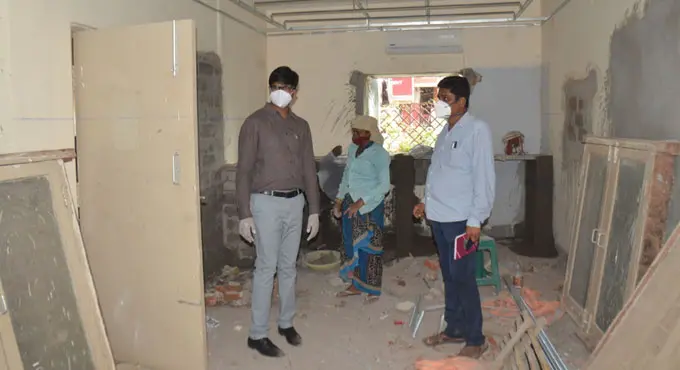
Mahabubabad District Collector VP Gautham has directed officials to complete construction of an oxygen plant at the government area hospital within 10 days to facilitate treatment of COVID-19 patients. Accompanied by revenue and other department officials, he inspected the allotted site on Friday and asked them to ensure oxygen supply to 70 beds through the plant, and to study the plant at Khammam government hospital. He also sought faster work on the Covid block and expressed displeasure over delay in the RTPCR lab.
Source
Mahabubabad — politics · read the original report ↗
Desk check · compared with the source
What the desk checked (5)
- Collector VP Gautham directed officials to complete the oxygen plant at the government area hospital in 10 days. — Attributed to the District Collector in the source; no independent documentation provided.
- The plant is to supply oxygen to 70 beds at the hospital. — Figure appears in the source as part of the Collector's directive.
- Officials were asked to study the oxygen plant set up at Khammam government hospital. — Attributed to the Collector; no further detail given on the Khammam facility.
- The Collector expressed displeasure over delay in RTPCR lab works. — Source places the phrase in quotes without a direct quotation from the Collector.
- RDO Komuraiah, Superintendent Venkataramalu, EE Srinivas and Tahsildar Ranjith accompanied the Collector. — Names listed in the source; designations as given, unverified externally.
Analysts’ view opinion
This is a textbook example of crisis-era "deadline governance" at the district level — the emphasis is on speed of execution rather than on policy design. Ordering an oxygen plant that will serve 70 beds to be finished in ten days reflects a shift towards decentralised, hospital-level oxygen generation instead of dependence on state-level supply chains. At the same time, the Collector's recorded displeasure over delays in the RTPCR lab quietly signals how far behind district health infrastructure was before the second wave arrived.
- The intended beneficiaries are clear — rural patients who depend on the district government area hospital and cannot access private care.
- Asking officials to study the existing plant at Khammam government hospital is a pragmatic replication model across districts, though the story does not spell out technical standards or maintenance capacity.
- A ten-day deadline demonstrates political will, but supply of equipment, power load and trained technicians typically lie outside a district administration's direct control.
- Running the oxygen plant, the Covid block and the RTPCR lab simultaneously risks competing priorities and strain on the same state medical infrastructure agency.
- Past experience suggests such assets can end up underused without operator training, maintenance contracts and continuous auditing after commissioning.
What to watch — Watch whether the ten-day deadline is actually met, whether the plant delivers uninterrupted supply to all 70 beds, and whether the reasons for the RTPCR lab delay are made public.
The story does not establish the plant's capacity, funding source, contractor, the cause of the delays, or any operations and maintenance arrangement — it records an instruction, not a completed project.
Deep dive
Research brief · 7 facts · 3 dates · exam-readyThe brief
Context
During the second wave of COVID-19 in India in 2021, districts scrambled to build medical oxygen generation capacity at government hospitals as demand for oxygen-supported beds surged. In Telangana's Mahabubabad district, Collector VP Gautham inspected the site allotted for an oxygen plant at the government area hospital on Friday, 7 May 2021, and set a 10-day deadline for its completion. The same visit covered the hospital's under-construction Covid block and RTPCR testing lab, where the Collector expressed displeasure over delays.
Key facts
- Mahabubabad District Collector VP Gautham directed officials to complete the oxygen plant at the government area hospital within 10 days.
- The plant is intended to ensure oxygen supply to 70 beds at the government area hospital.
- The Collector inspected the site allotted for the oxygen plant on Friday; the report is dated 7 May 2021, 07:10 PM.
- Officials were asked to visit Khammam government hospital and study the oxygen plant constructed there as a model.
- Gautham inspected the ongoing works of the Covid block at the hospital and directed officials to speed up the works.
- He inspected the RTPCR lab construction work at the hospital and 'expressed displeasure' over the delay.
- Officials accompanying the Collector included RDO Komuraiah, Hospital Superintendent Venkataramalu, TSMSIDC Executive Engineer Srinivas and Tahsildhar Ranjith.
Timeline
- Friday (as reported on 7 May 2021)Collector VP Gautham, with revenue and other department officials, inspects the site allotted for the oxygen plant at the government area hospital, Mahabubabad.
- Same visit, FridayCollector inspects the Covid block works and directs officials to speed them up; inspects RTPCR lab construction and expresses displeasure over delay.
- Within 10 days of the directiveDeadline set by the Collector for completing construction of the oxygen plant serving 70 beds.
Who has a stake
- Mahabubabad District Collector VP Gautham — District administration head responsible for COVID-19 treatment infrastructure; issued the 10-day deadline and reviewed progress on site.
- Government Area Hospital, Mahabubabad (Superintendent Venkataramalu) — Recipient facility; oxygen supply to 70 beds, a Covid block and an RTPCR lab depend on timely completion.
- Telangana State Medical Services & Infrastructure Development Corporation (Executive Engineer Srinivas) — Agency associated with hospital infrastructure works under review, including the oxygen plant, Covid block and RTPCR lab.
- Revenue officials (RDO Komuraiah, Tahsildhar Ranjith) — Responsible for site allotment and coordination for the oxygen plant construction.
- COVID-19 patients in Mahabubabad district — Access to oxygen-supported beds and faster local RTPCR testing depends on completion of these works.
- Khammam government hospital — Its existing oxygen plant is to be studied as a reference model for the Mahabubabad plant.
Why it matters
Oxygen availability was the decisive constraint on COVID-19 survival during the second wave, and in-house plants reduce dependence on cylinder transport from distant suppliers. A plant piping oxygen to 70 beds at a district-level government hospital determines whether serious patients can be treated locally instead of being referred elsewhere. The Collector's displeasure over the RTPCR lab delay also underlines how testing capacity and treatment capacity must be built together.
UPSC angle
Prelims pointers
- Mahabubabad District Collector (2021): VP Gautham; district is in Telangana.
- Oxygen plant at Mahabubabad government area hospital to supply oxygen to 70 beds; 10-day completion deadline set on 7 May 2021.
- TSMSIDC = Telangana State Medical Services & Infrastructure Development Corporation, involved in hospital infrastructure works.
- Khammam government hospital's oxygen plant was cited as the model to study.
- RTPCR lab construction at Mahabubabad area hospital was delayed, drawing the Collector's displeasure.
- Officials named: RDO Komuraiah, Superintendent Venkataramalu, EE Srinivas, Tahsildhar Ranjith.
Mains framing
The Mahabubabad case illustrates how the second COVID-19 wave shifted district administration from case management to emergency health-infrastructure creation. The Collector's directive to finish an oxygen plant in 10 days, pipe oxygen to 70 beds, and replicate the Khammam hospital model shows both the urgency and the improvisation involved: decentralised, on-site oxygen generation reduces reliance on cylinder logistics that failed under peak demand. The parallel delays in the Covid block and the RTPCR lab, which drew official displeasure, point to a deeper structural problem — district hospital capacity is typically expanded reactively during crises rather than built up in advance, and execution depends on coordination among revenue officials, hospital administration and infrastructure agencies such as TSMSIDC. The way forward suggested by the source's own logic is peer learning from facilities that have already commissioned plants, compressed timelines with direct collector-level monitoring, and integrating diagnostics (RTPCR) with treatment capacity so that testing and oxygenated beds come online together rather than sequentially.
Key terms
- Oxygen plant (PSA-type hospital plant)
- An on-site facility that generates medical oxygen at the hospital and pipes it to beds, reducing dependence on externally supplied cylinders; here meant for 70 beds.
- RTPCR lab
- Laboratory for reverse transcription polymerase chain reaction testing, the confirmatory diagnostic test for COVID-19; one was under construction at the Mahabubabad hospital.
- Covid block
- A dedicated hospital block for treating COVID-19 patients; works at the Mahabubabad area hospital were ongoing and ordered to be speeded up.
- TSMSIDC
- Telangana State Medical Services & Infrastructure Development Corporation, whose executive engineer accompanied the Collector on the inspection.
- RDO / Tahsildhar
- Revenue Divisional Officer and Tahsildhar — district revenue functionaries involved in land allotment and local coordination for the plant.
- District Collector
- Head of district administration, here driving deadlines and inspections for COVID-19 health infrastructure.
Practice questions
- Decentralised, hospital-level medical oxygen generation emerged as a key response to India's second COVID-19 wave. Examine its advantages and the administrative bottlenecks in commissioning such plants at district hospitals.
- Discuss the role of the District Collector in public health emergency management, with reference to the coordination required among revenue, hospital and infrastructure agencies.
- 'Testing capacity and treatment capacity must expand together.' In light of delays in RTPCR labs and Covid blocks at district hospitals, critically evaluate India's pandemic health infrastructure planning.
Grounded only in the source report — figures and dates are the source's, not inferred.