
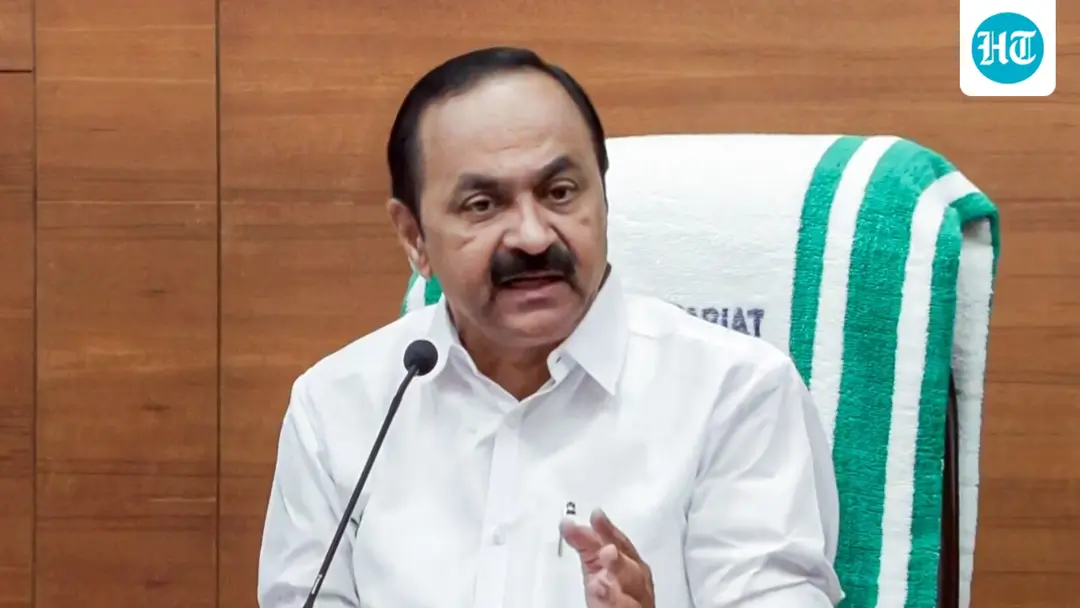
Kerala CM Satheesan says he never sought AI dance video's removal
Kerala Chief Minister V D Satheesan said on Wednesday that neither he nor his office had complained about or sought the removal of an AI-generated video showing him dancing with KSEB staff. At a press conference, he said police had told him complaints were received under the Information Technology Rules. He said he had enjoyed the video and was sad he could no longer see it. Meta restricted access in India to the clip, posted on Instagram page 'aikavala', which its operator said drew 1.78 crore views by Sunday.
Source
Hindustan Times — India · read the original report ↗
Desk check · compared with the source
What the desk checked (5)
- Neither Satheesan nor his office complained about the AI video or sought its removal. — Directly quoted and attributed to Satheesan at a press conference.
- Police informed Satheesan that complaints were received against the video under the Information Technology Rules. — Attributed to Satheesan citing police; no police statement in source.
- Meta restricted access in India to the viral AI video showing Satheesan dancing with KSEB officials. — Stated in source without direct attribution to Meta.
- The video, posted on Instagram page 'aikavala' last Thursday, had 1.78 crore views by Sunday. — Figure appears in source, attributed to the page's operator.
- Satheesan said AI imitation of a person or recreation of work could have legal implications under IP or copyright law. — Attributed to Satheesan's remarks at a law college convocation.
Analysts’ view opinion
Chief Minister V D Satheesan's flat denial that he or his office sought the removal of a satirical AI video is a politically calculated move. A takedown seen as silencing critics would hurt the government far more than the mockery itself, so he has distanced himself from it while banking the goodwill of the "I enjoyed it" line. But who actually filed the complaints is not established in the story — and that gap is now the political flashpoint.
- By separating himself from any censorship claim, Satheesan defuses the most damaging framing available to his critics.
- Restricting a video that had already crossed 1.78 crore views tends to amplify rather than contain it, and his statement reads as pre-empting that backlash.
- Because the video's backdrop is the power crisis, the opposition has an opening to shift the conversation from dance moves to electricity management.
- His jokes comparing himself to Mohanlal and Vijay, and the reference to a five-year-old's praise, are classic image management — absorbing mockery by laughing along.
- Raising the need for new laws on AI and intellectual property lets him move the debate from a personal grievance to a policy question.
What to watch — Watch for opposition pressure over who filed the IT Rules complaints and whether any government or ruling-party quarter was involved, and whether Meta's restriction holds.
The story does not establish who complained, on what basis Meta acted, or whether any official order was issued.
Deep dive
Research brief · 8 facts · 5 dates · exam-readyThe brief
Context
An AI-generated video showing Kerala Chief Minister V D Satheesan dancing with Kerala State Electricity Board (KSEB) officials, set against the backdrop of a recent power crisis in the state, went viral on Instagram. Meta subsequently restricted access to the clip in India, prompting speculation that the Chief Minister or his office had asked for its removal. At a press conference on Wednesday, Satheesan denied filing any complaint, saying police had told him complaints were received under the Information Technology Rules seeking the video's removal, and that he had personally enjoyed the video.
Key facts
- Kerala CM V D Satheesan said on Wednesday that neither he nor his office complained about the AI-generated dance video or sought its removal.
- Satheesan said police informed him that complaints had been received against the video under the Information Technology Rules, seeking its removal.
- The AI video showed Satheesan dancing with officials of the Kerala State Electricity Board (KSEB), against the backdrop of a recent power crisis.
- Meta restricted access in India to the viral AI-generated video.
- The video was posted on the Instagram page 'aikavala' last Thursday and had 1.78 crore views by Sunday, according to the page's operator.
- Satheesan said: 'I had publicly said that I enjoyed the video. I never knew I could dance so well. I am sad that I cannot see it any longer, especially while travelling.'
- Satheesan said it was the media that reported there were legal issues surrounding the video.
- At a convocation at Government Law College, Satheesan spoke of the possibility of new laws being framed for emerging technologies such as artificial intelligence, noting AI imitation of a person or recreation of someone's work could have ramifications under intellectual property rights or copyright
Timeline
- Last ThursdayThe AI-generated video of Satheesan dancing with KSEB staff is posted on the Instagram page 'aikavala'.
- By SundayThe video garners 1.78 crore views, according to the page's operator.
- MondaySatheesan again refers to the video, saying he was happy about it despite its partly mocking intent, after a five-year-old praised his dance moves.
- WednesdayAt a press conference, Satheesan says neither he nor his office complained or sought removal; police told him complaints came under the IT Rules.
- Recently (date not stated in the source)At a Kerala High Court event, Satheesan says he was excited by the video and could dance better than Mohanlal and Tamil Nadu CM C Joseph Vijay.
Who has a stake
- V D Satheesan, Chief Minister of Kerala — Subject of the AI video; has denied seeking its removal and publicly welcomed it, while flagging legal questions around AI mimicry.
- Meta (Instagram's parent) — Acted as intermediary and restricted access to the clip in India, raising questions about takedown processes and transparency.
- Operator of Instagram page 'aikavala' — Creator/publisher of the video; lost Indian access to a clip that drew 1.78 crore views.
- Kerala Police — Received complaints against the video under the Information Technology Rules and informed the CM.
- Kerala State Electricity Board (KSEB) officials — Depicted in the AI video, made in the context of the state's recent power crisis.
- Social media users and satirists in India — Affected by how AI-generated political content is treated under intermediary takedown rules.
Why it matters
The episode shows how AI-generated political content can be taken down by a platform even when the person depicted says he never asked for it, leaving unclear who triggered the restriction and on what ground. It puts the Information Technology Rules, intermediary takedown practice and the space for political satire in the spotlight. Satheesan's own remarks that AI imitation may raise intellectual property and copyright questions signal that new law-making around AI is being actively debated.
UPSC angle
Prelims pointers
- V D Satheesan is the Chief Minister of Kerala as referred to in the story.
- KSEB stands for Kerala State Electricity Board; the AI video showed the CM dancing with its officials amid a recent power crisis.
- Complaints against the video were received under the Information Technology Rules, according to the police as told to the CM.
- Meta restricted access in India to the AI video posted on the Instagram page 'aikavala'.
- The clip drew 1.78 crore views by Sunday, per the page's operator.
- Satheesan said AI imitation of a person or recreation of work could have legal ramifications under intellectual property rights or copyright laws.
Mains framing
The controversy over the AI-generated video of Kerala's Chief Minister dancing with KSEB officials illustrates the governance gap opened up by generative AI in political communication. The immediate cause is a viral synthetic clip, made against the backdrop of a power crisis, that drew 1.78 crore views before Meta restricted access in India; the complication is that the person depicted publicly denies having complained or sought its removal, while police say complaints were received under the Information Technology Rules. This raises three sets of questions: the transparency and accountability of intermediary takedowns when the aggrieved party is unclear; the boundary between political satire, which is protected expression, and impersonation or deepfakes that can mislead; and the adequacy of existing legal categories, with the Chief Minister himself noting that AI mimicry of a person or recreation of someone's work could attract intellectual property or copyright liability, and that new laws may be needed for emerging technologies. A way forward, consistent with what the source records, lies in clearer disclosure of who requests removals and under which rule, calibrated treatment of clearly labelled satire, and a considered legislative response to AI-generated likeness and content rather than ad hoc platform action.
Key terms
- AI-generated video (deepfake-style content)
- Synthetic audio-visual content created using artificial intelligence, here depicting the Kerala CM dancing with KSEB staff.
- Information Technology Rules
- The rules under which, per police, complaints were received against the video seeking its removal from social media.
- KSEB (Kerala State Electricity Board)
- Kerala's state power utility, whose officials featured in the AI video amid a recent power crisis.
- Meta
- The company operating Instagram, which restricted access in India to the viral AI clip.
- Intellectual property rights / copyright
- Legal regimes Satheesan cited as possibly applying when AI imitates a person or recreates someone's work.
- 'aikavala'
- The Instagram page that posted the AI video; its operator said it got 1.78 crore views by Sunday.
Practice questions
- Discuss the challenges of regulating AI-generated content involving public figures in India, with reference to intermediary obligations under the Information Technology Rules.
- Where should the line be drawn between political satire and impersonation in the age of generative AI? Examine with reference to free speech and intellectual property concerns.
- Platform takedowns can occur without the depicted person's request. Critically examine the need for transparency in content restriction processes in a democracy.
Grounded only in the source report — figures and dates are the source's, not inferred.