
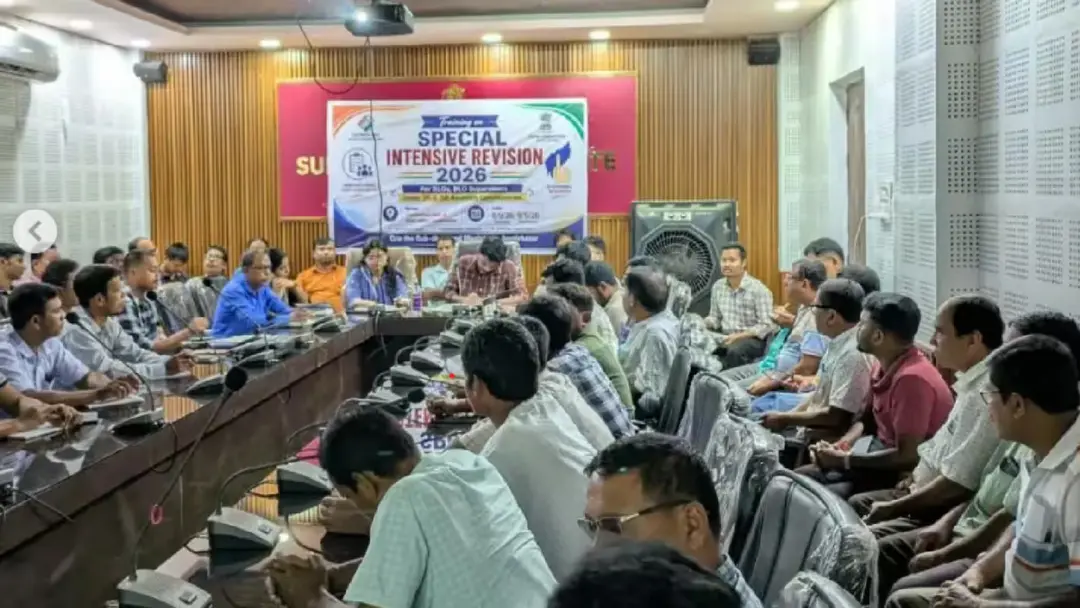
Teachers double as BLOs for Tripura's SIR voter verification
Teachers and other government staff serving as Booth Level Officers in Tripura are combining voter verification for the Special Intensive Revision with their regular duties, they told News18. Agartala BLOs Ranjit Debnath and Rupa De said they work on evenings and weekends and are also addressing voter anxiety, noting the 2005 roll is the reference point and that those missing from it can attend hearings with documents such as birth certificates. Preparatory work runs October 27-November 5, with house-to-house enumeration from November 6 to December 5.
Source
News18 — India · read the original report ↗
Desk check · compared with the source
What the desk checked (4)
- Tripura's SIR involves preparatory work from October 27 to November 5, house-to-house enumeration from November 6 to December 5, draft roll on December 12 and final roll on February 15, 2027. — Schedule appears in the source, partly via an AI-generated 'Quick Answers' box giving the years as 2026; no direct Election Commission document is cited.
- The 2005 electoral roll is the reference point, and voters not listed can appear for a hearing with documents such as birth certificates. — Attributed to BLOs Rupa De and Ranjit Debnath in interviews with News18.
- Delhi High Court asked the EC to deploy government school teachers as BLOs without causing 'unbearable stress'. — Attributed in the source to a bench of Chief Justice DK Upadhyaya and Justice Tejas Karia hearing a PIL; quotes are reproduced from the source.
- No instances of illegal immigrants' names appearing in old rolls have been found in a Bangladesh border area of Unakoti district. — Attributed to Gram Rozgar Sevak Ful Mian; a single individual's account, not official data.
Analysts’ view opinion
Tripura's SIR is not merely an administrative clean-up; it is a politically loaded rewriting of the electoral roll in a border state ahead of the next assembly contest. The BLOs themselves say people are anxious after West Bengal's SIR — a sign that citizenship and illegal-immigration politics could quickly attach themselves to this exercise. The real political test is the Election Commission's credibility: heavy deletions hand the opposition a weapon, while a smooth, low-friction revision helps the incumbents.
- Using teachers and other government employees as BLOs means any error or grievance will be attributed to the state machinery, giving critics a ready political target.
- Making the 2005 roll the reference point is politically consequential in a border state, since it effectively frames who counts as a long-standing voter and who must prove eligibility.
- Opposition parties and teachers' bodies could frame the school-work-plus-SIR burden as administrative overreach, and the Delhi High Court's 'unbearable stress' observation strengthens that line of argument.
- One border-area official saying no illegal immigrant names have surfaced so far cuts against narratives built on infiltration claims — but it is a single local account, not a statewide finding.
- The mention that SIR was delayed because of village council elections shows how tightly this exercise is entangled with the state's electoral calendar.
What to watch — Watch the December 12 draft roll for the scale of deletions and how they are distributed across tribal constituencies, border belts and Muslim-majority pockets — that is where the political fight will ignite.
The story does not establish which party gains or loses, nor how many names may ultimately be dropped; it is essentially a ground-level account of BLOs' experiences.
Deep dive
Research brief · 8 facts · 7 dates · exam-readyThe brief
Context
Tripura is preparing for the Election Commission's Special Intensive Revision (SIR) of electoral rolls, an exercise in which every voter's entry is verified against an older reference roll. As in other states, the ground work falls on Booth Level Officers (BLOs) drawn from government staff — largely school teachers — who must run house-to-house enumeration alongside their regular jobs. News18 spoke to BLOs in Agartala and in remote border areas about how they are managing the workload and the public anxiety around the exercise, which follows the SIR in West Bengal. In Tripura the 2005 electoral roll is the reference point for verification.
Key facts
- Tripura's SIR begins with preparatory work from October 27 to November 5, followed by house-to-house enumeration from November 6 to December 5.
- The draft electoral roll is to be published on December 12, and the final roll on February 15, 2027.
- The 2005 electoral roll is the reference point for verification in Tripura, BLOs told News18.
- BLOs said voters not found in the 2005 roll can appear for a hearing and submit documents such as birth certificates to establish eligibility.
- Rupa De, a psychology teacher at Bodhjung Boys' Higher Secondary School, Agartala, has been a BLO for five years and works school hours 10 am to 5 pm, doing BLO duty on Saturdays and Sundays.
- Ranjit Debnath is the BLO for the Agartala-6 constituency and a teacher at a government school in Agartala.
- The Delhi High Court, hearing a PIL on the Delhi SIR, asked the EC to deploy government school teachers as BLOs without causing "unbearable stress" and to "humanise their condition", noting an 11-hour workload and that teaching staff are mostly women.
- Ful Mian, a Gram Rozgar Sevak in Unakoti district bordering Bangladesh, said no instances of illegal immigrants' names in the old rolls had surfaced yet, crediting online mapping to ascertain 2005 voters.
Timeline
- 2005The electoral roll being used as the reference point for Tripura's SIR verification.
- Earlier this year (Delhi SIR)Delhi High Court, hearing a PIL, asks the Election Commission to be sensitive to teachers deployed as BLOs.
- Before Tripura's exerciseSIR completed in West Bengal, contributing to anxiety among people in Tripura, per BLO Ranjit Debnath.
- October 27 to November 5Preparatory work for SIR in Tripura.
- November 6 to December 5House-to-house enumeration by BLOs.
- December 12Publication of the draft electoral roll.
- February 15, 2027Publication of the final electoral roll.
Who has a stake
- Booth Level Officers (BLOs) in Tripura — Must complete house-to-house verification within fixed deadlines while continuing teaching or other government duties, often on evenings and weekends.
- Government school teachers, especially women — Form the bulk of BLO deployment; workload and long hours were flagged by the Delhi High Court as needing sensitivity.
- Voters in Tripura — Face anxiety over possible omission; those absent from the 2005 roll must attend hearings with documents to prove eligibility.
- Election Commission of India — Owns the SIR schedule and the credibility of the revised roll; was directed by the Delhi HC to avoid "unbearable stress" for teacher-BLOs.
- School students — The Delhi PIL was filed over the impact of teachers' BLO deployment on students in affected schools.
- Border-area residents in Unakoti district — Subject of illegal-immigration concerns; local BLO says no such names have appeared in old rolls so far.
Why it matters
The SIR determines who stays on the electoral roll, so the accuracy of the exercise rests on frontline BLOs who are simultaneously running classrooms, census work and village council election arrangements. Overstretched enumerators and confused voters raise the risk of errors and wrongful omissions, while teachers' diversion affects schooling — a concern the Delhi High Court has already flagged. In Tripura, a border state, the exercise also carries the political charge of illegal-immigration claims.
UPSC angle
Prelims pointers
- Special Intensive Revision (SIR) in Tripura: preparatory work Oct 27-Nov 5; house-to-house enumeration Nov 6-Dec 5; draft roll Dec 12; final roll Feb 15, 2027.
- Reference roll for Tripura's SIR: the 2005 electoral roll.
- Booth Level Officer (BLO): field-level officer, often a government school teacher, who conducts voter verification for the ECI.
- Delhi High Court (Chief Justice DK Upadhyaya and Justice Tejas Karia) heard a PIL on teachers' deployment as BLOs in the Delhi SIR.
- Raima Valley is a Scheduled Tribe constituency in Tripura; Unakoti district borders Bangladesh.
- Voters missing from the 2005 roll can appear at hearings with documents such as birth certificates.
Mains framing
The Special Intensive Revision in Tripura illustrates a structural problem in Indian election administration: a deadline-driven, document-based verification of every voter is executed by staff whose primary job lies elsewhere. BLOs interviewed are serving teachers who verify voters on evenings and weekends, one travelling 30-35 km from school to home, another simultaneously handling village council election arrangements — including meals for polling officers and disability ramps — and recent census work. The consequences run in two directions: education suffers, as flagged in the PIL before the Delhi High Court, which asked the EC to avoid "unbearable stress" and to "humanise" conditions of a largely women teaching workforce; and voters face uncertainty, with anxiety in Tripura heightened after the West Bengal SIR, forcing BLOs into an informal grievance-counselling role explaining that the 2005 roll is the benchmark and that hearings with birth certificates and other documents remain open. The way forward suggested by the source's own experience is procedural clarity and technology: reliable online mapping of 2005 entries, as reported from Unakoti, reduces both the burden on enumerators and the scope for disputes, while sensitivity to BLO workload — as the court urged — is essential to accuracy.
Key terms
- Special Intensive Revision (SIR)
- An Election Commission exercise involving intensive, house-to-house verification of every entry in the electoral roll against an earlier reference roll.
- Booth Level Officer (BLO)
- A government employee, often a school teacher, attached to a polling booth to verify voters and collect enumeration forms for the ECI.
- 2005 roll as reference point
- In Tripura's SIR, names in the 2005 electoral roll are treated as verified; others must establish eligibility through hearings and documents.
- Draft and final electoral roll
- The draft roll (December 12) invites claims and objections; the final roll (February 15, 2027) is the authoritative voter list.
- Gram Rozgar Sevak
- A village-level functionary linked to rural employment work; one such official in Unakoti district is serving as a BLO.
- PIL (Public Interest Litigation)
- Litigation filed in public interest; one such petition in the Delhi High Court raised the impact of teachers' BLO duty on students.
Practice questions
- Deploying school teachers as Booth Level Officers ensures administrative reach but at an educational cost. Critically examine, with reference to the Special Intensive Revision.
- Discuss how document-based verification of electoral rolls, using an older roll as the reference point, affects the rights of voters in border and marginalised areas.
- What institutional reforms can reduce the burden on frontline election staff while maintaining the accuracy and credibility of electoral rolls?
Grounded only in the source report — figures and dates are the source's, not inferred.