
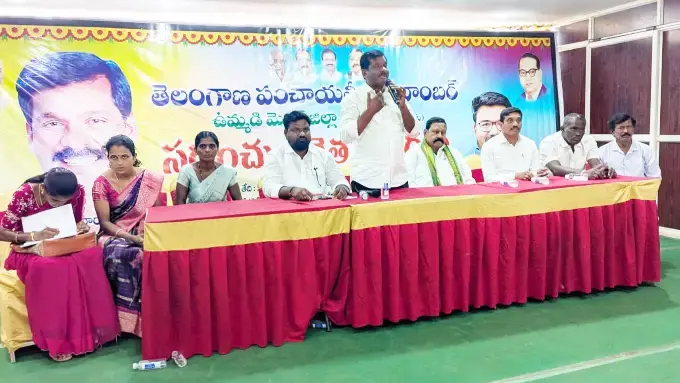
Strengthen gram panchayats, says Panchayati Raj Chamber chief
Telangana Panchayati Raj Chamber state president Satyanarayana Reddy called for strengthening gram panchayats. He spoke at an awareness meeting of sarpanches of the erstwhile Medak district held in Sangareddy town. He said newly formed panchayats should be provided their own buildings and their revenue limits fixed, and sought road facilities for tanda panchayats and Madhira villages. He also asked the state government to allocate funds matching central releases. Chamber state secretary Mandipal Venkat, vice-president Ashorrao and sarpanches attended.
Source
Medak — వార్తలు · read the original report ↗
Desk check · compared with the source
What the desk checked (5)
- Telangana Panchayati Raj Chamber state president Satyanarayana Reddy said gram panchayats should be strengthened. — Attributed by name and designation in the source.
- He demanded own buildings for newly formed panchayats and demarcation of their revenue limits. — Attributed to the speaker; appears in source.
- He sought road connectivity for tanda panchayats and Madhira villages. — Attributed to the speaker; no official response cited.
- He asked the state government to allocate funds matching central releases. — Attributed to the speaker; no figures given in source.
- State secretary Mandipal Venkat, state vice-president Ashorrao and sarpanches of various villages attended. — Names listed in source; spellings as given, unverified.
Analysts’ view opinion
On the surface this reads as a routine list of demands from a sarpanches' convention. Politically, though, the mix — buildings and revenue boundaries for newly created panchayats, roads to tanda and remote villages, and state funds matched to central releases — is an attempt to turn scattered village-level frustration into one organised voice. The framing that the Centre is releasing funds and the state should match them clearly shifts the burden of answering onto the state government. Since sarpanches are every party's ground-level machinery, such conventions are a signal both the ruling side and the opposition have reason to track.
- Bringing sarpanches of the erstwhile Medak district together on one platform converts dispersed local grievances into a collective bargaining forum.
- The demand for state funds parallel to central releases goes straight to Centre–state fiscal politics, and places the onus of response on the state government.
- Newly formed panchayats lacking their own buildings and defined revenue limits is not merely administrative — it touches the authority and standing of the elected village representative.
- Raising roads for tanda panchayats and remote habitations indirectly engages tribal and backward-area vote-bank politics.
- Because sarpanches are central to parties' village-level outreach, their discontent can become a real field-level cost for any party in power.
What to watch — Watch whether the state government or the panchayati raj department responds to these demands, and whether similar sarpanch conventions spread to other districts.
The story does not establish any government response, the actual state of fund allocation, or whether this body has any party affiliation.
Deep dive
Research brief · 7 facts · 1 dates · exam-readyThe brief
Context
At an awareness meeting (chaitanya sadassu) of sarpanches from the erstwhile (undivided) Medak district held in Sangareddy town, Telangana Panchayati Raj Chamber state president Satyanarayana Reddy demanded that gram panchayats be strengthened. Gram panchayats are the lowest tier of the three-tier Panchayati Raj system and depend heavily on devolved funds from the Union and state governments. His demands centred on basic infrastructure for newly created panchayats, roads for tanda (tribal hamlet) panchayats, and state matching of central fund releases. The report was published on 28 September 2026.
Key facts
- Telangana Panchayati Raj Chamber state president Satyanarayana Reddy called for strengthening gram panchayats.
- He spoke at an awareness meeting (chaitanya sadassu) of sarpanches of the erstwhile Medak district, held in Sangareddy town.
- He demanded that newly formed panchayats be given their own buildings and that their revenue limits be fixed.
- He sought road facilities for tanda panchayats and Madhira villages.
- He asked the state government to allocate funds in parallel with the funds being released by the Centre.
- Chamber state secretary Mandipal Venkat and state vice-president Ashorrao attended, along with sarpanches of various villages.
- The report was published on 28 September 2026 at 18:45 IST by the Telangana District Team.
Timeline
- 28 September 2026Awareness meeting of sarpanches of erstwhile Medak district held in Sangareddy town; report published the same day at 18:45 IST.
Who has a stake
- Gram panchayats of erstwhile Medak district — Seek own buildings, fixed revenue limits and adequate funds to function effectively.
- Sarpanches (village heads) — Elected heads who must deliver civic services with limited buildings, funds and defined jurisdiction.
- Telangana Panchayati Raj Chamber — Body voicing sarpanches' demands; its president, secretary and vice-president led the meeting.
- Telangana state government — Asked to release funds matching central allocations and to fix revenue limits of new panchayats.
- Union government — Releasing funds to panchayats, which the Chamber wants the state to match.
- Tanda panchayats and Madhira villages — Lack road facilities; connectivity demanded at the meeting.
Why it matters
Gram panchayats are the frontline of rural service delivery, but without their own buildings, clearly fixed revenue jurisdictions and predictable funds they cannot function as units of self-government. The demand that the state match central releases points to the recurring question of fiscal devolution to the third tier. Connectivity demands for tanda panchayats also highlight the gap in basic infrastructure for tribal hamlets.
UPSC angle
Prelims pointers
- Gram panchayat is the lowest of the three tiers of Panchayati Raj; sarpanch is its elected head.
- Telangana Panchayati Raj Chamber state president: Satyanarayana Reddy; state secretary: Mandipal Venkat; vice-president: Ashorrao.
- Venue of the sarpanches' awareness meeting: Sangareddy town, erstwhile (undivided) Medak district, Telangana.
- 'Tanda' refers to a tribal/Lambada hamlet; some tandas have been made separate gram panchayats.
- Demands raised: own panchayat buildings, fixing of revenue limits, road facilities, and state funds parallel to central releases.
Mains framing
The demands voiced at the Sangareddy sarpanches' meeting illustrate a structural weakness of India's third tier of government: panchayats carry statutory responsibility for local governance but often lack the physical, jurisdictional and fiscal foundations to exercise it. Newly carved-out panchayats, including tanda panchayats, frequently function without their own buildings or clearly demarcated revenue limits, which affects record-keeping, tax collection and service delivery; poor road connectivity compounds the exclusion of tribal hamlets. The plea that the state allocate funds in parallel with central releases reflects dependence on grants and the risk that untied central transfers alone cannot sustain local works. The way forward suggested by the source is limited but specific: provide buildings to new panchayats, fix their revenue jurisdictions, extend road facilities to tanda panchayats and Madhira villages, and ensure state matching of central funds so that panchayats can plan expenditure with certainty.
Key terms
- Gram panchayat
- The village-level elected local body, the lowest tier of the Panchayati Raj system.
- Sarpanch
- The elected head of a gram panchayat.
- Telangana Panchayati Raj Chamber
- An organisation of panchayat representatives in Telangana that raises sarpanches' demands with governments.
- Tanda panchayat
- A gram panchayat formed for a tanda, a tribal/Lambada hamlet; here demanding road connectivity.
- Revenue limits
- The demarcated revenue jurisdiction of a panchayat, which the Chamber wants fixed for newly formed panchayats.
- Erstwhile Medak district
- The undivided district that was later reorganised; Sangareddy is now a separate district headquarters town in that region.
Practice questions
- Why do newly created gram panchayats struggle to function without fixed revenue limits and their own buildings? Discuss with reference to local self-government in India.
- Examine the issue of fiscal devolution to the third tier: should states be required to match central releases to panchayats?
- Road connectivity for tribal hamlets (tandas) remains a gap in rural infrastructure. Suggest measures to address it through panchayat-level planning.
Grounded only in the source report — figures and dates are the source's, not inferred.