
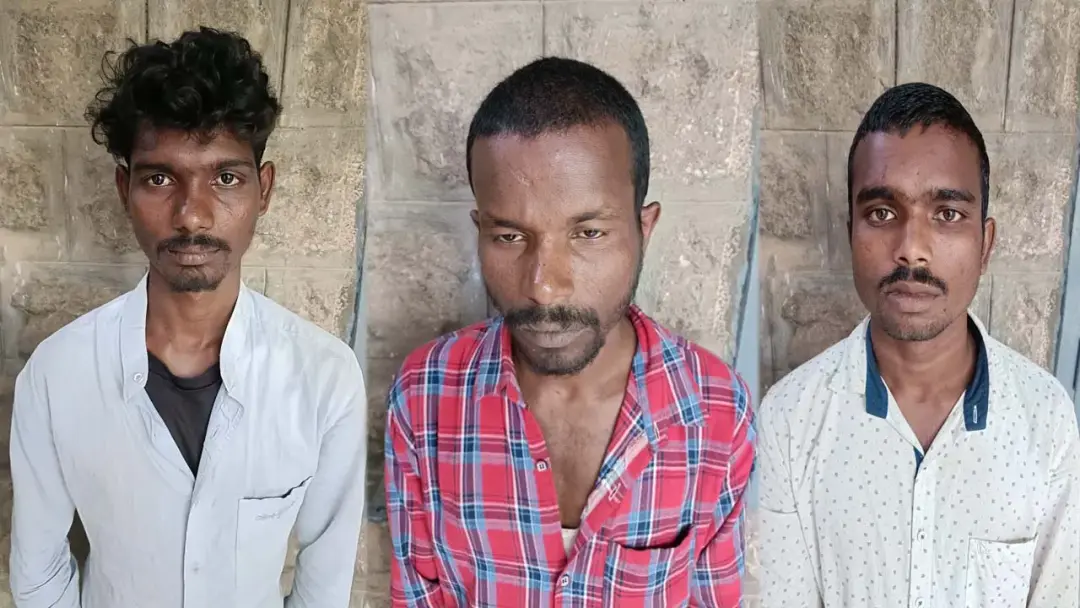
Three get 20 years for ASHA worker's rape and murder
A Guntur court has sentenced three men to 20 years in prison for the gang rape and murder of an ASHA worker from Anupu Chenchu Colony in Guntur district, with judge Neelima delivering the verdict. Police found that Sheelam Anji, Saviti China Anji and Sheelam Baiswami lured her out of the village by promising to trace her lost mobile phone. Each was fined Rs 70,000, and Rs 2.10 lakh was ordered paid to the victim's family. Public prosecutor Pallapu Krishna credited evidence gathered by investigating officer Ravichandra.
Source
Guntur — నేరాలు · read the original report ↗
Desk check · some claims need care
What the desk checked (5)
- A Guntur court sentenced three men to 20 years in jail for the gang rape and murder of an ASHA worker — Attributed in the source to the verdict of judge Neelima; no case number or verdict date given.
- Each convict was fined Rs 70,000 and Rs 2,10,000 was ordered to be paid to the victim's family — Figures appear in the source; arithmetic of three fines of Rs 70,000 matches Rs 2,10,000, internally consistent.
- The accused — Sheelam Anji, Saviti China Anji and Sheelam Baiswami — lured the woman by offering to help find her lost mobile phone — Stated in the source as police findings; no direct police quote or official statement cited.
- Investigating officer Ravichandra's evidence collection enabled a quick conviction — Attributed to public prosecutor Pallapu Krishna.
- The incident occurred three years ago and the trial ran for three years — Source gives no dates; timeline is vague and unverified.
Analysts’ view opinion
A Guntur court has convicted three men of the gang rape and murder of an ASHA worker and sentenced each to 20 years' imprisonment, with fines and a directed payment to the victim's family. Legally, the case is notable less for the sentence quantum than for how it was built: a body recovered in the open, a murder weapon removed by the accused, and a conviction resting on the investigative record assembled by the police. A 20-year term in a rape-and-murder case tracks the court's assessment of the proven charges and the evidence before it, and the reasoning in the judgment — not the headline number — is what will matter on appeal.
- Convictions in cases where the accused try to destroy or remove evidence typically turn on circumstantial chains and forensic linkage, which is why the prosecution has publicly credited the investigating officer's collection of material.
- The court has both fined each convict and directed a sum to the victim's family — a form of court-ordered compensation that under Indian criminal procedure sits alongside, and does not replace, statutory victim compensation schemes.
- The story describes charges under four sections but does not specify them, so it is not established from this report whether sentencing was under the general rape and murder provisions or any enhanced provision.
- A three-year gap between the offence and the verdict is faster than many sessions trials of this kind, but 'quick' in system terms is still three years for the family — and the conviction is not final while appellate remedies remain open.
- Convicts sentenced by a sessions court ordinarily have a right of appeal to the High Court, and the State may separately seek enhancement if it considers the sentence inadequate — both routes remain procedurally available.
What to watch — Watch for whether the three file appeals in the High Court, whether the State seeks enhancement of the 20-year term, and whether the compensation ordered is actually disbursed to the family.
This report does not establish the specific sections of conviction, the evidentiary basis set out in the judgment, or whether the accused had legal representation of their choice — and no appeal outcome can be inferred from a trial court verdict.
Deep dive
Research brief · 8 facts · 6 dates · exam-readyThe brief
Context
An ASHA worker from Anupu Chenchu Colony in Guntur district, Andhra Pradesh, lost her mobile phone about three years ago. While searching for it she approached a fellow villager, Muthayya, for help; three men present there — Sheelam Anji, Saviti China Anji and Sheelam Baiswami — persuaded her that an acquaintance of theirs could locate the phone. They took her some distance from the village, gang-raped and killed her, and disposed of the boulder used in the killing. After a police investigation and a three-year trial, a Guntur court has now convicted and sentenced all three.
Key facts
- A Guntur court sentenced three men to 20 years in prison for the gang rape and murder of an ASHA worker.
- Judge Neelima delivered the verdict; the trial ran for three years.
- The convicts are Sheelam Anji, Saviti China Anji and Sheelam Baiswami.
- Each convict was fined Rs 70,000; Rs 2.10 lakh was ordered to be handed over to the victim's family.
- The victim was an ASHA worker from Anupu Chenchu Colony who had lost her mobile phone about three years ago.
- The accused lured her away by claiming an acquaintance of theirs could tell where the phone was.
- The trio raped and killed her outside the village and made the boulder used in the murder disappear to destroy evidence.
- The case was registered under four sections; public prosecutor Pallapu Krishna credited investigating officer Ravichandra for gathering all the evidence.
Timeline
- About three years agoThe ASHA worker of Anupu Chenchu Colony lost her mobile phone and approached villager Muthayya for help.
- Same occasionSheelam Anji, Saviti China Anji and Sheelam Baiswami convinced her that a known person could trace the phone and took her away from the village.
- Same dayThe three gang-raped and murdered her, then removed the boulder used in the killing and fled.
- After the murderPolice took up the case, cracked it and arrested the three accused; case registered under four sections.
- Over three yearsTrial conducted in the Guntur court.
- Recently (date not stated in the source)Judge Neelima sentenced the three to 20 years' imprisonment with Rs 70,000 fine each and Rs 2.10 lakh compensation to the family.
Who has a stake
- Victim's family — Awarded Rs 2.10 lakh from the fines; seeking justice and closure after the killing.
- The three convicts — Sentenced to 20 years in jail and fined Rs 70,000 each.
- Guntur court / Judge Neelima — Delivered the verdict after a three-year trial, setting a deterrent example.
- Police and investigating officer Ravichandra — Credited with collecting the evidence that secured conviction in a short time.
- Public prosecutor Pallapu Krishna — Led the prosecution; said police and lawyers worked together to get the accused punished.
- ASHA workers and women in the locality — Safety of frontline health workers who move alone in villages; the murder caused a sensation locally.
Why it matters
The case underlines the vulnerability of ASHA workers — frontline women health workers who often travel alone in villages — and how ordinary interactions can be exploited to lure victims. It also shows that meticulous evidence-gathering by the investigating officer and coordination between police and prosecutors can secure conviction in a gang rape and murder case, even where the accused tried to destroy evidence.
UPSC angle
Prelims pointers
- ASHA (Accredited Social Health Activist) workers are community-level frontline health volunteers.
- Guntur court sentenced three men to 20 years' imprisonment for gang rape and murder; verdict by Judge Neelima.
- Fine: Rs 70,000 on each convict; Rs 2.10 lakh ordered paid to the victim's family.
- Convicts: Sheelam Anji, Saviti China Anji, Sheelam Baiswami; village — Anupu Chenchu Colony, Guntur district.
- Public prosecutor in the case: Pallapu Krishna; investigating officer: Ravichandra.
- Case was registered under four sections; trial lasted three years.
Mains framing
The Guntur verdict in the ASHA worker's gang rape and murder case highlights three strands of the criminal justice debate: the safety of women frontline workers, the quality of investigation, and the pace of trials. The accused exploited the victim's trust — offering to help trace her lost mobile phone — and then attempted to destroy physical evidence by removing the boulder used in the killing, the classic hurdle in securing convictions in sexual violence cases. Conviction was possible because the investigating officer collected all the evidence and police and prosecution coordinated, as the public prosecutor noted; yet the trial still took three years, pointing to the need for faster disposal in cases of sexual violence. The way forward suggested by the case itself is institutional: strong, evidence-led investigation, cooperation between police and prosecutors, victim compensation from fines, and attention to the working conditions and safety of ASHA workers who move alone in rural areas. (No policy claims beyond what the source states.)
Key terms
- ASHA worker
- Accredited Social Health Activist — a community health worker who serves as the link between villagers and the public health system.
- Public prosecutor
- Government lawyer who conducts the criminal case against the accused on behalf of the state; here, Pallapu Krishna.
- Investigating officer
- Police officer responsible for collecting evidence and building the case; here, Ravichandra.
- Gang rape
- Rape committed by more than one person acting together, treated as an aggravated offence in law.
- Destruction of evidence
- Removing or concealing material proof, such as the boulder used in the murder here, to escape detection.
Practice questions
- Discuss the challenges in securing convictions in cases of sexual violence where the accused destroy physical evidence, with reference to the Guntur ASHA worker case.
- ASHA workers are the backbone of rural health delivery but face safety risks in the field. Examine the measures needed to protect frontline women health workers.
- How does coordination between the investigating officer and the public prosecutor influence the outcome of criminal trials? Illustrate with an example.
Grounded only in the source report — figures and dates are the source's, not inferred.