
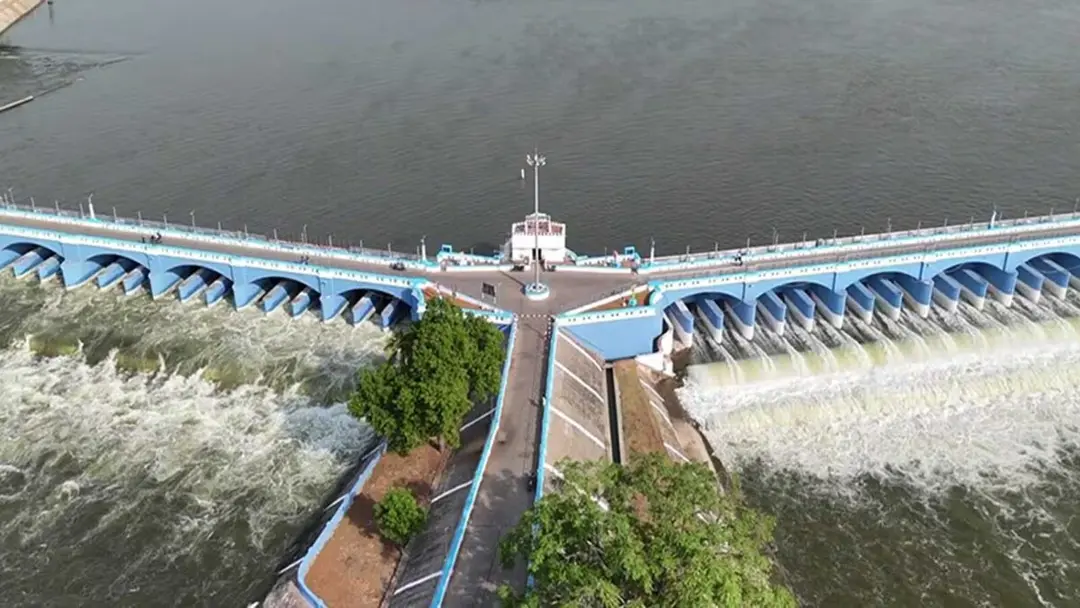
Cauvery reservoir storage falls sharply, Karnataka warns of shortages
Storage in Karnataka's four major Cauvery basin reservoirs — Krishna Raja Sagar, Kabini, Hemavati and Harangi — is significantly lower than a year ago. KRS gross storage stands at 27.54 TMC against 47.68 TMC last year, with live storage down nearly 51%. Chief Minister DK Shivakumar has asked people to be "mentally prepared" for drinking water and power shortages. He said the state faces around a 60% rainfall deficit, with 178 taluks deficient and 101 declared drought-hit in the first phase. Hydropower generation has fallen about 23%.
Source
News18 — India · read the original report ↗
Desk check · compared with the source
What the desk checked (5)
- KRS reservoir holds 27.54 TMC gross storage against 47.68 TMC on September 16 last year; live storage down nearly 51%. — Figures appear in source and are repeated consistently in its own summary box; attributed to reservoir data cited by the report.
- Karnataka faces around 60% rainfall deficit, with 178 taluks deficient, 158 very scanty and 20 with no rainfall. — Attributed to CM DK Shivakumar in the source; internally consistent (158+20=178).
- 101 taluks declared drought-hit in the first phase. — Attributed to the state government in the source; no independent verification possible.
- Hydroelectric power generation has declined by around 23%. — Attributed to the state government; no supporting data or baseline period given.
- About 112.88 TMC of surplus Cauvery water flowed into the sea over five years; Mekedatu could store at least 22 TMC of drinking water. — Attributed to Water Resources Minister N Cheluvarayaswamy; a claim made in support of the project, not independently sourced.
Analysts’ view opinion
The drought is no longer just an administrative challenge in Karnataka — it is a political test. By asking people to be "mentally prepared", Chief Minister DK Shivakumar is lowering expectations early, while simultaneously projecting activity through field inspections and district in-charge ministers' visits. His appeal to the Opposition not to politicise the drought signals he knows how electorally sensitive scarcity is. The parallel push for the Mekedatu project shows an attempt to convert the crisis into leverage for a long-sought storage solution.
- Warning about drinking water and power shortages in advance shifts the blame narrative towards the rainfall deficit and buys the government political cover.
- Declaring 101 taluks drought-hit with more possibly to follow makes relief allocation a constituency-level political decision, not just a technical one.
- Writing to Prime Minister Modi for a central team cuts both ways — credit if aid arrives, a grievance against the Centre if it does not.
- Plans to lobby the Union Jal Shakti Minister on Mekedatu, with Karnataka MPs' backing, will reopen the politically charged river-water contest with Tamil Nadu.
- The September 21-23 special legislature session and the September 18 cabinet meeting are likely to become the main arenas for government-Opposition combat over drought management.
What to watch — Watch whether the Opposition builds a sustained attack on drought management in the special session, and how the addition of more drought-hit taluks and the central team's visit play out.
The story does not establish how the Centre will respond, whether Mekedatu will get clearance, or what formal position the Opposition will adopt.
Deep dive
Research brief · 8 facts · 7 dates · exam-readyThe brief
Context
Karnataka's four major Cauvery basin reservoirs — Krishna Raja Sagar (KRS), Kabini, Hemavati and Harangi — are holding far less water than on the same date a year earlier, amid what Chief Minister DK Shivakumar describes as roughly a 60% rainfall deficit across the state. The shortfall threatens drinking water supply, irrigation in the Cauvery command area and hydropower generation, which has already fallen about 23%. The state has declared 101 taluks drought-hit in a first phase and has written to the Prime Minister seeking a central assessment team. Simultaneously, Water Resources Minister N Cheluvarayaswamy has revived the push for the Mekedatu project as a long-term storage solution, arguing 112.88 TMC of surplus Cauvery water flowed to the sea in five years.
Key facts
- KRS reservoir (gross capacity 49.45 TMC) holds 27.54 TMC against 47.68 TMC on September 16 last year; live storage 19.17 TMC vs 39.30 TMC, a fall of nearly 51%.
- Kabini (capacity 19.52 TMC) has 10.95 TMC gross against 18.23 TMC last year; live storage is just 1.14 TMC vs 8.42 TMC.
- Hemavati (gross capacity around 37 TMC) holds 19.49 TMC against 36.95 TMC a year ago; live storage 15.12 TMC vs 31.58 TMC.
- Harangi (capacity 8.5 TMC) has 6.48 TMC gross against 8.33 TMC last year; live storage 5.73 TMC vs 7.58 TMC.
- Flow realised at Biligundlu, the Karnataka-Tamil Nadu measuring point, was 37.531 TMC between June 16 and September 14 this year.
- CM Shivakumar cites about 60% rainfall deficit, 178 deficient taluks (158 very scanty, 20 with no rainfall); 101 taluks declared drought-hit in the first phase.
- Hydroelectric power generation has declined by around 23% due to lower inflows; state had earlier released Rs 379 crore for drinking water, including Rs 1 crore per rural assembly constituency.
- Mekedatu is projected to create storage for at least 22 TMC of drinking water; the minister says 112.88 TMC of surplus Cauvery water flowed into the sea over the past five years.
Timeline
- June 16 - September 14 (current year)Flow realised at Biligundlu on the Karnataka-Tamil Nadu border stands at 37.531 TMC.
- September 16, 2025Reference date for year-ago reservoir figures: KRS 47.68 TMC, Kabini 18.23 TMC, Hemavati 36.95 TMC, Harangi 8.33 TMC.
- Earlier (date not stated in the source)Shivakumar directs officials to prepare a rainfall-deficit and drought report within 15 days based on spot inspections; writes to PM Modi seeking a central team.
- Wednesday (September 2026)Water Resources Minister N Cheluvarayaswamy chairs a Cauvery Neeravari Nigam review meeting, orders 20% of water reserved for drinking and field visits by officials.
- September 16, 2026Story published showing sharp year-on-year fall in Cauvery basin reservoir storage.
- September 18State cabinet scheduled to meet on drought management, drinking water and farmer measures.
- September 21-23Special session of the Karnataka legislature, with drought and agrarian crisis expected as key issues.
Who has a stake
- Karnataka government / CM DK Shivakumar — Must manage drinking water, irrigation and power shortages, seek central assistance, and defend its drought response politically.
- Water Resources Minister N Cheluvarayaswamy — Leads Cauvery Neeravari Nigam review, orders field inspections and pushes Mekedatu clearance.
- Farmers in the Cauvery command area — Sowing decisions and irrigation depend on reservoir levels; government warns water may not be released as expected.
- Urban and rural drinking water consumers — 20% of available water reserved for drinking; Rs 379 crore released earlier for drinking water needs.
- Tamil Nadu — Downstream releases and flows at Biligundlu; has raised queries on Mekedatu, said to be addressed via an SOP.
- Union government / PM Modi, Jal Shakti Ministry, Central Water Commission — Asked to send a central drought assessment team and to clear the Mekedatu project.
- Power consumers and the state utility — About 23% fall in hydropower generation amid high electricity demand forces alternative supply arrangements.
Why it matters
The Cauvery basin covers 34,273 sq km across 11 Karnataka districts and underpins drinking water for major towns, irrigation for 18.85 lakh acres under the tribunal award, and a significant share of hydropower. A near-51% collapse in KRS live storage alongside a 60% rainfall deficit means competing claims — drinking water, crops, power and downstream releases to Tamil Nadu — will have to be rationed in the coming months. The crisis also revives the contested Mekedatu storage proposal, an interstate flashpoint.
UPSC angle
Prelims pointers
- Four major Karnataka Cauvery basin reservoirs: Krishna Raja Sagar (49.45 TMC), Kabini (19.52 TMC), Hemavati (~37 TMC), Harangi (8.5 TMC).
- Biligundlu is the Cauvery measuring point on the Karnataka-Tamil Nadu border; 37.531 TMC realised June 16-September 14 this year.
- Cauvery basin in Karnataka: 34,273 sq km across 11 districts; tribunal award targets irrigation of 18.85 lakh acres (15.55 lakh major/medium + 3.30 lakh minor).
- Mekedatu project claim: storage for at least 22 TMC of drinking water; 112.88 TMC surplus flowed to sea in five years.
- Karnataka drought status: 178 deficient taluks, 158 very scanty, 20 nil rainfall, 101 declared drought-hit in first phase.
- Cauvery Neeravari Nigam is the state body reviewing Cauvery basin water management.
Mains framing
Karnataka's current Cauvery crisis illustrates how a monsoon failure — an estimated 60% rainfall deficit with 178 deficient taluks — translates rapidly into a multi-sector emergency: KRS live storage down nearly 51%, Kabini's live storage at a mere 1.14 TMC, and hydropower generation down about 23%. The immediate governance challenge is allocation: the state has ordered 20% of available water reserved exclusively for drinking, three-day-cycle releases to tanks in Tumakuru, Basaralu and Nagamangala, twice-daily monitoring of dam levels and releases to Tamil Nadu, and advisories to farmers not to sow on the assumption of future releases. Fiscal and federal responses include Rs 379 crore already released for drinking water, a request to the Prime Minister for a central assessment team, and a field-inspection-based drought report. The longer-term response advanced by the state is the Mekedatu project, pitched as creating 22 TMC of drinking water storage to capture surplus water otherwise flowing to the sea — but it remains contingent on Tamil Nadu's concerns, Central Water Commission and Jal Shakti clearances, and land for the submergence area. The way forward the source supports is credible field-based drought assessment, transparent reservoir data to guide cropping decisions, drinking water prioritisation, alternative power arrangements, and negotiated interstate resolution rather than politicised confrontation.
Key terms
- TMC
- Thousand million cubic feet, the standard unit used for reservoir storage and river flows in India.
- Live storage vs gross storage
- Gross storage is total water in a reservoir; live storage is the usable portion above dead storage level.
- Mekedatu project
- Proposed Karnataka reservoir on the Cauvery, projected to store at least 22 TMC of drinking water; opposed/questioned by Tamil Nadu.
- Biligundlu
- The Cauvery flow measuring point on the Karnataka-Tamil Nadu border used to track interstate water releases.
- Cauvery Neeravari Nigam
- Karnataka's state corporation handling Cauvery basin irrigation projects and water management, whose review meeting the minister chaired.
- Cauvery Water Disputes Tribunal award
- The adjudication under which Karnataka's irrigation entitlement of 18.85 lakh acres in the basin is framed.
Practice questions
- Examine how rainfall deficits in the Cauvery basin translate into competing demands for drinking water, irrigation and hydropower, using Karnataka's current reservoir position as a case study.
- The Mekedatu project is presented as a drought-year solution for Karnataka but remains contested by Tamil Nadu. Critically assess the institutional mechanisms available for resolving such interstate river disputes.
- Discuss the role of field-based drought assessment and real-time reservoir data disclosure in improving state drought management and farmers' cropping decisions.
Grounded only in the source report — figures and dates are the source's, not inferred.