
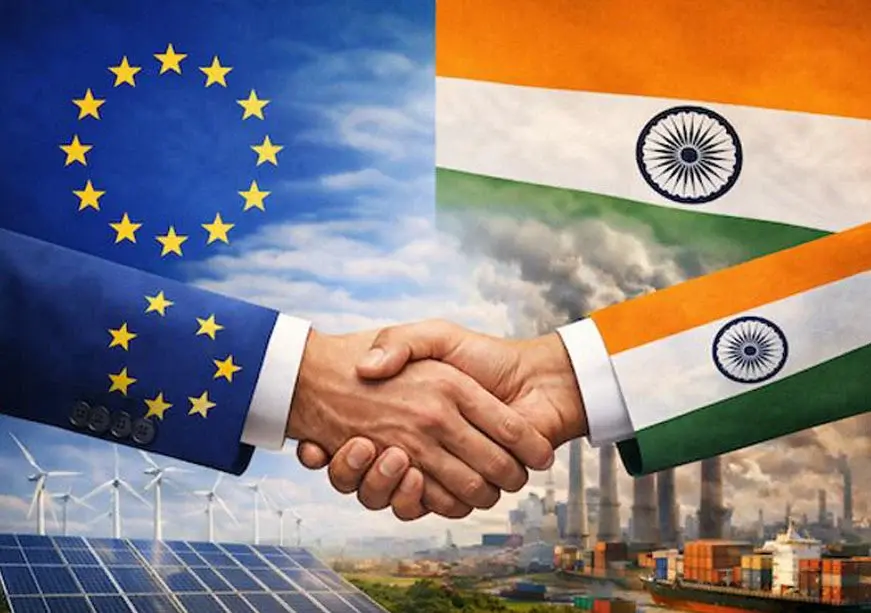
Energy cooperation central to EU-India free trade deal, analysis says
India and the European Union concluded their free trade agreement on 27 January 2026 after nearly 20 years of talks, covering a US$200 billion trade relationship. An ORF analysis says energy cooperation is built into the deal's structure. It establishes a green hydrogen task force, alongside India's commitment to mobilise nearly US$10 billion in foreign investment for 10 GW of electrolyser capacity by 2030. Europe offers a €500 million Green Transition Assistance package and €2 billion from the European Investment Bank. Tariff relief for European electric vehicles is delayed five years.
Source
Observer Research Foundation (ORF) · read the original report ↗
Desk check · compared with the source
What the desk checked (5)
- India and the EU concluded their Free Trade Agreement on 27 January 2026 after nearly 20 years of talks, covering a US$200 billion trade relationship. — Date and figure appear in the source; attributed to the author's analysis, no primary document cited.
- India committed to mobilise close to US$10 billion in foreign investment for 10 GW of electrolyser capacity by 2030, and has begun an east-coast green ammonia hub of up to 1.5 million tonnes a year. — Figures appear in the source; project location described only as 'east coast', no implementing agency named.
- India's CBAM-exposed exports are 0.2% of GDP, nearly 90% in iron and steel, with compliance costs projected at US$2-4 billion annually. — Projection stated in source without attribution to a study; flagged as an estimate.
- Geological Survey of India has upgraded lithium estimates in Reasi district, Jammu and Kashmir, to 10.88 million tonnes of inferred resources. — Attributed in the source to the Geological Survey of India; figure appears in source.
- Commerce Minister Piyush Goyal said the CBAM outcome showed dialogue rather than confrontation could resolve contentious issues. — Paraphrased statement attributed to a named minister; no direct quote or venue given.
Analysts’ view opinion
This is less a tariff-cutting deal than a supply-chain deal. India is being positioned to supply the physical inputs Europe's energy transition needs — green hydrogen, ammonia, critical minerals — and in return gets €500 million in green transition assistance, €2 billion from the EIB and a target of roughly $10 billion in foreign investment. The payoff, though, is capital and construction over the next decade rather than cash in hand today.
- India's first gain is investment flow rather than export revenue — 10 GW of electrolyser capacity by 2030 implies heavy construction, equipment orders and jobs, though the story notes disbursement mechanics for part of the money are still unsettled.
- On CBAM, costs are not reduced: compliance is projected at $2-4 billion a year once fully operational, concentrated overwhelmingly in iron and steel (nearly 90 percent of exposure), with India securing only a forward-looking safeguard.
- Delaying EV duty relief by five years is straightforward industrial protection — a win for domestic EV makers, a cost to Indian buyers who would have benefited sooner from cheaper European models.
- European help to decarbonise Indian steel and aluminium effectively shares part of the transition bill instead of leaving it entirely on Indian producers.
- The minerals dividend arrives last: India is stronger on deposits and exploration than on refining, and the story is explicit that China retains leverage at the processing stage where the margins sit.
What to watch — Watch whether the technical simplifications are formally notified and the disbursement mechanics finalised — that is the point at which exporters and investors see real money.
Twenty years of talks produced the agreement, but the story does not establish that the investment and minerals targets will actually be met, or quantify the eventual effect on prices, jobs or growth.
Deep dive
Research brief · 8 facts · 6 dates · exam-readyThe brief
Context
India and the European Union concluded their long-delayed Free Trade Agreement on 27 January 2026, after nearly twenty years of on-off negotiations, covering a US$200 billion trade relationship with sweeping tariff cuts and vehicle quotas. An ORF analysis argues that energy cooperation is not a green add-on but is built into the deal's architecture, since India and the EU are the third- and fourth-largest greenhouse gas emitters, with net-zero targets of 2070 and 2050 respectively. The deal creates a green hydrogen task force, addresses the EU's Carbon Border Adjustment Mechanism, and opens tariff liberalisation for critical minerals, while shielding India's young EV sector for five years.
Key facts
- The India-EU FTA was closed on 27 January 2026 after nearly twenty years of talks, covering a US$200 billion trade relationship.
- The FTA sets up a green hydrogen task force; India commits to mobilise close to US$10 billion in foreign investment for 10 GW of electrolyser capacity by 2030.
- India has broken ground on an east-coast green ammonia hub for up to 1.5 million tonnes a year, combining nearly 2 GW electrolysers, 7.5 GW renewables and 2 GW pumped-storage hydropower.
- Europe offers a €500 million Green Transition Assistance package for decarbonising Indian steel and aluminium; the European Investment Bank has separately committed €2 billion for climate-resilient infrastructure.
- India's CBAM-exposed exports are 0.2 percent of GDP, with nearly 90 percent concentrated in iron and steel; compliance costs are projected at US$2-4 billion annually when CBAM is fully operational.
- Tariff relief for European electric vehicles is delayed by five years to let India's EV manufacturing base mature.
- Geological Survey of India has upgraded lithium estimates in Reasi district, Jammu and Kashmir to 10.88 million tonnes of inferred resources, with further finds in Rajasthan and Jharkhand.
- India's National Critical Mineral Mission is a seven-year, INR 34,300-crore programme with 1,200 GSI exploration projects through 2031.
Timeline
- April 2025China imposed licensing restrictions on seven rare earth elements; Bajaj Auto warned production could be 'seriously' impacted and India announced an INR 7,280 crore package for domestic magnet production.
- 27 January 2026India and the EU concluded their Free Trade Agreement after nearly twenty years of negotiations.
- 2026European Court of Auditors special report found the EU falling short on almost every Critical Raw Materials Act target, saying diversification efforts 'are not producing results'.
- By 2030India's target of 10 GW electrolyser capacity; EU's Critical Raw Materials Act binding targets fall due.
- Through 2031National Critical Mineral Mission's 1,200 exploration projects to be completed.
- By 2035Absent faster progress, China projected to supply over 60% of refined lithium and cobalt, ~80% of battery-grade graphite and rare earths, ~70% of battery-grade manganese.
Who has a stake
- Government of India / Commerce and Industry Ministry — Minister Piyush Goyal called the CBAM outcome proof that dialogue rather than confrontation could resolve the deal's most contentious issue.
- European Union / Brussels — Seeks secure supplies of green hydrogen inputs and critical minerals to reduce dependence on Chinese processing and meet its 2050 net-zero goal.
- Indian iron and steel exporters — Bear nearly 90 percent of India's CBAM exposure, facing US$2-4 billion in annual compliance costs; technical simplifications still await formal notification.
- Indian EV manufacturers — Protected by a five-year delay in tariff relief for European electric vehicles while the domestic base matures.
- Geological Survey of India and IREL — GSI leads lithium exploration and 1,200 projects under the National Critical Mineral Mission; IREL runs rare earth extraction and refining units in Odisha and Kerala.
- European Investment Bank — Has committed €2 billion to climate-resilient infrastructure, though disbursement mechanics for some funds remain to be worked out.
- China — Controls midstream processing of critical minerals; its April 2025 rare earth licensing curbs exposed Indian and European vulnerability.
Why it matters
The FTA links the world's third- and fourth-largest emitters through concrete energy commitments rather than declaratory climate language, positioning India as a supplier of the physical inputs Europe's transition needs. For Indian exporters, the CBAM safeguard is a hedge against future costs, not relief today, since carbon certificate costs are not waived or reduced. And on critical minerals, both sides remain exposed to Chinese processing dominance, so the payoff depends on execution rather than the text of the agreement.
UPSC angle
Prelims pointers
- India-EU FTA concluded 27 January 2026; trade relationship worth US$200 billion; talks ran nearly twenty years.
- Net-zero targets: India 2070, EU 2050; India is the third-largest and the EU the fourth-largest greenhouse gas emitter.
- India's green hydrogen goal under the deal: 10 GW electrolyser capacity by 2030 with ~US$10 billion foreign investment.
- EU Critical Raw Materials Act 2030 targets: 10% EU extraction, 40% EU processing, 25% recycling, no single country supplying over 65% of a material.
- National Critical Mineral Mission: seven years, INR 34,300 crore, 1,200 GSI exploration projects through 2031.
- Reasi district (Jammu and Kashmir) lithium inferred resources upgraded to 10.88 million tonnes; IREL rare earth units in Odisha and Kerala.
Mains framing
The India-EU FTA illustrates how trade agreements are increasingly becoming instruments of energy and industrial policy. Its energy architecture rests on three pillars: a green hydrogen task force backed by India's 10 GW electrolyser and US$10 billion investment commitment and European finance (€500 million Green Transition Assistance for steel and aluminium decarbonisation, €2 billion from the EIB); a negotiated accommodation on CBAM, where India secured automatic extension of any flexibility granted to a third country plus a channel for recognising its own carbon-pricing and verification systems, though carbon certificate costs remain unchanged and technical simplifications await formal notification; and tariff liberalisation on critical minerals meant to connect India's lithium and rare earth base to European demand as the EU falls short of its Critical Raw Materials Act targets. The constraints are equally clear: India's CBAM exposure is small at 0.2 percent of GDP but concentrated nearly 90 percent in iron and steel with US$2-4 billion annual compliance costs; India is stronger in deposits and exploration than in refining, precisely where China holds leverage, as the April 2025 rare earth licensing curbs showed; and the deal shields domestic EV makers for five years. The way forward lies in disbursement mechanics, refining and midstream capacity under the National Critical Mineral Mission, and formal notification of CBAM simplifications, since, as the analysis notes, a trade deal cannot build a refinery.
Key terms
- Carbon Border Adjustment Mechanism (CBAM)
- EU mechanism imposing carbon costs on imports; India's exposure is 0.2% of GDP, nearly 90% in iron and steel, with US$2-4 billion projected annual compliance costs.
- Green hydrogen task force
- Body established under the India-EU FTA to drive hydrogen cooperation, paired with India's 10 GW electrolyser and US$10 billion investment commitment by 2030.
- Critical Raw Materials Act
- EU law setting binding 2030 targets of 10% extraction, 40% processing and 25% recycling within the EU, with no single country supplying over 65% of any material.
- National Critical Mineral Mission
- India's seven-year, INR 34,300-crore programme tasking the Geological Survey of India with 1,200 exploration projects through 2031.
- IREL
- State-run Indian company operating rare earth extraction and refining units in Odisha and Kerala.
- Green Transition Assistance package
- €500 million European support aimed at decarbonising Indian steel and aluminium production.
Practice questions
- Examine how the India-EU Free Trade Agreement of January 2026 integrates energy and climate cooperation into a trade framework, and assess the limits of what such an agreement can deliver.
- India secured an automatic extension of any CBAM flexibility granted to third countries, but no waiver of carbon certificate costs. Critically evaluate what this means for Indian steel exporters.
- 'India is stronger on raw deposits and exploration than on refining.' Discuss this in the context of critical mineral supply chains and China's midstream dominance.
Grounded only in the source report — figures and dates are the source's, not inferred.