
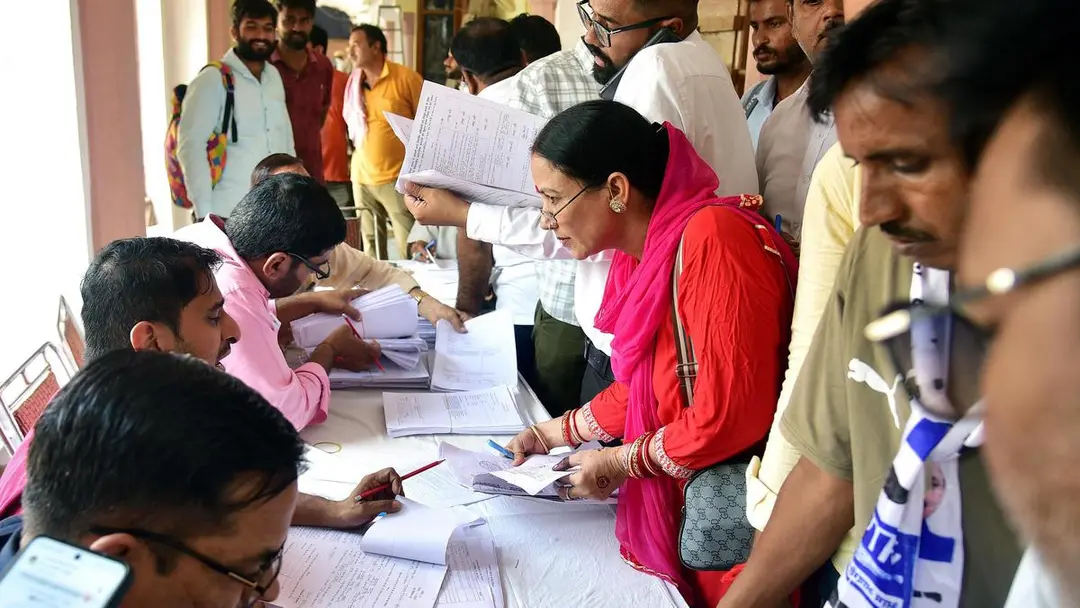
Nominations filed for mayor polls in 305 Rajasthan urban bodies
The process to elect mayors and chairpersons in 305 of Rajasthan's urban local bodies began on Wednesday, with 989 nominations filed by candidates from the BJP, Congress, other parties and Independents. The process was deferred in the Jaipur, Jodhpur and Kota municipal corporations and Suket municipality in Kota district due to EVM-related technical problems, where re-polling was held at 10 polling stations. Mayors and chairpersons will be elected on September 21 and their deputies on September 22.
Source
The Hindu — National · read the original report ↗
Desk check · compared with the source
What the desk checked (4)
- Nominations began Wednesday for mayors and chairpersons in 305 of Rajasthan's 309 urban local bodies. — Figure appears in source; process attributed to State Election Commission public notice issued Tuesday.
- A list contains 989 nominations, with multiple nominations in several urban bodies, including the same candidate appearing more than once. — Figure appears in source, attributed to 'a list'; issuing authority not specified.
- The process was deferred in Jaipur, Jodhpur and Kota municipal corporations and Suket municipality due to EVM-related technical problems. — Stated in source; re-polling at 10 polling stations on September 16, 2026, with counting on September 17.
- Mayors/chairpersons will be elected on September 21 and deputies on September 22. — Schedule stated in source; revised schedule for the four deferred bodies to be issued later by the SEC.
Analysts’ view opinion
The election of mayors and chairpersons across 305 urban local bodies in Rajasthan is a test of both major parties' grip on power at the grassroots. With councillor elections already done, what follows is essentially an arithmetic and persuasion game, in which Independents could hold decisive leverage for the BJP and the Congress alike. The 989 nominations — including instances of the same candidate appearing more than once — point to the familiar local-body tactic of keeping backup and insurance candidates in play.
- Because these are indirect elections decided by elected councillors, floor management and winning over Independents matter more than campaigning at this stage.
- Multiple nominations in several bodies suggest either internal party contests or deliberately parked backup names to allow last-minute substitution.
- Jaipur, Jodhpur and Kota are the state's most politically visible corporations, and deferring their process splits the news impact of any victory claim into two phases.
- Re-polling over EVM-related technical problems gives the opposition an opening to question the process, though the counter-argument is that the Election Commission acted to correct the gap.
- Mayoral posts carry control over civic administration and local patronage, so both parties will try to project the outcome as a measure of their standing.
What to watch — Watch the September 21 and 22 results, and then the revised schedule the State Election Commission issues for Jaipur, Jodhpur, Kota and Suket after the re-poll count, where majorities could turn on a handful of wards.
The story does not establish how many bodies either party controls or who is likely to win the mayoral posts, nor does it explain the cause or extent of the EVM-related problems.
Deep dive
Research brief · 8 facts · 7 dates · exam-readyThe brief
Context
Rajasthan has completed the election of councillors in its urban local bodies earlier this month, and the next stage — the indirect election of mayors, chairpersons and their deputies — has now begun. The State Election Commission issued a public notice for these polls in 305 of the State's 309 urban local bodies. Nominations opened on Wednesday, with candidates from the BJP, Congress, other parties and Independents in the fray. In four bodies, the process has been put off because EVM-related technical problems prevented declaration of results in some wards.
Key facts
- The mayor/chairperson election process began Wednesday in 305 of Rajasthan's 309 urban local bodies.
- A list of 989 nominations was filed by BJP, Congress, other party and Independent candidates.
- Multiple nominations were filed in several urban bodies, including cases where the same candidate figures more than once.
- The State Election Commission issued the public notice for the polls on Tuesday, for 305 of 309 urban local bodies.
- The process was deferred in four bodies: Jaipur, Jodhpur and Kota municipal corporations and Suket municipality in Kota district.
- Re-polling was held at 10 polling stations on Wednesday, September 16, 2026, after EVM-related technical problems blocked declaration of results in some wards.
- Counting of the re-poll was set for Thursday, September 17, 2026.
- Mayors and chairpersons are to be elected on September 21; deputy mayors, deputy chairpersons and vice-presidents on September 22.
Timeline
- Earlier in September 2026Councillors elected across Rajasthan's urban local bodies, setting the stage for indirect election of mayors and chairpersons.
- Tuesday (September 15, 2026)State Election Commission issues public notice for election of mayors and chairpersons in 305 of 309 urban local bodies.
- Wednesday, September 16, 2026Nomination process begins; 989 nominations listed. Re-polling held at 10 polling stations in the four deferred bodies.
- Thursday, September 17, 2026Counting of the re-poll scheduled.
- September 21, 2026Election of mayors and chairpersons in the 305 urban local bodies.
- September 22, 2026Election of deputy mayors, deputy chairpersons and vice-presidents.
- Later, date not stated in the sourceRevised schedule to be issued by the State Election Commission for the four deferred urban bodies.
Who has a stake
- State Election Commission, Rajasthan — Conducts the polls, issued the public notice, ordered re-polling at 10 stations and must issue a revised schedule for the four deferred bodies.
- BJP and Congress — Control of mayor and chairperson posts in 305 urban bodies, which shapes urban governance and local political standing.
- Independents and other parties — Among the 989 nominations; can be decisive in closely divided houses where mayors are elected indirectly.
- Elected councillors — They form the electorate for the mayors, chairpersons and deputies to be chosen on September 21 and 22.
- Voters of Jaipur, Jodhpur, Kota corporations and Suket municipality — Face delay in getting elected heads after EVM-related technical problems forced re-polling at 10 stations.
Why it matters
Mayors and chairpersons head the executive leadership of municipal corporations, councils and municipalities that deliver everyday urban services, so the outcome across 305 bodies determines who runs Rajasthan's cities and towns. The deferral in Jaipur, Jodhpur, Kota and Suket over EVM-related technical problems also puts a spotlight on the reliability of poll machinery in local body elections.
UPSC angle
Prelims pointers
- Rajasthan has 309 urban local bodies; polls for mayors/chairpersons notified in 305 of them.
- 989 nominations were filed on the first day of the mayor/chairperson election process.
- Urban local bodies in Rajasthan comprise municipal corporations, municipal councils and municipalities.
- State Election Commissions conduct local body elections; the Rajasthan SEC issued the public notice and will issue the revised schedule.
- Mayors/chairpersons to be elected September 21, 2026; deputies and vice-presidents on September 22, 2026.
- Four bodies deferred: Jaipur, Jodhpur, Kota municipal corporations and Suket municipality (Kota district).
Mains framing
The Rajasthan mayoral polls illustrate how the third tier of governance actually works: citizens directly elect councillors, who then indirectly elect mayors, chairpersons and their deputies, making small numbers, Independents and multiple nominations politically significant — the source records 989 nominations, with the same candidate figuring more than once in some bodies. The deferral of the process in Jaipur, Jodhpur and Kota corporations and Suket municipality, after EVM-related technical problems prevented declaration of ward results and forced re-polling at 10 stations, points to the administrative and technological capacity constraints that dog local body elections even as State Election Commissions are constitutionally tasked with conducting them. The implications are twofold: delayed leadership in the State's largest cities weakens continuity in municipal decision-making, and repeated procedural glitches can erode confidence in local democracy. The way forward, on the evidence available, lies in the State Election Commission's timely revised schedule for the four bodies, tighter scrutiny of nominations and stronger technical audit and contingency planning for polling equipment, so that indirect elections to municipal leadership are completed transparently and on time.
Key terms
- Urban local body (ULB)
- Elected municipal institution of urban self-government; in Rajasthan these are municipal corporations, municipal councils and municipalities, numbering 309.
- State Election Commission
- State-level body that conducts local body elections; here it issued the public notice and will announce a revised schedule for the four deferred bodies.
- Mayor / chairperson
- Elected head of a municipal corporation (mayor) or of a municipal council/municipality (chairperson), chosen by elected councillors.
- Deputy mayor / vice-president
- Second-ranking elected office in urban bodies, to be filled in the 305 ULBs on September 22, 2026.
- Re-polling
- Fresh voting ordered at specific polling stations — here 10 stations — where results could not be declared, in this case due to EVM-related technical problems.
Practice questions
- Discuss how the indirect election of mayors and chairpersons by councillors shapes accountability and stability in urban local governance in India.
- EVM-related technical problems delayed results in Rajasthan's largest municipal corporations. Examine the capacity challenges before State Election Commissions in conducting local body polls.
- What are urban local bodies in India, and how do municipal corporations, municipal councils and municipalities differ in composition and functions?
Grounded only in the source report — figures and dates are the source's, not inferred.