
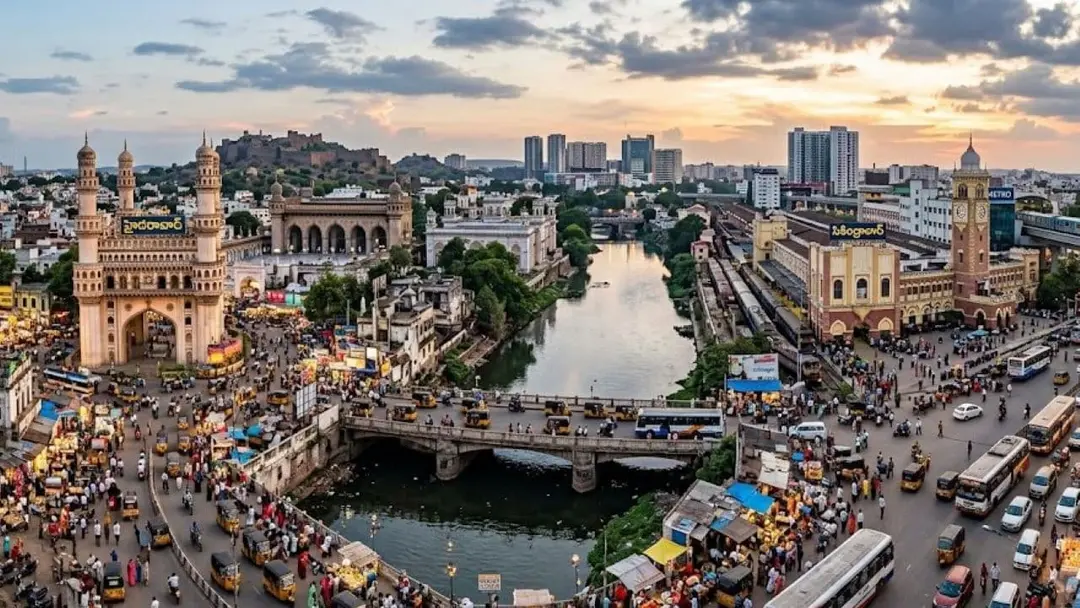
Why Hyderabad was called Patnam and Secunderabad Lashkar
Though Hyderabad and Secunderabad have merged into twin cities, older residents once called Hyderabad 'Patnam' and Secunderabad 'Lashkar', a feature report notes. In Telugu, 'pattanam' denoted a large town or city and became 'patnam' in the Telangana dialect. In Urdu-Persian, lashkar means army or military camp. Secunderabad grew around British military bases and cantonment activity under colonial rule, fixing that name. It survives in usages such as Lashkar Bonalu.
Source
Zaheerabad — స్థానికం · read the original report ↗
Desk check · some claims need care
What the desk checked (5)
- Telugu speakers called Hyderabad 'Patnam', derived from 'pattanam' meaning a large town or city. — Presented as popular usage in the source; no source, scholar or document cited.
- 'Lashkar' means army or military camp in Urdu-Persian. — Linguistic claim stated in source without attribution; internally consistent with the article's explanation.
- Secunderabad developed around British military bases and cantonment activity, giving rise to the name 'Lashkar'. — Historical claim in source, unattributed; consistent with the article's overall account.
- The name Lashkar survives in usages such as 'Lashkar Bonalu'. — Example cited in source; no external corroboration provided.
- Hyderabad was formed centuries ago and grew into a major southern Indian city. — General statement with no dates or sources given in the source text.
Analysts’ view opinion
On the surface this is a language-and-history piece, but it is a useful reminder of how potent identity remains as political currency in Telangana. 'Patnam', a Telangana-dialect rendering of the Telugu word for a town, and 'Lashkar', from the Urdu-Persian word for army or military camp, show that one metropolis grew out of two distinct historical roots — a courtly commercial city on one side, a British cantonment on the other. Names and memories like these are the raw material parties naturally reach for when building cultural narratives. No party features in this story, yet the dual inheritance it describes still maps onto the city's political geography.
- Hyderabad as 'Patnam' and Secunderabad as 'Lashkar' encode a Telugu-Urdu linguistic plurality that is itself a defining feature of the city's politics.
- Secunderabad's cantonment origins — garrisons and a separate administrative apparatus — give historical depth to recurring questions about jurisdiction in city governance.
- The survival of usages like 'Lashkar Bonalu' shows how festivals and local tradition become arenas for cultural politics.
- Place names are routinely contested terrain in South Asian politics, and historical explainers of this kind supply the vocabulary for such debates.
- There is no political claim or controversy in the story itself, so reading it as a party clash would be over-interpretation.
What to watch — Watch how parties draw on old names, place-name heritage and local festivals when framing cultural identity appeals.
The story only explains the historical origins of two colloquial names; it names no party, leader, policy or renaming proposal.
Deep dive
Research brief · 8 facts · 3 dates · exam-readyThe brief
Context
Hyderabad and Secunderabad today function as a single metropolis, and a traveller moving from one side to the other may see no clear dividing line. Historically, though, they were distinct: Hyderabad spread around Charminar, Golconda and Puranapul as a centre of city life, trade and royal culture, while Secunderabad grew under British rule around military bases and cantonment activity. That is why older residents called Hyderabad 'Patnam' and Secunderabad 'Lashkar'. The feature traces how both nicknames carry the city's history in them.
Key facts
- Older generations of residents referred to Hyderabad as 'Patnam' and to Secunderabad as 'Lashkar'.
- In Telugu, 'pattanam' meant a large town or city; in the Telangana dialect it became 'patnam'.
- Hyderabad was formed centuries ago and grew into an important city of South India, which is why locals called it 'Patnam'.
- Older people living around Secunderabad would say 'Patnam pothunna' (I am going to Patnam) when heading towards Hyderabad.
- In Urdu-Persian, 'lashkar' means army or military camp.
- Under British rule, Secunderabad developed mainly through military bases and cantonment activity, giving rise to the name 'Lashkar'.
- Residents of the Hyderabad side would say 'Lashkar ku pothunna' when travelling to Secunderabad.
- The name survives in current usage such as 'Lashkar Bonalu'; 'patnam' is still used in parts of Telangana for a big city.
Timeline
- Centuries agoHyderabad city takes shape, expanding around Charminar, Golconda and Puranapul, and emerges as a major South Indian city; locals begin calling it 'Patnam'.
- British colonial periodSecunderabad develops around British military bases and cantonment activity, including residences, offices, training grounds and transport facilities; Urdu speakers call it 'Lashkar'.
- Present dayHyderabad and Secunderabad have merged and are known as twin cities, but the old names persist in usages like Lashkar Bonalu.
Who has a stake
- Older residents of Hyderabad and Secunderabad — Carriers of the 'Patnam' and 'Lashkar' usages that preserve memory of the two areas' separate identities.
- Telugu-speaking population of Telangana — 'Patnam', from the Telugu 'pattanam', is still used in some parts of Telangana to mean a big city.
- Urdu-speaking residents — It was Urdu speakers who identified the cantonment area as 'Lashkar', from the Urdu-Persian word for army or military camp.
- Secunderabad Cantonment — Its colonial military origin shaped the area's growth, housing, offices, training spaces and transport, and fixed its popular name.
Why it matters
Place nicknames are not mere affection; they record how a city grew and what each quarter was built for. 'Patnam' encodes Hyderabad's identity as a centre of urban life, bazaars, royal precincts and old monuments, while 'Lashkar' preserves the memory of British cantonment rule in Secunderabad. Even after the twin cities merged into one metropolis, such names, local stories and road and locality names keep those historical traces visible.
UPSC angle
Prelims pointers
- Hyderabad's old popular name 'Patnam' derives from Telugu 'pattanam', meaning a large town or city.
- 'Lashkar', the popular name for Secunderabad, is Urdu-Persian for army or military camp.
- Secunderabad grew as a British-era cantonment area with military bases, residences, offices and training grounds.
- Hyderabad's historic spread included Charminar, Golconda and Puranapul.
- Hyderabad and Secunderabad are together known as the twin cities.
- 'Lashkar Bonalu' is a surviving usage of the old name for Secunderabad.
Mains framing
Urban toponymy is a primary source for reading how Indian cities were formed. In the Hyderabad case, two names used by an older generation map two distinct growth logics: 'Patnam', from the Telugu 'pattanam' for a large town, reflects Hyderabad's organic emergence centuries ago as a South Indian centre of city life, commerce, royal culture, bazaars and old monuments; 'Lashkar', the Urdu-Persian word for army or military camp, reflects Secunderabad's colonial creation around British military bases and a cantonment system that expanded to include housing, offices, training grounds and transport. The implication is that colonial and pre-colonial urbanisation left layered settlements within what is now a single metropolis, and that language communities — Telugu and Urdu speakers — named the same city in their own idioms. The way forward, as the report suggests, lies in recognising that these names, along with locality and road names and local stories, are records of the city's past worth documenting even as the twin cities merge into one urban whole.
Key terms
- Patnam
- Telangana-dialect form of the Telugu 'pattanam', meaning a large town or city; the old popular name for Hyderabad.
- Lashkar
- Urdu-Persian word for army or military camp; the old popular name for Secunderabad.
- Cantonment
- A military station area; Secunderabad's cantonment grew with camps, residences, offices, training spaces and transport facilities.
- Twin cities
- The joint identity of Hyderabad and Secunderabad, which today appear as a single metropolis.
- Lashkar Bonalu
- A present-day usage in which the Secunderabad area is still referred to by its old name 'Lashkar'.
Practice questions
- Trace how the popular names 'Patnam' and 'Lashkar' reflect the distinct historical development of Hyderabad and Secunderabad.
- How do colonial cantonment settlements shape the spatial and cultural character of Indian cities? Illustrate with the example of Secunderabad.
- Discuss the value of place names and local usages as historical sources for understanding urban growth in India.
Grounded only in the source report — figures and dates are the source's, not inferred.