
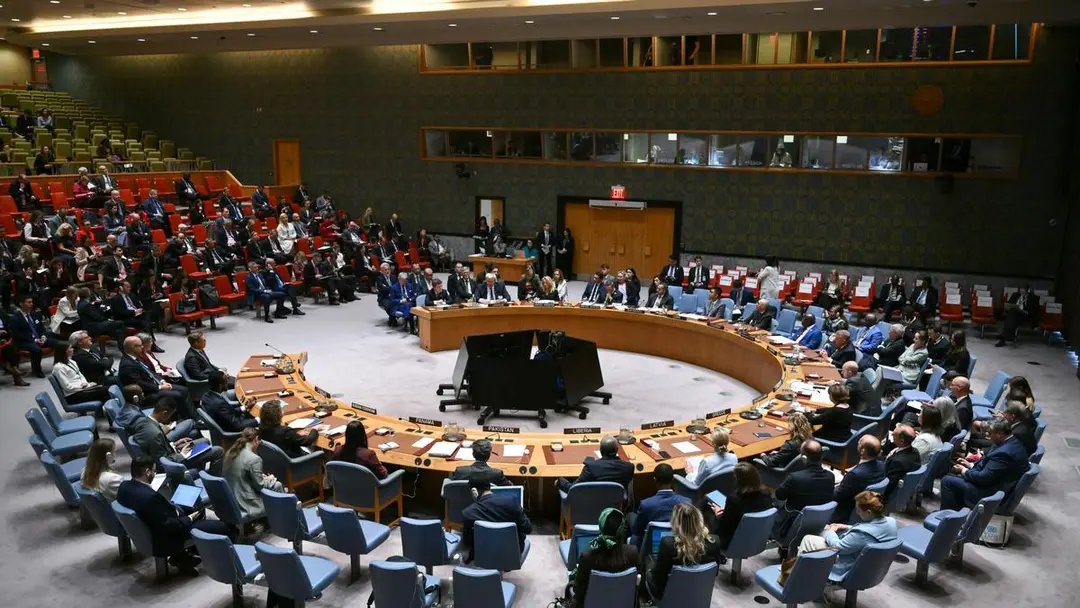
France proposes regulating UNSC veto in mass atrocity cases
At the ongoing UN General Assembly session, France proposed regulating the use of the Security Council veto in humanitarian crises and cases of genocide. Amitabh Mattoo said President Emmanuel Macron's September 22 remarks renewed the French-Mexican initiative launched in 2015, which now has 128 states' support, with 21 joining in four months, and the U.K. accepting the principle. Swaran Singh said no P5 member seeks to eliminate the veto, and the Charter does not mention it.
Source
United Nations / UNGA · read the original report ↗
Desk check · compared with the source
What the desk checked (5)
- France and Mexico announced that 128 states now support the veto-restraint declaration, with 21 joining in the last four months. — Figures appear in source, attributed to Amitabh Mattoo citing France and Mexico announcements; not independently verified here.
- Emmanuel Macron raised the veto-regulation proposal at the UNGA on September 22. — Date and speaker stated in source by Mattoo; no document cited.
- The U.K. has joined France in accepting the voluntary veto-restraint principle, making two P5 members committed. — Attributed to Mattoo in the source; no official text quoted.
- The Liechtenstein initiative, adopted by the UNGA in 2022, requires the General Assembly to meet within 10 working days after a veto. — Described in source by Mattoo with year and timeline; consistent internally.
- The word 'veto' is not mentioned in the UN Charter and was created through a separate mechanism. — Stated as assertion by Swaran Singh; no source given in text.
Analysts’ view opinion
France's proposal is not an attempt to abolish the veto — it is an attempt to change the political behaviour of the P5 without touching the UN Charter. Amitabh Mattoo frames it as a renewed push behind the 2015 France-Mexico initiative, under which permanent members would voluntarily refrain from vetoing in cases of genocide, crimes against humanity and large-scale war crimes. Strategically, the real shift is the numbers: 128 states now back the declaration, 21 having joined in the last four months, and the U.K. has accepted the principle — so for the first time two of the five permanent members are committed to this form of self-restraint. But the instrument remains moral and political, not legally binding.
- Because charter amendment would require the consent of the very powers whose privilege is at stake, voluntary restraint is the pragmatic route — reformist rather than revolutionary, as Mattoo puts it.
- France and the U.K. lining up together hints at a split within the P5, though Swaran Singh notes it is easier for these two — not the heavyweights of the group — to take such a principled position.
- The initiative's origins are strategic: Chinese and Russian vetoes paralysed the Council over Syria, and after the 2013 Ghouta chemical weapons attack then President François Hollande proposed a 'code of good conduct'.
- Three questions are often conflated and should not be: use of the veto, accountability for its use, and broader structural reform of the Council — Macron's move addresses only the first.
- The Liechtenstein initiative adopted in 2022, convening the General Assembly within 10 working days of any veto, and the ACT code of conduct covering all Council members, are existing steps towards accountability whose strength is moral rather than legally coercive.
What to watch — Watch whether the support count keeps climbing, how the remaining three permanent members — the U.S., Russia and China — respond to the principle, and whether the weight of 128 states changes behaviour the next time a veto meets a humanitarian crisis.
As a voluntary declaration it carries no enforcement mechanism, and the story does not establish that any permanent member would observe the restraint when core national interests are at stake, nor how the framing would apply to specific conflicts such as Gaza.
Deep dive
Research brief · 8 facts · 6 dates · exam-readyThe brief
Context
At the ongoing UN General Assembly session, France has proposed that the use of the veto in the UN Security Council be "regulated" in situations of humanitarian crisis — such as Sudan or Lebanon — and in cases of genocide, arguing the veto is a matter of responsibility rather than privilege. French President Emmanuel Macron's September 22 UNGA remarks revive the French-Mexican initiative of 2015, under which P5 members would voluntarily refrain from vetoing action on genocide, crimes against humanity and large-scale war crimes. In a conversation moderated by Kallol Bhattacherjee, Amitabh Mattoo (Dean, School of International Studies, JNU) and Swaran Singh (former Professor, SIS, JNU) debate whether permanent membership and veto powers should be abolished. The discussion distinguishes veto use, accountability for veto use, and broader structural reform of the Council.
Key facts
- Macron articulated the proposal at the UNGA on September 22; it renews the French-Mexican initiative first launched in 2015.
- France and Mexico announced this week that 128 states now support the declaration, with 21 joining in the last four months.
- The U.K. has joined France in accepting the principle — for the first time two of the five permanent members commit to voluntary veto restraint.
- The P5 are the U.S., U.K., France, China and Russia; none of them is talking of eliminating the veto power they hold.
- The word 'veto' is not mentioned in the UN Charter; it was created through a separate mechanism, per Swaran Singh.
- The Liechtenstein initiative, adopted by the UNGA in 2022, requires the General Assembly to be convened within 10 working days whenever a veto is cast.
- Chinese and Russian vetoes during the Syrian civil war blocked UNSC resolutions; after the August 2013 chemical weapons attack in Ghouta, then French President Francois Hollande in September proposed a 'code of good conduct' for the UNSC.
- The ACT (Accountability, Coherence and Transparency) code of conduct extends the pledge beyond the P5 to non-permanent Security Council members not to vote against credible action to prevent genocide, crimes against humanity and war crimes.
Timeline
- August 2013Chemical weapons attack in Ghouta, Syria, amid UNSC paralysis caused by Chinese and Russian vetoes.
- September 2013Then French President Francois Hollande proposes a 'code of good conduct' for the UNSC on voluntary veto restraint.
- 2015French-Mexican initiative launched, asking permanent members to refrain from the veto in genocide, crimes against humanity and large-scale war crimes.
- 2022UNGA adopts the Liechtenstein initiative, convening the Assembly within 10 working days of any veto being cast.
- September 22 (current UNGA session)Macron articulates the renewed push for regulating the veto at the UNGA.
- This weekFrance and Mexico announce 128 states now support the declaration; U.K. accepts the principle.
Who has a stake
- France and Mexico — Co-sponsors of the 2015 initiative seeking voluntary P5 restraint on the veto in mass atrocity situations without amending the Charter.
- The P5 (U.S., U.K., France, China, Russia) — Hold the veto; abolition would require Charter amendment and their own consent to give up privilege.
- United Kingdom — Second P5 member to accept the principle of voluntary restraint, signalling a split in P5 positions.
- UN General Assembly — Under the Liechtenstein initiative it becomes the forum where a vetoing member must explain and defend its action.
- Populations in humanitarian crises (Sudan, Lebanon, Gaza) — Face UNSC paralysis when vetoes block action to prevent or halt atrocities.
- India and aspirant members — Whether the veto will be extended to new permanent members if and when they are inducted remains unresolved.
Why it matters
The veto has repeatedly paralysed the Security Council in mass atrocity situations, as the Syrian civil war showed, and formal abolition would need a Charter amendment that the veto-holders themselves must approve. The French proposal matters because it seeks behavioural change by the P5 rather than legal change — reformist rather than revolutionary — and now claims 128 states and two P5 backers. For India and other aspirants, the debate also shapes the unresolved question of whether new permanent members would receive the veto at all.
UPSC angle
Prelims pointers
- P5 of the UNSC: United States, United Kingdom, France, China and Russia.
- The word 'veto' does not appear in the UN Charter; it was created through a separate mechanism.
- French-Mexican initiative (2015): voluntary P5 restraint on veto in genocide, crimes against humanity, large-scale war crimes; 128 states support it.
- Liechtenstein initiative, adopted by UNGA in 2022: UNGA must meet within 10 working days of a veto being cast.
- ACT initiative = Accountability, Coherence and Transparency code of conduct, covering non-permanent UNSC members too.
- Francois Hollande proposed a UNSC 'code of good conduct' in September, after the August 2013 Ghouta chemical attack.
Mains framing
The veto debate should not be reduced to 'retain or abolish'; the source identifies at least five overlapping approaches — abolition, extension of the veto to new permanent members in the name of sovereign equality, voluntary restraint in mass atrocity cases, political accountability after a veto is cast, and broader structural reform of the Council. The cause of the current push is repeated paralysis: Chinese and Russian vetoes blocked resolutions on Syria, and Macron's September 22 revival of the 2015 French-Mexican initiative now claims 128 states, 21 of them joining in four months, with the U.K. becoming the second P5 member to accept the principle. Its implications are normative rather than legal: it seeks to change P5 political behaviour while skirting the near-impossible task of rewriting the Charter, whose amendment would require the consent of the very members losing privilege. Swaran Singh's counterpoint is structural — no international organisation can survive if it decides against the fundamental interests of a major power, and France and the U.K., not being P5 heavyweights, find principled positions easier to adopt. The pragmatic way forward, per Mattoo, lies in accountability mechanisms such as the Liechtenstein initiative and the ACT code of conduct, whose strength is moral and political rather than legally coercive but which at least make a vetoing power justify itself before the UNGA.
Key terms
- Veto
- Power of a UNSC permanent member to block a resolution; the word itself is not mentioned in the UN Charter.
- P5
- The five permanent members of the UN Security Council: the U.S., U.K., France, China and Russia.
- French-Mexican initiative
- Declaration launched in 2015 for voluntary P5 restraint from vetoing action on genocide, crimes against humanity and large-scale war crimes.
- Liechtenstein initiative
- UNGA-adopted mechanism (2022) requiring the Assembly to convene within 10 working days of a veto so the vetoing state explains its action.
- ACT code of conduct
- Accountability, Coherence and Transparency Initiative asking all UNSC members, permanent and non-permanent, not to block credible atrocity-prevention action.
- Code of good conduct
- Proposal made by then French President Francois Hollande in September, after the Ghouta attack, for self-restraint in UNSC veto use.
Practice questions
- Is regulating the UNSC veto through voluntary restraint a meaningful reform, or does it merely legitimise the existing privilege of the P5? Discuss with reference to the French-Mexican and Liechtenstein initiatives.
- "Formal abolition of the veto would require Charter amendment and the consent of the very permanent members whose privilege is being removed." Examine the structural obstacles to UNSC reform in the light of this statement.
- Should the veto be extended to new permanent members if the Security Council is expanded? Analyse the arguments of equality versus effectiveness.
Grounded only in the source report — figures and dates are the source's, not inferred.