
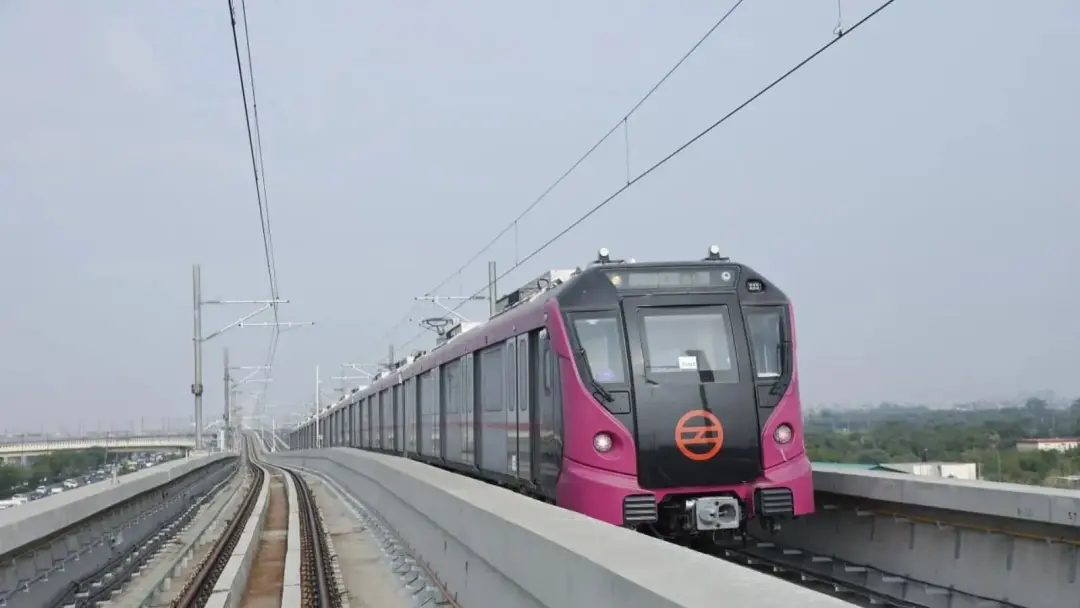
Delhi Metro logs record 82.44 lakh boardings amid DTC strike
The Delhi Metro recorded its highest-ever single-day ridership of 82.44 lakh passenger boardings on Thursday as a strike by Delhi Transport Corporation bus drivers continued. Boardings stood at 72.73 lakh on Monday, 76.86 lakh on Tuesday and 80.71 lakh on Wednesday. Officials said the previous high was 81.88 lakh on August 8, 2025. The Metro averages about 64 lakh daily. The DTC Karamchari Ekta Union estimates over 10,000 drivers are striking, halting more than 80% of bus services. Demands include a Rs 2,000 minimum daily wage, annual bonus and medical insurance.
Source
Indian Express — Cities · read the original report ↗
Desk check · compared with the source
What the desk checked (5)
- Delhi Metro recorded its highest-ever single-day ridership of 82.44 lakh passenger boardings on Thursday. — Figure appears in source; day-wise progression (72.73, 76.86, 80.71, 82.44 lakh) is internally consistent.
- Previous highest was 81.88 lakh on August 8, 2025, the eve of Rakshabandhan. — Attributed to officials in the source.
- More than 80% of the city's public bus system has been halted and over 10,000 drivers are on strike. — Attributed to the DTC Karamchari Ekta Union, which supports the strike; an interested party estimate.
- DTC has 6,840 buses and average daily ridership of about 40 lakh; Metro average is about 64 lakh. — Figures appear in source without explicit attribution.
- Drivers demand a minimum daily wage of Rs 2,000, annual bonus, holiday pay and medical insurance. — Stated in source as the protesting drivers' demands; no direct quote given.
Analysts’ view opinion
The Metro's record numbers look like an infrastructure success story, but politically they are a stress signal. With over 80% of DTC bus services halted, ridership jumping from a daily average of around 64 lakh to 82.44 lakh journeys means the entire public transport burden has shifted onto the Metro. The longer the strike — already in its fourth day — runs, the more likely everyday commuter inconvenience becomes a political issue.
- The steady climb from 72.73 lakh on Monday to 82.44 lakh on Thursday is a graph that tracks the deepening strike and the mounting pressure with it.
- A labour strike has overtaken a record previously set on festival-eve rush days around Rakshabandhan — this is crowding born of compulsion, not celebration.
- The drivers' demands — a Rs 2,000 minimum daily wage, an annual bonus and medical insurance — are fiscal in nature, but both conceding and refusing them carry a political cost for the government.
- The figure of over 10,000 participating drivers is the union's own estimate; the story carries no independently verified count, so a numbers contest between the two sides is likely to continue.
- The Metro counts 'passenger journeys' — a commuter changing lines is counted twice — so spinning the record as a headcount of people would be a politically convenient but imprecise reading.
What to watch — Watch whether the strike extends further, how far talks between the government and the union progress, and what extra services or crowd-management steps the Metro announces.
The story does not establish the government's response, the state of any negotiations, or which party gains or loses politically — and even the link between the strike and the ridership surge rests on timing rather than stated proof.
Deep dive
Research brief · 8 facts · 10 dates · exam-readyThe brief
Context
A strike by Delhi Transport Corporation (DTC) bus drivers over wages and service conditions has crippled the capital's public bus system, pushing commuters onto the Metro. The Delhi Metro recorded its highest-ever single-day ridership of 82.44 lakh passenger boardings on Thursday, against an average of around 64 lakh. The DTC Karamchari Ekta Union, which supports the strike, says more than 10,000 drivers are participating and over 80% of bus services have been halted. The strike entered its fourth day on Friday.
Key facts
- Delhi Metro recorded an all-time high 82.44 lakh passenger boardings on Thursday amid the DTC drivers' strike.
- Ridership through the strike week: 72.73 lakh (Monday), 76.86 lakh (Tuesday), 80.71 lakh (Wednesday), 82.44 lakh (Thursday).
- The Metro's average daily ridership is around 64 lakh passengers.
- The previous record was 81.88 lakh boardings on August 8, 2025, the eve of Rakshabandhan; next highest was 81.01 lakh on August 27 this year, again Rakshabandhan eve.
- Last year, August 11 saw 80.97 lakh passenger journeys.
- DTC operates 6,840 buses and carries an average of around 40 lakh riders daily on normal days.
- The DTC Karamchari Ekta Union estimates more than 10,000 drivers are on strike, halting over 80% of the public bus system.
- Drivers' demands include a minimum daily wage of Rs 2,000, an annual bonus, payment for work on government holidays and medical insurance.
Timeline
- Till 2018Delhi Metro calculated and reported passenger ridership.
- From 2019Delhi Metro switched to reporting 'passenger journeys' instead of ridership.
- August 11 (last year)Metro logged 80.97 lakh passenger journeys.
- August 8, 2025Then-record 81.88 lakh boardings on the eve of Rakshabandhan.
- August 27, 202581.01 lakh boardings, again on Rakshabandhan eve.
- Monday (strike begins)Metro boardings at 72.73 lakh.
- TuesdayDriver participation in the strike was limited; boardings rose to 76.86 lakh.
- Wednesday (day two of strike)Boardings climbed to 80.71 lakh; over 80% of bus services halted in following days.
- ThursdayRecord 82.44 lakh passenger boardings on the Metro.
- FridayDTC drivers' strike enters its fourth day.
Who has a stake
- DTC bus drivers — Seeking a minimum daily wage of Rs 2,000, annual bonus, holiday pay and medical insurance through the strike.
- DTC Karamchari Ekta Union — Supporting the strike; its estimates of 10,000+ striking drivers and 80% service halt frame the dispute publicly.
- Delhi Transport Corporation — Its 6,840 buses and roughly 40 lakh daily riders are affected by the stoppage.
- Delhi Metro (DMRC) — Handling record loads well above its 64 lakh average, with heavy crowding at stations.
- Delhi commuters — Face halted bus services and severe crowding on the Metro as the only alternative.
Why it matters
The record 82.44 lakh boardings show how dependent Delhi's mobility is on a single rail network once buses stop running, with a 40-lakh-a-day bus system largely idle. It also exposes the fragility of last-mile and feeder transport, and the labour grievances of the drivers who run it. For policymakers, the episode is a stress test of urban transport resilience in a megacity.
UPSC angle
Prelims pointers
- Delhi Metro's highest-ever single-day ridership: 82.44 lakh passenger boardings (Thursday, during DTC strike).
- Previous record: 81.88 lakh on August 8, 2025 (Rakshabandhan eve); 81.01 lakh on August 27, 2025.
- Delhi Metro average daily ridership: about 64 lakh passengers.
- DTC fleet: 6,840 buses; average daily ridership about 40 lakh on normal days.
- Delhi Metro reported 'passenger ridership' till 2018 and 'passenger journeys' from 2019.
- Strike demands: Rs 2,000 minimum daily wage, annual bonus, holiday pay, medical insurance.
Mains framing
The Delhi episode illustrates how a labour dispute in one mode of urban transport cascades across an entire city's mobility. With over 10,000 DTC drivers striking and more than 80% of bus services halted, roughly 40 lakh daily bus trips had to find alternatives, driving Metro boardings from 72.73 lakh on Monday to a record 82.44 lakh on Thursday, far above the 64-lakh average, and causing heavy station crowding. The causes lie in the service conditions of drivers, whose demands include a Rs 2,000 minimum daily wage, an annual bonus, payment for work on government holidays and medical insurance. The implications are twofold: an absence of redundancy in bus-metro networks, and the reality that metro capacity, though large, is designed as a complement rather than a substitute for buses. A way forward, on the evidence available, involves institutionalised grievance-redressal and wage negotiation mechanisms for transport workers, contingency plans for service disruptions, and integrated multimodal planning so that crowding does not transfer risk to a single network. The source does not state the government's or DTC management's response, so claims beyond this must be avoided.
Key terms
- DTC (Delhi Transport Corporation)
- Delhi's public bus operator, with 6,840 buses and around 40 lakh average daily riders on normal days.
- DTC Karamchari Ekta Union
- The union supporting the drivers' strike; it estimates 10,000+ striking drivers and an 80% halt in bus services.
- Passenger journeys
- Counts the number of metro lines a passenger uses; one line change equals two journeys, two changes equal three.
- Passenger ridership
- The older metric of persons riding, which Delhi Metro reported until 2018 before shifting to passenger journeys in 2019.
- Minimum daily wage demand of Rs 2,000
- A core strike demand, alongside annual bonus, government-holiday pay and medical insurance.
Practice questions
- The Delhi DTC strike pushed Metro ridership to a record high. Discuss what this reveals about the resilience and multimodal integration of urban transport in Indian megacities.
- Examine the labour-relations dimensions of public transport undertakings in India, using the demands raised by striking DTC drivers as a reference.
- How does the shift from reporting 'passenger ridership' to 'passenger journeys' affect the interpretation of metro ridership data for policy purposes?
Grounded only in the source report — figures and dates are the source's, not inferred.