
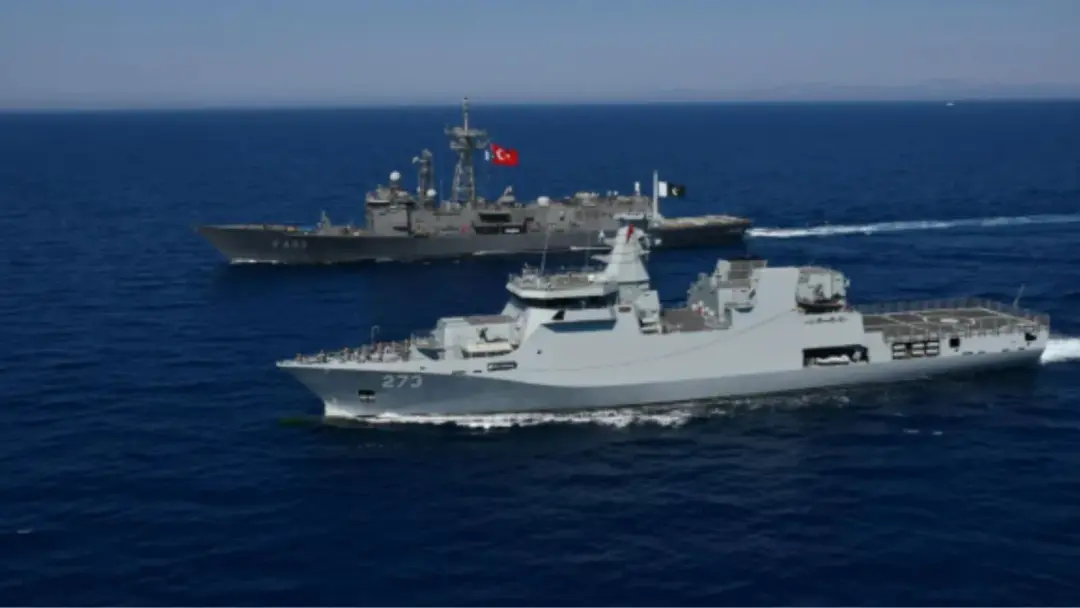
Pakistan summons Indian envoy over Arabian Sea naval collision
Pakistan on Thursday protested the North Arabian Sea collision between an Indian Navy warship and a Pakistan Navy vessel, calling the September 15 incident a "highly provocative and unacceptable action" within its Exclusive Economic Zone. Islamabad summoned the Indian High Commission's Charge d'Affaires, alleging the Indian ship manoeuvred dangerously close during exercise SEASPARK-26. Indian sources said PNS Hunain closed in at high speed and was damaged, while the Indian warship was unharmed. India had summoned Pakistan's envoy on Wednesday.
Source
Indian Express — India · read the original report ↗
Desk check · some claims need care
What the desk checked (5)
- Pakistan called the September 15 collision a 'highly provocative and unacceptable action' in its EEZ and summoned the Indian Charge d'Affaires. — Attributed to a statement by Pakistan's Ministry of Foreign Affairs.
- India protested the 'unprofessional conduct of Pakistani naval units' and summoned Pakistan's Charge d'Affaires on Wednesday. — Attributed to New Delhi in the source; wording quoted.
- PNS Hunain closed in on the Indian warship at high speed and was damaged, while the Indian warship was undamaged. — Attributed to unnamed Indian official sources; contested by Pakistan's account.
- The incident occurred about 120 nautical miles from the Gulf of Oman during Pakistan's SEASPARK-26 exercise. — Location described as 'reportedly'; exercise name appears in Pakistan's statement.
- A similar incident occurred on June 16, 2011 involving PNS Babur and INS Godavari in the Gulf of Aden. — Historical detail stated in source without separate attribution.
Analysts’ view opinion
This has become less about a minor bump at sea and more about a tit-for-tat diplomatic scoreboard, with each side summoning the other's envoy within 24 hours. Islamabad's protest, coming a day after New Delhi's, reads as an attempt to seize the narrative rather than concede it. Notably, both capitals have kept the response in the diplomatic lane rather than the military one, suggesting a shared interest in capping escalation.
- India protested first and Pakistan mirrored it the next day — a classic diplomatic move to avoid appearing to have absorbed a complaint without answering it.
- Pakistan is framing the incident as a provocation inside its Exclusive Economic Zone, while India's position is that an EEZ is international waters and that the Pakistani vessel closed in — two framings pitched largely at two domestic audiences.
- Pakistan's invocation of the 1991 bilateral agreement on advance notice of military exercises anchors its case in treaty language, which is useful if it wants to raise the matter in wider forums.
- Indian sources' assertion that the damage was to the Pakistani vessel carries political value, bolstering the claim that the fault lay with the other side.
- The 2011 PNS Babur–INS Godavari precedent, which drew a defence minister's statement in Parliament, suggests such incidents can migrate quickly into domestic political debate.
What to watch — Watch whether this stays confined to matching demarches, or escalates to a parliamentary statement in India and a push by Pakistan to internationalise the episode.
The story does not establish which vessel actually manoeuvred dangerously or who was at fault — it offers only two contradictory official accounts with no independent verification.
Deep dive
Research brief · 8 facts · 6 dates · exam-readyThe brief
Context
On September 15, an Indian Navy frontline warship and a Pakistan Navy vessel, PNS Hunain, came into contact in the North Arabian Sea while Pakistan was conducting its biennial exercise SEASPARK-26. India summoned Pakistan's Charge d'Affaires on Wednesday over the "unprofessional conduct of Pakistani naval units"; Pakistan responded on Thursday by summoning the Indian High Commission's Charge d'Affaires in Islamabad, calling the incident a "highly provocative and unacceptable action" within its Exclusive Economic Zone. Indian sources say the Pakistani vessel closed in at high speed and was damaged, while the Indian warship was unharmed. Indian warships have been deployed in the area for routine surveillance and Operation Urja Suraksha, launched in March to protect energy supply lines through the Strait of Hormuz.
Key facts
- The collision occurred on September 15 in the North Arabian Sea, about 120 nautical miles from the Gulf of Oman.
- Pakistan's Ministry of Foreign Affairs summoned the Charge d'Affaires of the Indian High Commission in Islamabad on Thursday; India had summoned Pakistan's Charge d'Affaires on Wednesday.
- Pakistan said the incident occurred within its EEZ during its biennial naval exercise SEASPARK-26.
- Pakistan alleged a serious violation of international law and the bilateral Agreement on Advance Notice on Military Exercises, Manoeuvres and Troop Movements, 1991.
- Indian official sources identified the Pakistani vessel as PNS Hunain, an offshore patrol vessel often listed as a Yarmook-class corvette; it was damaged and returned to home port.
- No damage to the Indian warship was reported and it continued its routine surveillance mission, Indian sources said.
- An EEZ extends up to 200 nautical miles from a country's coastal baseline and is considered international waters, with freedom of navigation and overflight for foreign ships and aircraft.
- Operation Urja Suraksha was launched by the Indian Navy in March to safeguard India's crude oil, LPG and LNG supply lines passing through the Strait of Hormuz.
Timeline
- 1991India and Pakistan sign the bilateral Agreement on Advance Notice on Military Exercises, Manoeuvres and Troop Movements.
- June 16, 2011PNS Babur brushes past INS Godavari in the Gulf of Aden; India protests by summoning the Pakistan High Commission's naval advisor, and Defence Minister A K Antony makes a statement in Parliament.
- March (this year)Indian Navy launches Operation Urja Suraksha to secure energy supply lines through the Strait of Hormuz amid the West Asia conflict.
- September 15Collision between the Indian Navy warship and PNS Hunain in the North Arabian Sea, about 120 nautical miles from the Gulf of Oman, during SEASPARK-26.
- WednesdayIndia summons Pakistan's Charge d'Affaires, protesting the "unprofessional conduct of Pakistani naval units".
- ThursdayPakistan's MFA summons the Indian High Commission's Charge d'Affaires; says its envoy in New Delhi will lodge a matching demarche with India's MEA.
Who has a stake
- Indian Navy — Freedom of navigation for its warships on surveillance and Operation Urja Suraksha missions in the North Arabian Sea; its ship reported undamaged.
- Pakistan Navy — Conduct of its biennial exercise SEASPARK-26; PNS Hunain was damaged and returned to home port.
- Pakistan's Ministry of Foreign Affairs — Summoned India's Charge d'Affaires, terming the action belligerent and a violation of international law and the 1991 bilateral agreement.
- India's Ministry of External Affairs — Recipient of Pakistan's matching demarche; had summoned Pakistan's Charge d'Affaires a day earlier.
- Indian High Commission, Islamabad — Its Charge d'Affaires was summoned and asked to convey Pakistan's protest to New Delhi.
- India's energy supply chain — Crude oil, LPG and LNG shipments transiting the Strait of Hormuz that Operation Urja Suraksha is meant to protect.
Why it matters
A physical contact between Indian and Pakistani warships at sea, the first such reported incident since 2011, carries escalation risk in busy sea lanes that carry India's crude oil, LPG and LNG through the Strait of Hormuz. The duelling demarches show both sides invoking international law and the 1991 bilateral agreement on advance notice of military exercises, underscoring how thin maritime confidence-building measures are between the two neighbours.
UPSC angle
Prelims pointers
- Exclusive Economic Zone extends up to 200 nautical miles from the coastal baseline; it is not territorial sovereignty and permits freedom of navigation and overflight.
- SEASPARK-26 is Pakistan Navy's biennial naval exercise.
- Operation Urja Suraksha: Indian Navy operation launched in March to secure energy supply lines (crude oil, LPG, LNG) via the Strait of Hormuz.
- India-Pakistan Agreement on Advance Notice on Military Exercises, Manoeuvres and Troop Movements dates to 1991.
- PNS Hunain is an offshore patrol vessel, often listed as a Yarmook-class corvette because of its combat suite.
- June 16, 2011: PNS Babur brushed past INS Godavari in the Gulf of Aden; then Defence Minister A K Antony made a statement in Parliament.
Mains framing
The September 15 contact between an Indian frontline warship and PNS Hunain in the North Arabian Sea illustrates how competing legal claims and thin maritime confidence-building measures can turn routine naval activity into a diplomatic flashpoint. Pakistan frames the event as an aggressive Indian manoeuvre inside its EEZ, violating international law and the 1991 bilateral agreement on advance notice of military exercises; India counters that the Pakistani vessel closed in at high speed and unsafely, and that no warning was issued to steer clear of the exercise area as is typically required during certain drills. The legal core is that an EEZ, extending 200 nautical miles from the baseline, is not sovereign territory and foreign warships enjoy freedom of navigation there so long as coastal economic activity is not interfered with. The strategic backdrop is India's growing operational presence in the northern Arabian Sea through Operation Urja Suraksha, launched in March to protect energy shipments transiting the Strait of Hormuz amid West Asian conflict, which increases the density of naval interactions. Given the 2011 PNS Babur-INS Godavari precedent, the way forward suggested by the two sides' own statements lies in strict adherence to international law and existing bilateral instruments aimed at preventing incidents at sea, and in timely notification and communication around exercise areas.
Key terms
- Exclusive Economic Zone (EEZ)
- Maritime zone extending up to 200 nautical miles from the coastal baseline; treated as international waters where foreign ships and aircraft enjoy navigation and overflight freedom.
- SEASPARK-26
- Pakistan Navy's biennial naval exercise, under way when the September 15 collision occurred.
- Operation Urja Suraksha
- Indian Navy initiative launched in March to safeguard India's crude oil, LPG and LNG supply lines passing through the Strait of Hormuz.
- Charge d'Affaires
- The diplomat heading a mission in the absence of an ambassador or high commissioner; summoned by both capitals to receive protests.
- Demarche
- Formal diplomatic representation lodged with a host government, which Pakistan's envoy in New Delhi was to deliver to India's MEA.
- 1991 Advance Notice Agreement
- India-Pakistan bilateral agreement on advance notice of military exercises, manoeuvres and troop movements, cited by Pakistan as violated.
Practice questions
- Discuss the legal status of the Exclusive Economic Zone and the rights of foreign warships within it, with reference to the September 15 India-Pakistan naval incident.
- Examine the adequacy of India-Pakistan confidence-building measures at sea, including the 1991 agreement on advance notice of military exercises, in preventing incidents at sea.
- How does India's dependence on energy imports through the Strait of Hormuz shape its naval deployments in the North Arabian Sea? Illustrate with Operation Urja Suraksha.
Grounded only in the source report — figures and dates are the source's, not inferred.