
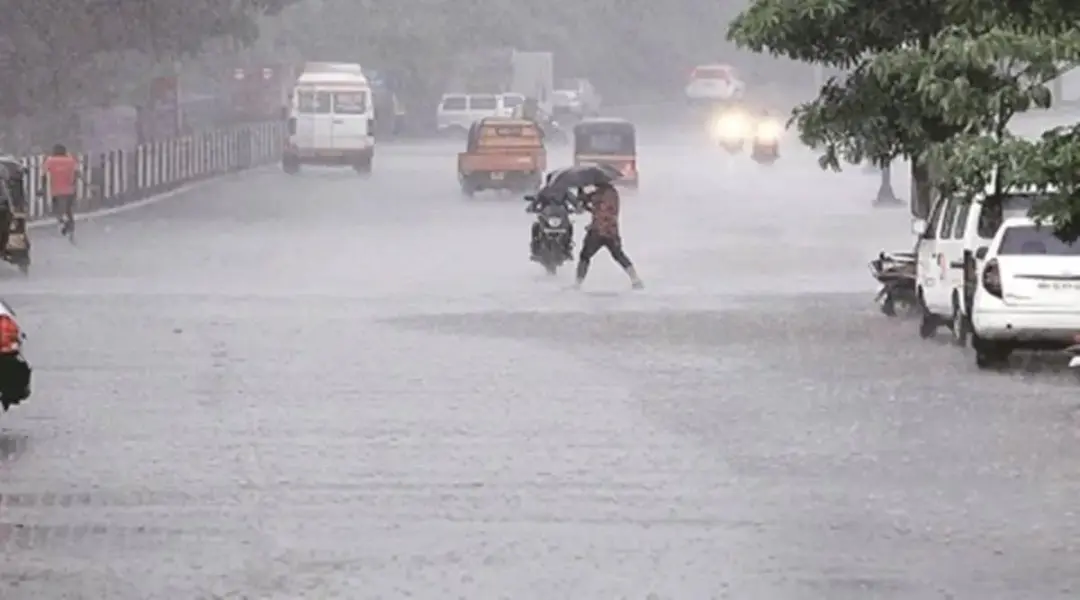
IMD issues red alert for four Andhra Pradesh districts as rain intensifies
Parts of Nellore, Chittoor and Kadapa districts recorded widespread rainfall in the last 12 hours due to a depression in the southwest Bay of Bengal. The IMD has kept a code red warning for Prakasam, Nellore, Kadapa and Chittoor, an orange alert for Guntur and Anantapur, and a yellow warning for Visakhapatnam, East Godavari, West Godavari, Krishna and Kurnool. Tirupati recorded 8 cm rain. Chittoor and Nellore declared a school holiday on Thursday. Fishermen were warned against venturing to sea for four days.
Source
East Godavari — weather · read the original report ↗
Desk check · compared with the source
What the desk checked (5)
- Code red warning for extremely heavy rainfall at one or two places over Prakasam, Nellore, Kadapa and Chittoor districts. — Attributed to IMD in source; repeated consistently in headline caption and body.
- Orange alert for Guntur and Anantapur; yellow warning for Visakhapatnam, East Godavari, West Godavari, Krishna and Kurnool. — Attributed to IMD; district lists internally consistent.
- Depression in southwest Bay of Bengal to cross coast between Karaikal and Sriharikota by Thursday evening. — Attributed to IMD forecast; figure for wind speed given as 25-30 knots in source.
- Tirupati recorded 8 cm rain till 8.30 am Thursday, Nellore 5 cm; Muthukur 7.6 cm by Thursday afternoon. — Figures appear in source, credited to IMD station data and Andhra Pradesh State Development Planning Society real-time data.
- Cloudburst-type rains and flash floods likely in south Nellore and east Chittoor. — Attributed to weather blogger Sai Praneeth B on Twitter, not an official forecast.
Analysts’ view opinion
This is a weather story, but in Andhra Pradesh disaster management is always a political test. The red-alert districts — Prakasam, Nellore, Kadapa and Chittoor — sit in politically significant Rayalaseema and south-coastal territory, so how visibly fast the state moves will shape the credit-and-blame ledger. District administrations declaring a school holiday in advance and warning fishermen off the sea reads as an attempt to establish a 'we acted in time' narrative.
- In disasters, public judgement usually rests on relief, compensation and restoration speed — early warnings are only the first test.
- Because the red and orange alert districts are politically consequential, expect a rise in ministerial and MLA field visits and photo-op governance.
- If flood damage turns out to be heavy, opposition parties have an obvious opening on drainage, flood-mitigation and delayed compensation.
- A four-day fishing ban is an income shock for a cohesive voting bloc, so demands for targeted relief for fishermen could become a political flashpoint.
- Damage assessment, any central team visits and fund releases would set up the familiar Centre-state bargaining narrative.
What to watch — Watch the scale of damage once the depression crosses the coast — evacuation, relief camps, the speed of compensation announcements and the sharpness of opposition criticism will follow from that.
The story establishes only weather warnings, rainfall figures and holiday announcements; it does not establish any loss of life or property, high-level government action, or any political reaction so far.
Deep dive
Research brief · 8 facts · 6 dates · exam-readyThe brief
Context
A depression that formed over the southwest Bay of Bengal brought widespread rainfall to southern Andhra Pradesh districts, with the system expected to cross north Tamil Nadu and adjoining south coastal Andhra Pradesh by Thursday evening, making landfall between Karaikal and Sriharikota close to the north of Puducherry. The India Meteorological Department (IMD) issued colour-coded warnings — red, orange and yellow — across districts depending on expected rainfall intensity. Nellore, Chittoor and Kadapa recorded widespread rain in a 12-hour spell, with waterlogging and flash flood risk reported, and district administrations ordered school closures.
Key facts
- A depression formed in the southwest Bay of Bengal was expected to cross north Tamil Nadu and adjoining coastal south Andhra Pradesh by Thursday evening.
- The system was forecast to cross the coast between Karaikal and Sriharikota, close to the north of Puducherry.
- IMD kept a code red warning of extremely heavy rainfall at one or two places over Prakasam, Nellore, Kadapa and Chittoor districts.
- Orange alert issued for Guntur and Anantapur (heavy to very heavy rain at one or two places); yellow warning for Visakhapatnam, East Godavari, West Godavari, Krishna and Kurnool.
- IMD forecast squally weather with wind speed reaching 25-30 knots in thundershowers over south Andhra coasts.
- Fishermen were warned against venturing into the sea for four days starting Thursday, with the sea likely to remain rough to very rough.
- Till 8.30 am Thursday, Tirupati (Chittoor) recorded the highest rainfall of 8 cm, followed by Nellore with 5 cm.
- As of Thursday afternoon, Muthukur in Nellore recorded up to 7.6 cm; Varadaiahpalem (Chittoor) and Viduvalur (Nellore) recorded over 6 cm, per Andhra Pradesh State Development Planning Society real-time data.
Timeline
- Preceding 12 hours (before Thursday morning)Several parts of Nellore, Chittoor and Kadapa districts record widespread rainfall due to the Bay of Bengal depression.
- Till 8.30 am, ThursdayIMD station at Tirupati records 8 cm rain, the highest; Nellore records 5 cm.
- November 11, 2021 (Thursday)Chittoor and Nellore district administrations declare a holiday for all educational institutions; social media posts report high-intensity winds at Sullurupeta and waterlogging in Nellore city.
- Thursday afternoonMuthukur in Nellore records the highest rainfall of up to 7.6 cm; Varadaiahpalem and Viduvalur cross 6 cm.
- Thursday evening (expected)Depression expected to cross north Tamil Nadu and adjoining south coastal Andhra Pradesh between Karaikal and Sriharikota.
- Four days from ThursdayFishermen warned not to venture into the sea as conditions stay rough to very rough.
Who has a stake
- India Meteorological Department (IMD) — Issues the depression forecast and colour-coded red, orange and yellow rainfall warnings that trigger district-level response.
- District administrations of Chittoor and Nellore — Declared a holiday for all educational institutions on Thursday in view of the rainfall warning.
- Residents of Nellore, Chittoor, Kadapa and Prakasam — Face extremely heavy rain, waterlogging (reported in Nellore city) and possible flash floods.
- Fishermen along the Andhra coast — Barred from going to sea for four days from Thursday due to rough to very rough sea, hitting livelihoods.
- Andhra Pradesh State Development Planning Society — State-run body providing real-time rainfall data used to track the event at mandal level.
- Students and educational institutions — Classes suspended on Thursday in the two worst-hit districts.
Why it matters
Post-monsoon depressions over the Bay of Bengal repeatedly expose south coastal Andhra Pradesh and north Tamil Nadu to extremely heavy rain, urban flooding and flash floods within a matter of hours. Colour-coded IMD alerts are the trigger for concrete administrative action — school holidays, fishing bans and evacuation readiness — so the accuracy and reach of these warnings directly determines loss of life and livelihood.
UPSC angle
Prelims pointers
- IMD colour codes: green (no action), yellow (watch), orange (be prepared), red (take action) — red here means extremely heavy rain likely.
- Red alert districts in this event: Prakasam, Nellore, Kadapa, Chittoor; orange: Guntur, Anantapur; yellow: Visakhapatnam, East Godavari, West Godavari, Krishna, Kurnool.
- Depression formed over southwest Bay of Bengal; landfall forecast between Karaikal and Sriharikota, north of Puducherry.
- Squally weather forecast with winds of 25-30 knots in thundershowers over south Andhra coasts.
- Sriharikota (Nellore district) hosts India's satellite launch centre and lies on the stretch named for the crossing.
- Andhra Pradesh State Development Planning Society (APSDPS) maintains real-time rainfall data for the state.
Mains framing
The episode illustrates how a single post-monsoon depression over the southwest Bay of Bengal can produce cascading hazards across two states: extremely heavy and 'cloudburst type' rain over southern Nellore and eastern Chittoor, flash floods, urban waterlogging in Nellore city, squally winds of 25-30 knots and rough seas that suspend fishing for four days. The causes lie in the cyclogenesis-prone northeast monsoon season over the Bay, combined with high exposure of low-lying coastal and urban settlements and drainage systems unable to absorb rain of 6-8 cm in hours. Implications are immediate — closure of educational institutions in Chittoor and Nellore, loss of fishing income, and risk to crops and transport in Prakasam, Kadapa, Guntur and Anantapur. The way forward, as visible in this case, rests on impact-based colour-coded warnings from the IMD translated quickly into district decisions, dense real-time rainfall monitoring of the kind maintained by the Andhra Pradesh State Development Planning Society, and pre-positioned response in red-alert districts; the growing role of informal weather bloggers in amplifying warnings also raises the question of how official communication can stay authoritative and timely.
Key terms
- Depression
- A low-pressure system over the sea; the one here formed in the southwest Bay of Bengal and was set to cross the coast near Puducherry.
- Code red warning
- IMD's highest-level alert, issued here for extremely heavy rainfall very likely at one or two places in four districts.
- Orange / yellow alert
- Orange signals heavy to very heavy rain (be prepared); yellow signals heavy rain (watch and stay updated).
- Squally weather
- Sudden sharp increase in wind speed with thundershowers; forecast at 25-30 knots over south Andhra coasts.
- Andhra Pradesh State Development Planning Society
- State-run agency whose real-time rainfall data recorded Muthukur's 7.6 cm and other mandal-level figures.
- Flash flood
- Rapid inundation from intense short-duration rain, flagged as likely in south Nellore and east Chittoor localities.
Practice questions
- Explain how IMD's colour-coded warning system works and evaluate its effectiveness in converting rainfall forecasts into district-level administrative action, using the Andhra Pradesh depression of November 2021.
- Why is the post-monsoon season over the Bay of Bengal particularly hazardous for the coasts of Tamil Nadu and south Andhra Pradesh? Discuss with reference to depressions and their associated hazards.
- Urban waterlogging and flash floods now accompany almost every heavy rainfall event in coastal towns. Examine the structural reasons and suggest measures for disaster preparedness.
Grounded only in the source report — figures and dates are the source's, not inferred.