
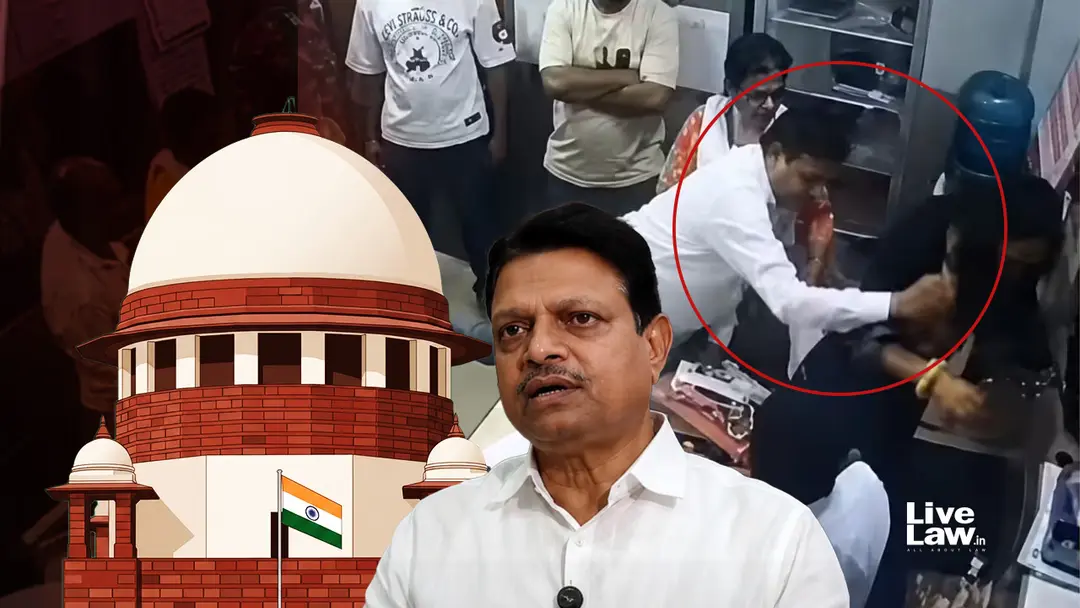
Supreme Court cancels bail of Shiv Sena corporator in doctors assault case
The Supreme Court set aside the Bombay High Court's order granting bail to Shiv Sena corporator Ramesh Sukrya Mhatre, accused of assaulting doctors and staff at a municipal hospital in Dombivli, Maharashtra. A bench of Justice Vikram Nath and Justice Sandeep Mehta directed him to surrender within three days. The bench orally remarked that a strong message must go out and the medical fraternity cannot be attacked in this manner. Mhatre and four others face charges including assaulting public servants, rioting and offences under the Maharashtra Medicare Act.
Source
Live Law (courts) · read the original report ↗
Desk check · compared with the source
What the desk checked (5)
- Supreme Court bench of Justices Vikram Nath and Sandeep Mehta set aside the Bombay High Court's August 7 bail order and directed Ramesh Sukrya Mhatre to surrender in three days. — Attributed to the court proceedings reported in the source; case number and title given.
- Justice Mehta orally said the medical fraternity cannot be attacked in this manner and the message must go loud and clear. — Direct quote of oral remark as reported in the source; oral observations are not part of a written order.
- Mhatre had spent 19 days in custody; 19 criminal cases were cited against him and he was acquitted in 18. — Figures presented as submissions by Senior Advocate Siddharth Dave, not independently established in the source.
- The case stems from a July 6 incident involving a nine-month pregnant woman allegedly kept waiting for hours at a Dombivli municipal hospital; FIR registered July 7 naming Mhatre as Accused No. 1. — Described in the source as per the petition and Mhatre's own claim; allegations untested.
- Mhatre and four others face charges including assaulting public servants, rioting and offences under the Maharashtra Medicare Service Persons Act, 2010. — Charge list appears in the source; conviction has not occurred.
Analysts’ view opinion
This ruling tests the settled principle that cancelling bail demands a higher threshold than refusing it. Despite the offence being magistrate-triable with a maximum of five years — a category where bail is ordinarily granted — the Supreme Court set aside the High Court's order, citing the accused's antecedents, the potential impact on the trial and the pattern of attacks on medical staff. The bench's oral remark about sending a "loud and clear" message reflects a deterrence-driven approach, which is always debated in a bail jurisprudence built on individualised discretion.
- Bail can lawfully be cancelled by a superior court, but precedent requires cogent grounds such as risk to witnesses, obstruction of trial or criminal antecedents — and the bench pointed to adverse impact on the trial and the nature of the allegations.
- The defence's factors — 19 days in custody, trial already begun with two witnesses examined, and a magistrate-triable offence — are classic pro-bail considerations that the Court did not so much reject as outweigh on gravity.
- Special statutes like the Maharashtra Medicare Service Persons Act, 2010 treat violence against healthcare workers as a distinct category, and the bench's query about invoking more serious offences reads as a signal to the investigating agency.
- The Court's earlier view that the High Court was justified in taking suo motu cognisance and staying the magistrate's bail invites scrutiny of the limits of suo motu jurisdiction in cases running alongside public protest.
- Oral observations about repeated incidents involving the same organisation are not the legal basis of the order; the defence's clarification that Mhatre was not involved in the Palghar incident underlines the principle of individual criminal liability.
What to watch — Watch whether a fresh bail plea follows the three-day surrender and in which forum, how the expedited trial proceeds including the complainant's scheduled deposition on October 3, and whether graver sections are added.
This is a bail-stage order, not a finding of guilt — the allegations remain unproven and the story does not set out the full reasoning of the judgment beyond the oral remarks.
Deep dive
Research brief · 8 facts · 8 dates · exam-readyThe brief
Context
Ramesh Sukrya Mhatre, a Shiv Sena corporator, is accused of assaulting doctors and staff at a municipal hospital in Dombivli, Maharashtra, after an incident on July 6 involving a nine-month pregnant woman allegedly kept waiting in acute labour. A Kalyan Magistrate granted him bail on July 14; the Bombay High Court took suo motu cognisance on July 18 after doctors' protests, stayed that bail, and later granted him bail on August 7 with stringent conditions. Maharashtra appealed to the Supreme Court against the High Court's bail order. A bench of Justice Vikram Nath and Justice Sandeep Mehta has now set aside the bail and ordered him to surrender in three days.
Key facts
- The Supreme Court set aside the Bombay High Court's August 7 order granting bail to Shiv Sena corporator Ramesh Sukrya Mhatre and directed him to surrender within three days.
- The bench comprised Justice Vikram Nath and Justice Sandeep Mehta; Justice Mehta orally said, "The message must go loud and clear. Medical fraternity cannot be touched and attacked in this manner."
- Mhatre and four other accused face charges of assaulting public servants, voluntarily causing hurt, rioting, criminal intimidation and intentional insult, plus the Maharashtra Medicare Act, 2010.
- The case stems from a July 6 incident involving a nine-month pregnant woman allegedly kept waiting for several hours in acute labour; the FIR was registered on July 7 naming Mhatre as Accused No. 1.
- Three doctors, including a woman doctor, were allegedly assaulted at the hospital; the complainant woman doctor was scheduled to depose on October 3.
- Senior Advocate Siddharth Dave said Mhatre had spent 19 days in custody, the trial had begun before a Magistrate and two prosecution witnesses were already examined.
- Dave said the main offence invoked carried a maximum punishment of five years and was Magistrate-triable; the Court asked whether more serious offences could be invoked.
- Dave said the 19 criminal cases cited against Mhatre were politically motivated and that he had been acquitted in 18 of them.
Timeline
- July 6Incident at the Dombivli municipal hospital involving a nine-month pregnant woman allegedly in acute labour kept waiting for hours; Mhatre says he came after family's calls and an altercation followed.
- July 7FIR registered naming Mhatre as Accused No. 1.
- July 14Magistrate in Kalyan grants Mhatre bail citing age, medical condition, no flight risk and CCTV evidence already secured.
- July 18Bombay High Court, after doctors' protests, takes suo motu cognisance, stays the bail order and directs Mhatre to surrender.
- August 7After two weeks, the High Court grants Mhatre bail with stringent conditions, including residing in Calangute, Goa, reporting thrice weekly at Anjuna Police Station and staying outside Maharashtra till trial.
- September 7Supreme Court expresses concern over another alleged assault on doctors in Palghar involving Shiv Sena workers; Mhatre withdraws challenge to bail conditions; notice issued on State's appeal with three weeks to respond.
- October 3Complainant woman doctor scheduled to depose before the Magistrate's court.
- Day of the order (today)Supreme Court allows the State's appeal, sets aside the High Court's bail order and directs Mhatre to surrender within three days.
Who has a stake
- Ramesh Sukrya Mhatre, Shiv Sena corporator — Bail cancelled; must surrender within three days and faces trial on assault, rioting and Maharashtra Medicare Act charges.
- Supreme Court bench (Justices Vikram Nath and Sandeep Mehta) — Signalling that attacks on healthcare professionals warrant a strong response, even in Magistrate-triable cases.
- State of Maharashtra — Appellant whose challenge to the High Court's bail order succeeded.
- Bombay High Court — Its suo motu intervention and stay were endorsed, but its bail grant was set aside; its expedited-trial timeline left untouched.
- Doctors and hospital staff, including the complainant woman doctor — Safety at workplace and the ability to depose without intimidation; their protests triggered the High Court's suo motu action.
- Four co-accused — Face the same set of charges including rioting and offences under the Maharashtra Medicare Act, 2010.
Why it matters
Violence against doctors inside hospitals is a recurring problem, and the Supreme Court has used this case to say that bail norms cannot be applied mechanically where healthcare workers are attacked, even when the offences are Magistrate-triable and carry only five years' maximum punishment. It also shows appellate courts weighing a political office-holder's criminal antecedents and the risk to an ongoing trial where the key witness is the assaulted doctor herself. The order strengthens the practical bite of special state laws like the Maharashtra Medicare Act, 2010.
UPSC angle
Prelims pointers
- Maharashtra Medicare Service Persons and Medicare Service Institutions (Prevention of Violence and Damage or Loss to Property) Act, 2010 — invoked in assaults on medical staff.
- Case: State of Maharashtra vs. Ramesh Sukrya Mhatre, Crl.A. No. 004604/2026; bench of Justice Vikram Nath and Justice Sandeep Mehta.
- Bombay High Court took suo motu cognisance on July 18 and stayed a Magistrate's bail order dated July 14.
- Supreme Court directed surrender within three days while refusing to interfere with the High Court's expedited-trial timeline.
- High Court bail conditions had included residence in Calangute, Goa, and thrice-weekly reporting at Anjuna Police Station.
- The main offence invoked carried a maximum of five years' imprisonment and was triable by a Magistrate.
Mains framing
The cancellation of a corporator's bail in the Dombivli hospital assault case raises the question of how courts should balance the settled principle that bail is the rule — particularly for Magistrate-triable offences punishable up to five years — against the deterrent needs of protecting public servants such as doctors. The defence stressed 19 days already spent in custody, a commenced trial with two witnesses examined, cooperation with the investigation, acquittals in 18 of 19 cited cases, and the higher threshold required for cancelling bail. The Court weighed criminal antecedents, the alleged assault on three doctors including a woman doctor who was yet to depose, and the likelihood that release could adversely affect the trial; it also pointed to a separate Palghar assault involving workers of the same organisation to suggest a pattern, observing "You are the leader. You are responsible." Institutionally, the judgment endorses High Courts' suo motu intervention where hospital violence provokes protests, and pairs strict bail scrutiny with expedited trial, special prosecutors and forensic timelines. A way forward lies in consistent enforcement of state medicare-protection laws, fast-tracking such trials so witness doctors can depose safely, and simultaneously addressing the service failures — such as prolonged waiting for a woman in acute labour — that trigger confrontations.
Key terms
- Maharashtra Medicare Act, 2010
- State law penalising violence against medicare service persons and damage to medicare institutions' property; invoked against Mhatre and four co-accused.
- Suo motu cognisance
- A court taking up a matter on its own motion; the Bombay High Court did so on July 18 after doctors protested the Magistrate's bail order.
- SLP (Special Leave Petition)
- Petition seeking the Supreme Court's discretionary leave to appeal; Mhatre filed one against the High Court's July 18 order and bail conditions.
- Magistrate-triable offence
- An offence triable by a Magistrate, usually of lesser gravity, where bail is ordinarily granted; the defence relied on this to resist cancellation.
- Cancellation of bail
- Withdrawal of bail already granted, which the defence argued requires a higher threshold than refusing bail; here granted on risk to the trial and antecedents.
- Special Public Prosecutor
- A prosecutor appointed for a specific case; the High Court's directions on such appointment were among those Mhatre had challenged.
Practice questions
- Critically examine the principles governing cancellation of bail in India, with reference to the Supreme Court's order in State of Maharashtra vs. Ramesh Sukrya Mhatre.
- Do special state laws penalising violence against healthcare workers, such as the Maharashtra Medicare Act, 2010, adequately deter hospital violence? Discuss with reference to recent incidents.
- Discuss the scope and limits of a High Court's power to take suo motu cognisance of a criminal bail order, using the Dombivli doctors' assault case as an illustration.
Grounded only in the source report — figures and dates are the source's, not inferred.