
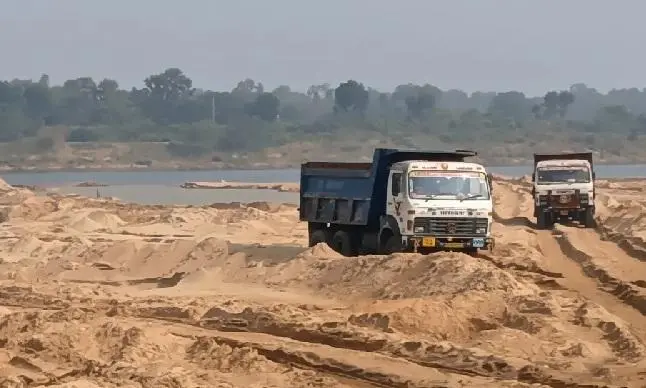
Illegal sand traders shift routes in Tirupati, Chittoor districts
Illegal sand transporters in Tirupati and Chittoor districts are using new routes and tactics to evade intensified enforcement, sources in the Revenue, Mines and Police departments said. Pilot vehicles are sent ahead to track police movement and guide sand-laden tippers towards Tamil Nadu and Karnataka. Sources said a tipper load fetches ₹1-1.2 lakh in Chennai and ₹1.2-1.4 lakh in Bengaluru, against costs of ₹45,000-₹60,000. Chief Minister Nara Chandrababu Naidu has directed officials to curb the trade.
Source
Chittoor — news · read the original report ↗
Desk check · some claims need care
What the desk checked (4)
- Illegal sand transporters in Tirupati and Chittoor districts use pilot vehicles to monitor police movement. — Attributed to unnamed sources in Revenue, Mines and Police departments and an anonymous revenue official.
- A tipper load fetches ₹1-1.2 lakh in Chennai and ₹1.2-1.4 lakh in Bengaluru; costs are ₹45,000-₹60,000 per load. — Figures appear in the source but are reported as estimates with no named source or official data.
- Around 15-20 vehicles from each constituency may be using the Chennai-Bengaluru Expressway route daily. — Hedged estimate attributed to unnamed sources; not verifiable from the text.
- Chief Minister Nara Chandrababu Naidu directed officials to prevent illegal sand mining and act against smugglers. — Attributed to the Chief Minister in the source; no date or document cited.
Analysts’ view opinion
Read legally, this is less a story about one offence than about a regulatory architecture under strain. Illegal sand extraction and transport typically engages a layered legal framework — mining and mineral concession rules, state sand policy, environmental clearance requirements and ordinary criminal law on theft of state property and obstruction of public servants — which is why Revenue, Mines and Police all appear in the same enforcement picture. The use of pilot vehicles and interstate corridors shifts the hard questions from whether conduct is unlawful to whether evidence can be gathered, jurisdiction can be asserted across state lines, and penalties can bite harder than the margins described in the story.
- The tactics described — advance pilot cars, night movement, concealed loads — go to proof rather than legality, and enforcement typically depends on interception at the moment of transport, which makes seizure and seizure-record integrity central.
- Seizure of vehicles and imposition of fines are administrative or statutory actions that usually carry their own procedural safeguards, including notice, confiscation proceedings and avenues of appeal before the designated authority or courts.
- Interstate movement raises classic jurisdictional friction: the offence of extraction occurs in one state while delivery occurs in another, so effective action generally needs either coordinated action by the receiving state or a documented chain of evidence from the source.
- Where organised, repeated activity and lookout vehicles are involved, investigators may consider whether conduct crosses from isolated violations into aiding or abetting and conspiracy, though the story does not say such charges have been framed.
- A chief ministerial direction to act strictly is an executive instruction, not a change in the law, and the legal validity of any seizure or penalty will still turn on the statutory power actually invoked in each case.
What to watch — Watch whether enforcement moves from vehicle seizures and fines towards registered cases and prosecutions, and whether any formal interstate coordination mechanism with Tamil Nadu and Karnataka authorities is put in place.
The story rests substantially on unnamed departmental sources and does not establish any individual's guilt, the number or nature of cases registered, the statutes invoked, or independent verification of the volumes and price figures cited.
Deep dive
Research brief · 8 facts · 4 dates · exam-readyThe brief
Context
Illegal sand mining and interstate transport from Tirupati and Chittoor districts of Andhra Pradesh has come under tighter scrutiny after Chief Minister Nara Chandrababu Naidu directed officials to act against smugglers. Sources in the Revenue, Mines and Police departments say traders have responded by changing routes and tactics rather than stopping. Sand-laden tippers are now escorted by "pilot" cars that scout for checkposts and enforcement teams, a method borrowed from red sanders smugglers. The sand is moved towards Chennai in Tamil Nadu and Bengaluru in Karnataka, where it fetches roughly double the cost of excavation and transport.
Key facts
- Illegal sand transporters in Tirupati and Chittoor districts are using new routes and tactics to evade intensified enforcement, per Revenue, Mines and Police sources.
- Pilot vehicles (cars sent ahead of tippers) monitor police movement and alert drivers; if a check is reported, the tipper waits until the route is clear.
- The pilot-vehicle tactic mirrors that used by red sanders smugglers to evade enforcement checks.
- Earlier concealment methods, such as covering sand with cement bags and gravel, have become less common after stepped-up checks and seizures.
- A tipper load fetches about ₹1 lakh to ₹1.2 lakh in Chennai and ₹1.2 lakh to ₹1.4 lakh in Bengaluru.
- Excavation and transportation costs range between ₹45,000 and ₹60,000 per load.
- Sand for Chennai is sourced mainly from Swarnamukhi River belts around Srikalahasti and Naidupeta; Tiruchanoor and Chandragiri feed Bengaluru-bound loads.
- The Chennai-Bengaluru Expressway, linking Baireddipalle in Chittoor district to Bengaluru's outskirts, is a new corridor; sources estimate 15-20 vehicles per constituency use it daily.
Timeline
- Earlier (before intensified checks)Illegal traders concealed sand loads under cement bags, gravel and other material to mislead checking teams.
- RecentlyChief Minister Nara Chandrababu Naidu directed officials to prevent illegal sand mining and transportation and take strict action against smugglers.
- Following the CM's directionsRevenue, Mines and Police departments began conducting checks, seizing vehicles and imposing fines.
- NowOperators shifted to pilot vehicles and new corridors such as the Chennai-Bengaluru Expressway; officials are mapping routes and strengthening inter-departmental coordination.
Who has a stake
- Revenue, Mines and Police departments of Andhra Pradesh — Responsible for checks, seizures and fines; must coordinate to stop interstate sand movement and counter pilot-vehicle tactics.
- Chief Minister Nara Chandrababu Naidu — Issued directions to curb illegal sand mining and transportation and ensure strict action against smugglers.
- Illegal sand traders and tipper operators — Earn ₹1-1.4 lakh per load against ₹45,000-₹60,000 costs; face vehicle seizures and fines.
- Swarnamukhi River belt areas (Srikalahasti, Naidupeta) and Tiruchanoor, Chandragiri — Source zones for illegally excavated sand, bearing the environmental burden of extraction.
- Tamil Nadu and Karnataka markets (Chennai, Bengaluru) — Destination markets whose demand drives the high prices fuelling the illegal trade.
- Field enforcement teams — Find it difficult to track sand tippers, particularly at night, because of pilot-vehicle warnings.
Why it matters
Sand is a high-demand, low-cost mineral whose illegal extraction depletes riverbeds and deprives the state of revenue, while the profit margin here — roughly double the cost per load — makes enforcement a losing race unless routes and networks are tackled. The shift to pilot vehicles and expressway corridors shows that enforcement drives can displace rather than stop such trade. It also underlines that interstate smuggling cannot be curbed by one district or one department acting alone.
UPSC angle
Prelims pointers
- Swarnamukhi River flows through the Srikalahasti-Naidupeta belt in Tirupati district, a key source of illegally mined sand.
- Chennai-Bengaluru Expressway connects Baireddipalle in Chittoor district to the outskirts of Bengaluru.
- Red sanders smuggling is associated with the Andhra Pradesh region; its pilot-vehicle evasion tactic is now used by sand traders.
- Three departments involved in sand enforcement in Andhra Pradesh: Revenue, Mines and Police.
- Reported tipper-load price: ₹1-1.2 lakh (Chennai), ₹1.2-1.4 lakh (Bengaluru); cost ₹45,000-₹60,000.
- Sand corridors to Bengaluru reported from Chandragiri, Puthalapattu, G.D. Nellore and Chittoor.
Mains framing
The illegal sand trade in Tirupati and Chittoor districts illustrates how enforcement without demand-side and structural intervention merely reshapes criminal logistics. The core driver is arbitrage: a tipper load costing ₹45,000-₹60,000 to excavate and move fetches ₹1-1.4 lakh in Chennai and Bengaluru, a margin large enough to absorb the risk of seizures and fines. As checks intensified, concealment under cement bags and gravel gave way to pilot cars that scout checkposts — a tactic imported from red sanders smuggling — and to new corridors such as the Chennai-Bengaluru Expressway, where fewer checks allow quick exit into Karnataka. The consequences are ecological, with riverbed extraction concentrated in the Swarnamukhi belt and around Tiruchanoor and Chandragiri; fiscal, through foregone mineral revenue; and institutional, with field teams unable to track movement at night. The way forward indicated in the source is route identification and stronger coordination among Revenue, Mines and Police departments, alongside the Chief Minister's directive for strict action — which points to the need for intelligence-led, interstate and night-time enforcement rather than static checkposts.
Key terms
- Pilot vehicle
- A car sent ahead of a sand-laden tipper to monitor police movement and alert the driver to stop if checks are reported.
- Tipper
- A heavy truck with a tipping body used here to haul bulk sand loads; the unit in which illegal sand is priced and seized.
- Red sanders smuggling
- Illegal trade in red sanders timber, whose smugglers pioneered the pilot-vehicle method now copied by sand traders.
- Swarnamukhi River belt
- River stretches around Srikalahasti and Naidupeta that are the main sourcing zone for sand headed to Chennai.
- Chennai-Bengaluru Expressway
- Highway corridor linking Baireddipalle in Chittoor district to Bengaluru's outskirts, now used to move sand with fewer police checks.
Practice questions
- Illegal sand mining persists despite enforcement drives because of the economics of the trade. Discuss with reference to the Tirupati-Chittoor sand corridors.
- How does the interstate nature of illegal sand transportation complicate enforcement? Suggest coordination mechanisms based on the reported experience of Andhra Pradesh's Revenue, Mines and Police departments.
- Examine how improved highway connectivity can create unintended opportunities for illegal mineral transport, using the Chennai-Bengaluru Expressway as an example.
Grounded only in the source report — figures and dates are the source's, not inferred.