
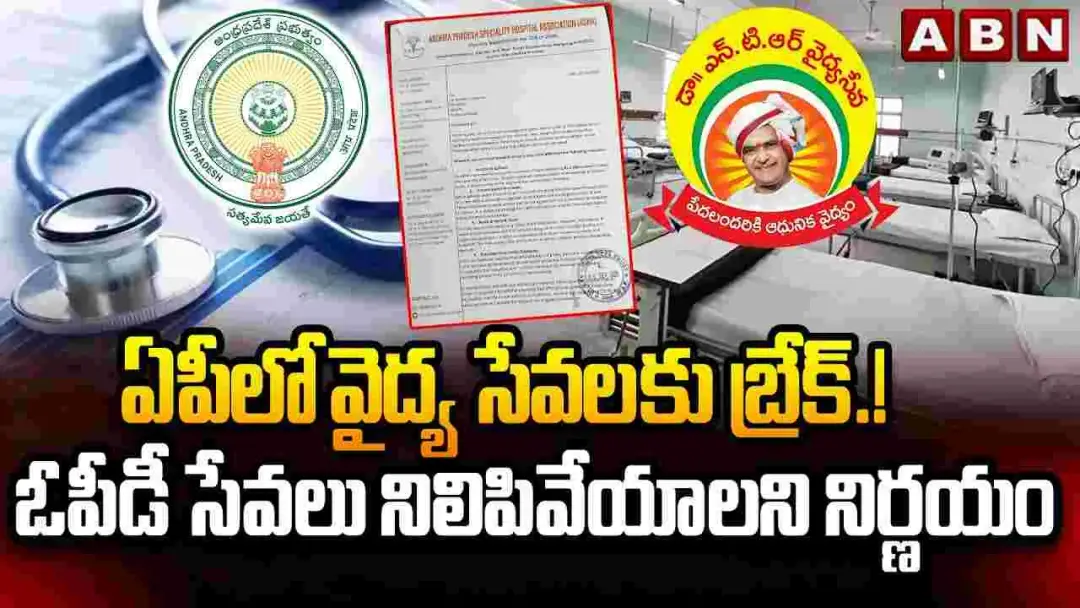
Speciality hospitals halt OPD services under NTR Vaidya Seva
The AP Speciality Hospitals Association, which provides services under the NTR Vaidya Seva Trust, announced it is stopping OPD services with immediate effect. It said Rs 2,500 crore in dues from the Andhra Pradesh government has not been released despite repeated requests, making staff salaries, hospital maintenance and implant purchases difficult. The association also said IVRS calls to patients are harming hospital-patient relations and that hospitals were not consulted on the Universal Health Policy. President Vijay Kumar submitted a letter to the CEO.
Source
Health · read the original report ↗
Desk check · compared with the source
What the desk checked (5)
- AP Speciality Hospitals Association has decided to stop OPD services under NTR Vaidya Seva with immediate effect. — Attributed to the association's announcement in the source; no independent confirmation available.
- Rs 2,500 crore in dues is pending from the Andhra Pradesh government. — Figure appears in the source as the association's claim; not verified against official data.
- IVRS calls to patients after treatment are damaging hospital-patient relations. — Stated as the association's opinion; no supporting evidence in source.
- Hospitals were not consulted while framing the Universal Health Policy. — Association's assertion; no government response included in the source.
- Association president Vijay Kumar submitted a letter to the NTR Vaidya Seva CEO. — Named attribution present in source; letter contents not reproduced.
Analysts’ view opinion
This is the classic failure point of publicly funded, privately delivered health insurance: the scheme's promise is made by the state, but the cash flow that sustains it is discretionary. By suspending only OPD follow-up services rather than inpatient care, the AP Specialty Hospitals Association has chosen a calibrated pressure tactic — visible enough to force negotiation, narrow enough to avoid the charge of abandoning acute patients. The grievance list in the letter to the NTR Vaidya Seva CEO goes beyond the stated Rs 2,500 crore in dues to questions of process, notably the claim that hospitals were not consulted while a universal health policy was being framed.
- Reimbursement-based schemes live or die on payment cycles; once arrears build to the scale alleged here, empanelled hospitals face real working-capital stress on salaries, maintenance and implants, which is the association's core argument.
- The choice to withdraw OPD rather than emergency or inpatient services suggests an attempt to maximise leverage while minimising immediate patient harm, though follow-up care is itself clinically important.
- The objection to IVRS verification calls points to a deeper design tension: audit and anti-fraud mechanisms protect public money but can strain provider trust if they feel punitive rather than collaborative.
- The complaint about no consultation on the universal health policy is a governance point as much as a financial one — schemes that redesign provider obligations without provider input tend to face compliance friction later.
- Standoffs of this kind between empanelled private hospitals and state health trusts are not new in India, and they have usually been resolved through partial payment releases and rate or process renegotiation rather than permanent exit.
What to watch — Watch whether the government or the trust responds with a phased release of dues and a formal consultation mechanism, and whether the suspension stays limited to OPD or widens to cashless inpatient care.
The story carries only the association's account: the government's and the trust's response, the verified dues figure and reconciliation status, and the actual number of patients affected are not established here.
Deep dive
Research brief · 8 facts · 2 dates · exam-readyThe brief
Context
The NTR Vaidya Seva Trust is Andhra Pradesh's government-funded health assurance scheme under which empanelled private and speciality hospitals treat beneficiaries and are later reimbursed by the state. The AP Speciality Hospitals Association, which groups such empanelled speciality hospitals, says reimbursements worth Rs 2,500 crore are pending from the state government. On September 15, the association announced it was stopping outpatient department (OPD) services offered under the scheme with immediate effect, and its president Vijay Kumar submitted a letter to the NTR Vaidya Seva CEO. The hospitals also objected to IVRS feedback calls made to patients after treatment and to not being consulted while the Universal Health Policy was framed.
Key facts
- The AP Speciality Hospitals Association, which provides services under the NTR Vaidya Seva Trust, decided to stop OPD services with immediate effect.
- The association says Rs 2,500 crore in dues from the Andhra Pradesh government have not been released.
- It said it had appealed several times but the requests were not heeded.
- The OPD services being halted are those provided to patients after treatment (post-treatment follow-up OPD).
- The association said IVRS calls with questions put to patients after hospital treatment are damaging patient-hospital relations.
- It said hospitals were not even consulted while the Universal Health Policy was being framed.
- Mounting dues have made staff salaries and allowances, hospital maintenance and purchase of implants a burden, the association said.
- Association president Vijay Kumar submitted a letter to the NTR Vaidya Seva CEO; the announcement was reported from Amaravati on September 15.
Timeline
- Before the announcement (dates not stated in the source)Speciality hospitals repeatedly appealed to the government for release of Rs 2,500 crore in dues; the appeals were not acted upon.
- September 15 (Amaravati)AP Speciality Hospitals Association announces halt of OPD services under NTR Vaidya Seva with immediate effect; president Vijay Kumar hands a letter to the NTR Vaidya Seva CEO.
Who has a stake
- AP Speciality Hospitals Association — Seeks release of Rs 2,500 crore dues; says salaries, maintenance and implant purchases have become unaffordable.
- Andhra Pradesh government — Has to release pending reimbursements and keep the state health assurance scheme functioning.
- NTR Vaidya Seva Trust and its CEO — Recipient of the association's letter; asked to take the initiative to resolve the dispute.
- Patients under NTR Vaidya Seva — Lose post-treatment OPD services at empanelled speciality hospitals during the halt.
- Hospital staff — Salaries and allowances at risk as dues pile up, according to the association.
- Vijay Kumar, association president — Leads the demand and formally conveyed it to the trust's CEO.
Why it matters
Publicly funded health assurance schemes work only if the state reimburses empanelled private hospitals on time; a Rs 2,500 crore backlog shows how delayed payments can translate directly into denied services. The immediate losers are poor and middle-class patients who depend on NTR Vaidya Seva for speciality care and follow-up. The dispute also raises questions about whether providers are consulted when a new Universal Health Policy is designed.
UPSC angle
Prelims pointers
- NTR Vaidya Seva Trust is Andhra Pradesh's health scheme under which empanelled hospitals treat beneficiaries and are reimbursed.
- AP Speciality Hospitals Association claims Rs 2,500 crore in pending dues from the AP government.
- OPD = Outpatient Department; the halted services were post-treatment follow-up OPD under the scheme.
- IVRS = Interactive Voice Response System, used to call patients with questions after treatment.
- Universal Health Policy: hospitals allege no consultation with them while it was framed.
- Association president Vijay Kumar submitted the letter to the NTR Vaidya Seva CEO (report dated September 15, Amaravati).
Mains framing
Government-financed health assurance schemes such as NTR Vaidya Seva rely on a purchaser-provider model in which the state buys speciality care from empanelled private hospitals. When reimbursement cycles break down — here an alleged Rs 2,500 crore backlog — providers say they cannot pay salaries, maintain facilities or buy implants, and they respond by withdrawing services, in this case post-treatment OPD care, with immediate effect. The cost of this standoff falls on beneficiaries who have no alternative access to speciality follow-up. Two further grievances sharpen the trust deficit: the association's complaint that IVRS verification calls to patients after treatment sour the hospital-patient relationship, and its claim that hospitals were not consulted while the Universal Health Policy was drafted. A way forward, on the facts available, lies in what the association itself demands — the government and NTR Vaidya Seva Trust officials taking the initiative to clear the dues and engage the providers — alongside predictable payment timelines and consultation with empanelled hospitals when scheme rules and audit mechanisms such as IVRS feedback are designed. The source does not state the government's response.
Key terms
- NTR Vaidya Seva Trust
- Andhra Pradesh government health scheme trust under which empanelled hospitals provide treatment and claim reimbursement.
- AP Speciality Hospitals Association
- Body of speciality hospitals empanelled under NTR Vaidya Seva; it announced the OPD halt.
- OPD
- Outpatient Department services, including post-treatment consultation and follow-up for discharged patients.
- IVRS
- Interactive Voice Response System; automated calls asking patients questions after treatment, used for scheme feedback or verification.
- Universal Health Policy
- Health policy referred to in the story which the association says was framed without consulting hospitals.
- Implants
- Surgical devices hospitals must buy upfront for procedures; purchases hit by pending dues, the association says.
Practice questions
- Delayed reimbursements to empanelled private hospitals can undermine publicly funded health assurance schemes. Discuss with reference to the suspension of OPD services under NTR Vaidya Seva.
- Examine the case for institutionalised consultation with service providers while framing health policies such as a Universal Health Policy.
- Do patient-feedback mechanisms like IVRS calls strengthen accountability in government health schemes, or do they strain hospital-patient trust? Critically analyse.
Grounded only in the source report — figures and dates are the source's, not inferred.