
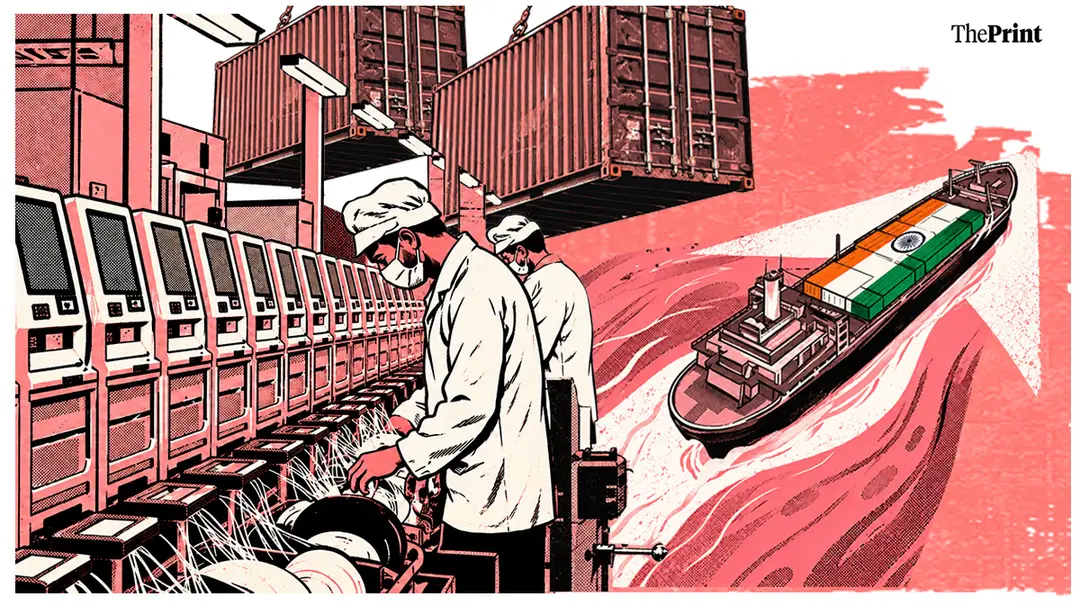
India's merchandise exports up 17% in April-July, says analysis
India's merchandise exports reached $173.8 billion in April-July, up 17 percent year-on-year, with July's $44.2 billion the highest on record, according to an analysis. Exports grew 0.93 percent to $441.8 billion in the previous fiscal year. The authors cite four drivers: the rupee at its cheapest in real trade-weighted terms since February 2014, the India-UK trade agreement now in force, global buyers de-risking China, and Western rearmament straining domestic defence capacity.
Source
ThePrint — India · read the original report ↗
Desk check · some claims need care
What the desk checked (5)
- India's merchandise exports in April-July were $173.8 billion, up 17 percent year-on-year, with July at a record $44.2 billion. — Figures appear in source; no issuing agency named for the trade data.
- Rupee stood at 90.4 on RBI's 6-currency REER in July 2026, 14.3 percent below the November 2024 peak of 105.4. — Attributed in source to the Reserve Bank of India's real effective exchange rate series.
- India-UK CETA came into force on 15 July with UK removing duties on 99 percent of Indian tariff lines; India-EU FTA concluded 27 January 2026, signature expected by 2026-end. — Stated in source without document citation; EU signature and implementation are projections, not completed events.
- Indian defence exports hit a record Rs 38,424 crore in FY26, up 62.7 percent, with private sector at 45 percent. — Figure appears in source; no government release cited.
- US Supreme Court struck down IEEPA tariffs on 20 February, followed by a Section 301 forced-labour duty of 10-12.5 percent from 24 July. — Specific legal claims presented without case citation; high-impact and should be verified independently.
Analysts’ view opinion
Merchandise exports of $173.8 billion in April-July, up 17 percent, with a record $44.2 billion July, mark a clear break from last fiscal year's near-flat 0.93 percent growth to $441.8 billion. The driver is not faster world trade but a rising Indian share of it: a rupee at its cheapest in real trade-weighted terms since February 2014, the UK trade deal now live, buyers de-risking away from China, and higher Western defence spending. Any one of these would be a good year; together they could amount to a shift in regime.
- A cheaper real exchange rate is a windfall for exporters but a cost for importers and consumers, since oil and component imports get dearer in rupee terms.
- Because this boost came without needing a single new policy decision, it is cheap growth — but it can unwind just as quietly if the currency firms again.
- The UK agreement lowers a tariff wall, yet how much reaches company earnings depends on whether exporters actually claim preferential rates, a firm-level question rather than a macro one.
- China de-risking plus capacity limits in Western defence and grid spending can feed Indian engineering and manufacturing order books, supporting jobs in those chains.
- India's gain rests on world trade merely holding up; renewed shipping disruption or chokepoint politics could slow the momentum.
What to watch — Watch whether the export run-rate holds in coming months, whether the real effective exchange rate stays near current levels, and how far utilisation of UK deal concessions actually rises.
The story does not quantify how much each of the four factors contributed, and an analytical explanation is not proof that the surge is durable.
Deep dive
Research brief · 8 facts · 10 dates · exam-readyThe brief
Context
An analysis by Nandita Rajhansa and Saurabh Mukherjea of Marcellus Investment Managers argues that India's merchandise exports have entered a new regime in FY27 after a flat FY26. Exports hit $173.8 billion in April-July, up 17 percent year-on-year, with July's $44.2 billion the highest July figure on record. The authors attribute the shift to four simultaneous changes: a real-terms cheap rupee, new trade agreements with the UK (in force) and the EU (concluded), global buyers de-risking from China, and Western rearmament outstripping domestic defence industrial capacity. The piece also flags risks: an unsigned US bilateral deal, low FTA utilisation, currency reversal, shipping chokepoints and carbon border taxes.
Key facts
- Merchandise exports in April-July were $173.8 billion, up 17 percent year-on-year; the June quarter alone was $129.3 billion, up 16 percent.
- July's exports of $44.2 billion were the highest July figure on record, beating the previous July peak of $38.3 billion in 2022.
- In FY26 merchandise exports grew just 0.93 percent to $441.8 billion; March 2026 exports shrank 7.4 percent when the Strait of Hormuz closed.
- On the RBI's 6-currency REER, the rupee stood at 90.4 in July 2026 — 14.3 percent below the November 2024 peak of 105.4 and 11 percent below its 10-year average of 101.5; spot USD/INR around 94.4.
- India-UK CETA came into force on 15 July this year; the UK removed duties on 99 percent of Indian tariff lines on Day 1, with 50-plus consignments worth over $140 million shipping on day one.
- India-EU FTA concluded 27 January 2026: preferential access on 97 percent of tariff lines covering 99.5 percent of India's export value; FY25 bilateral goods trade was $136.5 billion, with India exporting $75.9 billion.
- Exports to China in April-July rose to $7.78 billion from $5.72 billion, while exports to the US barely moved, from $33.48 billion to $34.49 billion.
- Defence exports hit a record Rs 38,424 crore in FY26, up 62.7 percent, with the private sector contributing 45 percent and registered defence exporters rising to 145 from 128.
Timeline
- February 2014Last month before now that the rupee was as cheap in real trade-weighted terms, in the wake of the taper tantrum.
- November 2024RBI 6-currency REER cycle peaks at 105.4.
- March 2025REER breaks below the fair-value line of 100.
- 2025India hit with a 25 percent US reciprocal tariff, doubled to 50 percent over Russian oil purchases.
- 2025World merchandise trade volumes grew 4.6 percent; world goods exports reached $26.26 trillion, up 7 percent. European allies and Canada raised defence spending nearly 20 percent in real terms.
- 27 January 2026India-EU FTA concluded after nearly two decades of negotiation.
- 20 February 2026US Supreme Court strikes down IEEPA tariffs, invalidating the 18 percent reciprocal rate India had negotiated.
- 11 March 2026Section 301 investigation into manufacturing overcapacity opened, covering 16 economies including India.
- March 2026Exports shrank 7.4 percent as the Strait of Hormuz closed.
- May 2026REER touches a low of 88.1.
Who has a stake
- Indian export manufacturers (textiles, auto ancillaries, precision engineering, pharma and pharma ancillaries) — Identified as the clearest beneficiaries of the EU and UK agreements and of global demand shifts.
- Union Commerce Minister Piyush Goyal / Government of India — Reiterated India will not sign the US bilateral deal until terms give Indian exporters an edge over competitors.
- Reserve Bank of India — Its 6-currency REER is the benchmark showing the rupee at its cheapest in real terms since February 2014.
- Indian IT services firms — Growth decelerating from double digits to mid-single digits; TCS alone removed some 12,200 roles in FY26 amid H-1B fee risk and AI.
- Indian defence and aerospace component suppliers — Western rearmament capacity constraints create orders; US is the single largest destination for Indian defence exports.
- Competing exporters — Bangladesh, Vietnam, Mexico, ASEAN — Bangladesh retains EBA access to 2029, Vietnam has an EU deal since 2020, ASEAN drew a record $225 billion FDI in 2025.
- United States administration / importers — US remains India's largest single export market; legal basis for tariffs rebuilt twice this year and bilateral deal unsigned.
- World Trade Organisation — Its 2026 baseline projects 1.9 percent volume growth recovering to 2.6 percent in 2027, with Middle East conflict the swing factor.
Why it matters
India's share of world merchandise trade is still under 2 percent and goods exports have slipped from 14.1 percent of GDP in FY23 to 12.1 percent in FY25, so a sustained export upcycle would mark a break from five decades of missed manufacturing opportunity. The authors argue that for the first time in 50 years the exchange rate, market access and global demand are aligned — but the gains depend on low FTA utilisation improving, the US arrangement settling and chokepoint and carbon-border risks staying contained.
UPSC angle
Prelims pointers
- India-UK CETA, India's only comprehensive agreement with a G7 economy, entered into force on 15 July 2026; UK removed duties on 99 percent of Indian tariff lines on Day 1.
- India-EU FTA concluded 27 January 2026; EU offered preferential access on 97 percent of tariff lines covering 99.5 percent of India's export value.
- REER (Real Effective Exchange Rate): RBI's 6-currency trade-weighted index; fair-value line is 100; July 2026 reading 90.4.
- Electronics exports rose from Rs 38,000 crore a decade ago to Rs 4.24 lakh crore in FY26, now India's third-largest export category.
- Manufacturing value added was 12.5 percent of Indian GDP in 2024, down from roughly 17 percent in 2010; manufactures were 67 percent of merchandise exports in 2024.
- Carbon border levies: UK carbon border tax from January 2027 on steel, aluminium, cement; EU has its CBAM and deforestation rules.
Mains framing
India's export record shows a structural failure: despite a large, young workforce, manufacturing value added fell from about 17 percent of GDP in 2010 to 12.5 percent in 2024, manufactures slipped from 79 percent of merchandise exports in 1999 to 67 percent in 2024, and India's share of world merchandise trade remains under 2 percent. The analysis argues FY27 marks a regime change driven by four simultaneous forces — a rupee at its cheapest real trade-weighted level since February 2014 after a decade of mild Dutch disease sustained by the IT services surplus; market access via the India-UK CETA (in force 15 July) and the concluded India-EU FTA; China+1 rerouting visible in shipment data, with India at roughly a quarter of global iPhone production and about 8 percent of the EMS market; and Western rearmament, with allied defence spending up nearly 20 percent in real terms in 2025 to over $574 billion, spilling orders to Indian suppliers. The constraints are equally concrete: domestic value addition in electronics is only 18-20 percent against about 40 percent in China; GTRI estimates Indian exporters claim preferences on only 20-30 percent of eligible exports versus 60-70 percent for those selling into India; the US bilateral agreement is unsigned with a Section 301 overcapacity probe live; and chokepoints plus carbon border taxes can erase tariff gains. The way forward implied is deepening value addition, raising FTA utilisation, building compliance capacity for CBAM-type rules, and completing a favourable US arrangement.
Key terms
- REER (Real Effective Exchange Rate)
- Trade-weighted, inflation-adjusted measure of a currency's value; RBI's 6-currency index has 100 as the fair-value line.
- Dutch disease
- When a boom in one sector strengthens the currency sharply, making other export sectors less competitive — here India's IT services surplus hurting manufacturers.
- India-UK CETA
- Comprehensive Economic and Trade Agreement, India's only comprehensive pact with a G7 economy, in force from 15 July 2026.
- IEEPA tariffs
- US tariffs under the International Emergency Economic Powers Act, struck down by the US Supreme Court on 20 February 2026.
- CBAM / carbon border tax
- EU's Carbon Border Adjustment Mechanism and the UK's equivalent levy on carbon-intensive imports like steel, aluminium and cement.
- Everything But Arms (EBA)
- EU scheme giving least-developed countries duty-free access; Bangladesh retains it through a transition running to November 2029.
Practice questions
- India's merchandise exports rose 17 percent in April-July after a flat FY26. Examine the factors behind this turnaround and assess how sustainable they are.
- "India does not need world trade to accelerate; it needs world trade to hold up while its share rises." Critically discuss in the light of recent global trade data and WTO projections.
- Free trade agreements deliver benefits only when utilised. Discuss the challenge of low preference utilisation by Indian exporters and suggest measures to address it.
Grounded only in the source report — figures and dates are the source's, not inferred.