
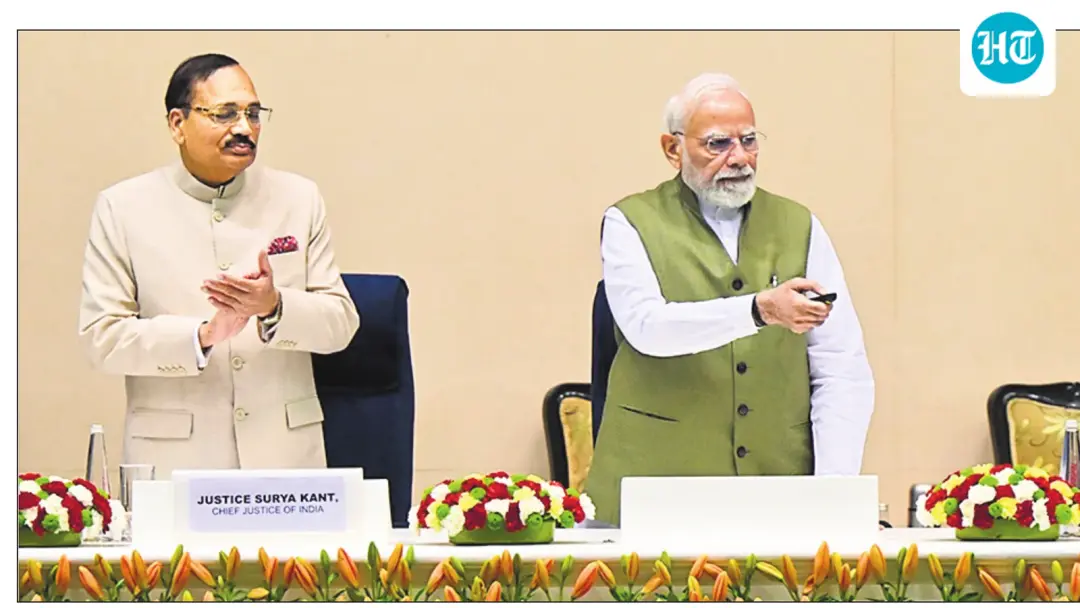
Modi says developing nations unjustly blamed for carbon emissions
Prime Minister Narendra Modi said on Saturday that developing countries are unjustly blamed for carbon emissions, noting India's per-capita emissions are less than half the global average while developed nations emit up to six times more. He was inaugurating the International Conference on 'The Future of Environment and Climate Dynamics' at Vigyan Bhawan, where he launched the NGT mobile application. Modi said solar capacity rose from about 2 GW in 2014 to over 160 GW. Environment minister Bhupender Yadav said non-fossil sources form 54.18% of installed capacity.
Source
Hindustan Times — India · read the original report ↗
Desk check · compared with the source
What the desk checked (5)
- Developing nations are unjustly blamed though developed nations emit up to six times more carbon per capita than India; India's per-capita emissions are less than half the global average. — Directly attributed to PM Narendra Modi in the source; figures appear as his statement, not independently verified.
- India's solar capacity rose from about 2 GW in 2014 to over 160 GW now. — Figure appears in source, attributed to Modi's speech.
- Electric vehicles increased 950-fold, from under 3,000 before 2014 to 2.5 million last year. — Attributed to Modi; source provides no independent data.
- Non-fossil sources account for 54.18% of installed electricity capacity, surpassing the 2030 target of 50% nine years early. — Attributed to Union environment minister Bhupender Yadav in the source.
- The conference involves stakeholders from 17 countries, UNEP and ADB; President Droupadi Murmu to attend the valedictory session on Sunday. — Stated as fact in source without named official attribution; scheduled event, subject to change.
Analysts’ view opinion
This is a political argument delivered in the form of a climate speech. By leading with per-capita emissions, Prime Minister Modi shifts India from the dock to the position of aggrieved party and problem-solver — reinforcing his image as a voice for the Global South. Framing the numbers (solar capacity from 2 GW to over 160 GW, non-fossil share at 54.18%) as targets met ahead of schedule also carries a clear domestic message.
- The phrase "unjustly blamed" is a bid for moral high ground in global negotiations, redirecting responsibility toward developed economies.
- Every statistic benchmarked to 2014 works as a before-and-after domestic political message, even when delivered from an international stage.
- Citing platforms like the International Solar Alliance and Global Biofuel Alliance positions India as a rule-shaper rather than a rule-taker on climate.
- The presence of the CJI, Attorney General and NGT chairperson lends institutional weight to the government's case, though the judicial remarks focused on environmental jurisprudence rather than emissions politics.
- The Opposition is unlikely to contest clean-energy numbers head-on; friction is more probable on air quality and local environmental clearances.
What to watch — Watch the President's valedictory remarks on Sunday, and how forcefully India carries this per-capita equity argument into forthcoming international climate negotiations.
The story reports claims and figures made from a government platform; it does not establish independent verification, nor does it carry Opposition or foreign reaction.
Deep dive
Research brief · 8 facts · 5 dates · exam-readyThe brief
Context
Prime Minister Narendra Modi inaugurated an International Conference on "The Future of Environment and Climate Dynamics" at Vigyan Bhawan, Delhi, where he launched the National Green Tribunal's mobile application. Speaking at the event, he argued that the global narrative on carbon footprints is flawed because developing nations are blamed despite far lower per-capita emissions than developed countries. The conference, attended by the Chief Justice of India, the Attorney General, the Union environment minister and the NGT chairperson, brings together jurists, academics and experts from 17 countries along with UNEP and the Asian Development Bank, with President Droupadi Murmu due at the valedictory session on Sunday.
Key facts
- Modi said India's per-capita carbon emissions are "less than half of the global average", while developed nations emit up to six times more per capita than India.
- He said India is the only G20 country to have fulfilled all commitments made at the Paris COP-21 well ahead of time.
- India's solar capacity rose from around 2 GW in 2014 to over 160 GW currently, aided by PM Surya Ghar Muft Bijli Yojana and PM Kusum.
- Electric vehicles saw a 950-fold increase, from under 3,000 before 2014 to 2.5 million last year.
- Wind capacity has grown threefold, with hydro expansion and nuclear power now open to private players, Modi said.
- Around 5,000 km of inland waterways have been operationalised; one standard inland vessel can carry the load of dozens of trucks.
- Environment minister Bhupender Yadav said non-fossil sources form 54.18% of installed electricity capacity, beating the 2030 target of 50% nine years early.
- Participants come from 17 countries, along with the United Nations Environment Programme and the Asian Development Bank.
Timeline
- 2014 (and before)Baseline year cited by Modi: solar capacity around 2 GW; electric vehicles under 3,000.
- COP-21, ParisIndia made climate commitments; the book "Convenient Action - Continuity for Change" was launched.
- RecentlyIndia's first hydrogen train, described as the world's longest such train, was flagged off.
- SaturdayModi inaugurates the International Conference on 'The Future of Environment and Climate Dynamics' at Vigyan Bhawan and launches the NGT mobile application.
- SundayPresident Droupadi Murmu to take part in the conference's valedictory session.
Who has a stake
- Prime Minister Narendra Modi — Asserting that the global carbon footprint narrative is flawed and projecting India's clean energy record internationally.
- Developing countries — Face blame for emissions despite lower per-capita output; equity in global climate burden-sharing.
- National Green Tribunal (NGT) — Its chairperson Justice Prakash Shrivastava attended; a new NGT mobile application was launched to aid access.
- Supreme Court / CJI Surya Kant — Custodian of environmental jurisprudence, including the right to a pollution-free environment as a fundamental right.
- Ministry of Environment (Bhupender Yadav) — Reporting non-fossil capacity of 54.18%, ahead of the 2030 target of 50%.
- UNEP and Asian Development Bank — International organisations participating in the conference alongside delegates from 17 countries.
- Farmers and households — Beneficiaries of PM Surya Ghar Muft Bijli Yojana and the PM Kusum scheme driving solar expansion.
Why it matters
The per-capita emissions argument is central to India's negotiating position in global climate talks, where questions of historical responsibility and equity decide who must cut how much. Modi's claims of early achievement of Paris-era goals and a 54.18% non-fossil share strengthen India's case that development and sustainability can advance together. The presence of the CJI, UNEP and ADB also signals that environmental governance in India is increasingly a joint judicial-executive-international conversation.
UPSC angle
Prelims pointers
- India's non-fossil sources account for 54.18% of installed electricity capacity, surpassing the 50% target set for 2030.
- Solar capacity: around 2 GW (2014) to over 160 GW (currently); EVs: under 3,000 (pre-2014) to 2.5 million last year.
- India-linked global platforms named: One Sun One World One Grid, International Solar Alliance, CDRI, Global Biofuel Alliance, International Big Cat Alliance.
- Schemes driving solar growth: PM Surya Ghar Muft Bijli Yojana and PM Kusum (for farmers).
- Judicial principles cited by CJI Surya Kant: precautionary principle, polluter pays, absolute liability, public trust doctrine.
- NGT mobile application launched by the PM at the International Conference on 'The Future of Environment and Climate Dynamics', Vigyan Bhawan.
Mains framing
India's climate diplomacy rests on the equity argument that per-capita emissions, not aggregate output, are the fair yardstick: Modi's assertion that India's per-capita emissions are less than half the global average while developed nations emit up to six times more restates the principle of differentiated responsibility that developing countries have long defended. The domestic record he cited - solar capacity rising from about 2 GW in 2014 to over 160 GW, a threefold rise in wind, a 950-fold increase in EVs to 2.5 million, nuclear opened to private players, 5,000 km of operational inland waterways and the first hydrogen train - is offered as proof that mitigation need not slow growth, reinforced by the environment ministry's claim of 54.18% non-fossil installed capacity nine years ahead of the 2030 target. Implications are twofold: it strengthens India's bargaining position on finance and technology transfer, and it places the onus of deeper cuts on historical emitters. Yet installed capacity is not the same as generation or actual emissions reduction, and judicial doctrines highlighted by CJI Surya Kant - precautionary principle, polluter pays, absolute liability, public trust - remain essential to hold implementation to account. The way forward lies in converting capacity into delivered clean power, strengthening institutions such as the NGT (including digital access via its new app), and using platforms like the International Solar Alliance, CDRI and the Global Biofuel Alliance to push equity-based cooperation.
Key terms
- Per-capita emissions
- Carbon emissions divided by population; the metric India uses to argue its climate burden is smaller than that of developed nations.
- National Green Tribunal (NGT)
- Specialised environmental adjudication body, chaired by Justice Prakash Shrivastava; a mobile app for it was launched at the conference.
- COP-21 (Paris)
- UN climate conference where India made commitments Modi says it fulfilled ahead of time; also where his book "Convenient Action" was launched.
- Non-fossil installed capacity
- Electricity capacity from renewables, hydro and nuclear; now 54.18% in India, past the 50% goal set for 2030.
- One Sun, One World, One Grid
- India-backed initiative for interconnected global solar power grids, cited among India's climate platforms.
- Polluter pays principle
- Legal principle, cited by CJI Surya Kant, that the party causing pollution bears the cost of remedying environmental damage.
Practice questions
- Critically examine the per-capita emissions argument used by India in global climate negotiations. Does it adequately address concerns about rising aggregate emissions?
- India's non-fossil sources now form 54.18% of installed electricity capacity, ahead of its 2030 target. Discuss the gap between installed capacity and actual clean power generation.
- Evaluate the role of the National Green Tribunal and Supreme Court doctrines such as polluter pays and the public trust doctrine in shaping India's environmental governance.
Grounded only in the source report — figures and dates are the source's, not inferred.