
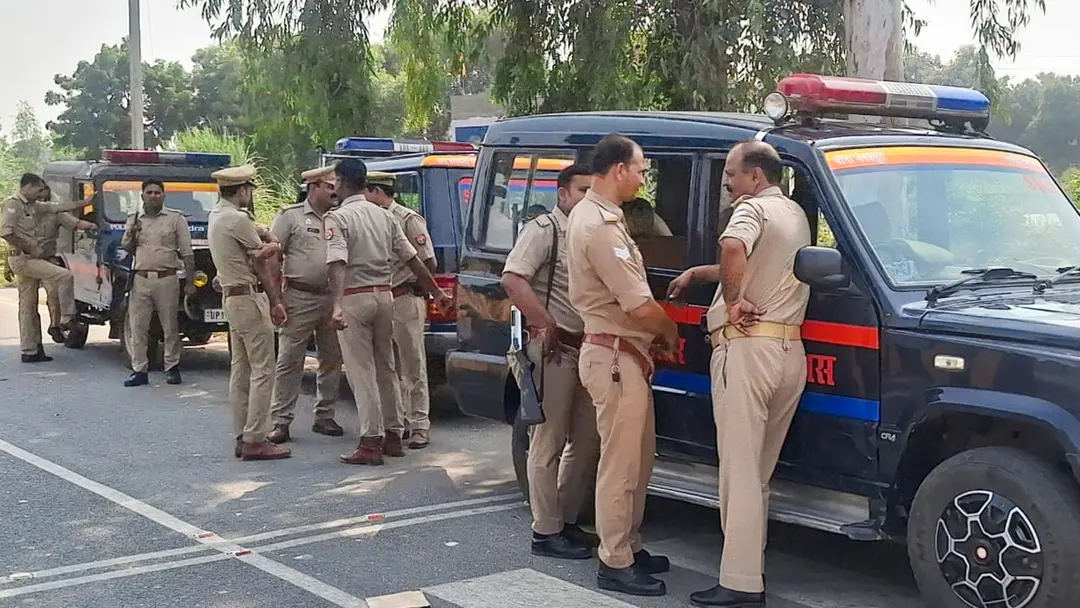
Maoist commander with ₹30 lakh bounty killed in Varanasi encounter
Jharkhand-based Maoist commander Brijesh Ganjhu, alias Gopal Singh, who carried a ₹30 lakh bounty, was killed in an encounter with police in Varanasi, Uttar Pradesh, on Sunday morning. He headed the banned Tritiya Prastuti Committee (TPC), a splinter group of the CPI (Maoist). The Jharkhand government had announced ₹25 lakh and the NIA ₹5 lakh for him. A police officer said Ganjhu opened fire when intercepted; bullets hit the bulletproof jackets of UP ATS deputy SP Vipin Rai and head constable Nitendra Krishna.
Source
Hindustan Times — India · read the original report ↗
Desk check · compared with the source
What the desk checked (5)
- Brijesh Ganjhu alias Gopal Singh, TPC chief, carried a combined ₹30 lakh bounty (₹25 lakh Jharkhand government, ₹5 lakh NIA). — Figures appear in source and are internally consistent; attributed to Jharkhand government and NIA announcements.
- He was killed in an encounter near Tengara Mod in Varanasi on Sunday morning. — Stated in source; source elsewhere spells the spot 'Teghra Mod', an internal inconsistency in place name.
- Ganjhu jumped from the motorcycle and opened fire before being shot in the exchange. — Attributed to an unnamed police officer; no independent account in source.
- Bullets struck bulletproof jackets of UP ATS deputy SP Vipin Rai and head constable Nitendra Krishna. — Named officials given in source; no separate attribution for the detail.
- TPC is a banned splinter group of CPI (Maoist) and NIA had declared Ganjhu wanted in several cases. — Background stated in source without citation.
Analysts’ view opinion
In law, a death in an encounter is not a closure but the trigger for a mandatory inquiry process. Under Supreme Court-laid guidelines, every death caused by police firing calls for an independent investigation, a magisterial inquiry and intimation to the human rights commission as standard procedure. At the same time, if the stated sequence — firing at police, bullets striking two bulletproof jackets — is borne out by evidence, the officers have available to them the legal defences of self-defence and force reasonably used while effecting an arrest.
- What exists so far is the police account alone; the burden of corroborating it falls on an independent probe.
- The post-mortem report, ballistic matching, scene-of-crime evidence and the injured officers' medical records will be the decisive material.
- A bounty and an NIA wanted listing are not findings of guilt; the cases against him now abate with the death of the accused.
- The status of the associate travelling with him — arrested or absconding — is not stated; if arrested, custody, remand and legal-aid rights attach immediately.
- Because a Jharkhand-based accused died in Uttar Pradesh, procedural questions of inter-state coordination, transfer of cases and NIA jurisdiction come into play.
What to watch — Watch whether an FIR is registered and against whom, under which sections, whether a magisterial inquiry is ordered, and whether ballistic and post-mortem findings align with the police narrative.
The sequence of events has not been independently verified — the account rests on the police version, and the story does not establish whether any inquiry has been initiated.
Deep dive
Research brief · 8 facts · 4 dates · exam-readyThe brief
Context
Brijesh Ganjhu, alias Gopal Singh, chief of the banned Tritiya Prastuti Committee (TPC) — a splinter group that emerged from the CPI (Maoist) — was killed in an encounter with police in Varanasi, Uttar Pradesh, on Sunday morning. A resident of Lutu village under Lawalong police station in Jharkhand's Chatra district, he carried a combined bounty of ₹30 lakh and had been declared wanted by the National Investigation Agency (NIA) in several cases. Police, acting on a tip-off, tried to intercept him as he travelled by motorcycle through Varanasi's Ramnagar area; he opened fire and was shot in the exchange.
Key facts
- Brijesh Ganjhu, alias Gopal Singh, chief of the banned Tritiya Prastuti Committee (TPC), was killed in a police encounter in Varanasi, Uttar Pradesh, on Sunday morning.
- He carried a combined bounty of ₹30 lakh: ₹25 lakh announced by the Jharkhand government and ₹5 lakh by the National Investigation Agency (NIA).
- The NIA had declared Ganjhu wanted in several cases.
- The TPC is a splinter group that emerged from the CPI (Maoist) and is banned in Jharkhand.
- Ganjhu was a resident of Lutu, under Lawalong police station, Chatra district, Jharkhand.
- The encounter took place near Tengara Mod, in the Lanka Maidan area under Ramnagar police station jurisdiction in Varanasi.
- Police said he was riding a motorcycle with an associate from Teghra Mod towards Mughalsarai via Ramnagar when police tried to intercept him.
- Bullets fired by him struck the bulletproof jackets of UP Anti Terror Squad (ATS) deputy SP Vipin Rai and head constable Nitendra Krishna; Rai is undergoing treatment.
Timeline
- Before the encounter (date not stated in the source)Jharkhand government announces ₹25 lakh reward for information leading to Ganjhu's arrest; NIA adds ₹5 lakh and declares him wanted in several cases.
- Sunday morningActing on a tip-off, police attempt to intercept Ganjhu as he travels by motorcycle with an associate through the Lanka Maidan area of Varanasi.
- Sunday morningGanjhu jumps out of the vehicle and opens fire; in the exchange he is shot, and bullets hit the bulletproof jackets of two police personnel.
- Sunday morningGanjhu is rushed to hospital and declared dead on arrival; deputy SP Vipin Rai remains under treatment.
Who has a stake
- Uttar Pradesh Anti Terror Squad (ATS) and Varanasi police — Conducted the interception and encounter; deputy SP Vipin Rai and head constable Nitendra Krishna were hit on their bulletproof jackets.
- Jharkhand government — Had banned the TPC and announced a ₹25 lakh reward for Ganjhu; the killing removes a top wanted commander operating from its territory.
- National Investigation Agency (NIA) — Had declared Ganjhu wanted in several cases and announced a ₹5 lakh reward.
- Tritiya Prastuti Committee (TPC) — Loses its chief; the banned CPI (Maoist) splinter group faces a leadership vacuum.
- Residents of Chatra district and the Jharkhand-UP corridor — Directly affected by the operations and violence of banned left-wing extremist outfits in the region.
Why it matters
The killing of a ₹30 lakh bounty commander shows how left-wing extremist leadership from Jharkhand's Chatra belt moves into and operates from urban centres such as Varanasi, far from traditional forest strongholds. It also highlights inter-state coordination, with the UP ATS acting on a tip-off against a man wanted by both a state government and the NIA. The role of bulletproof jackets in saving two policemen underlines the importance of protective equipment in such operations.
UPSC angle
Prelims pointers
- Tritiya Prastuti Committee (TPC) is a banned splinter group that emerged from the CPI (Maoist), active in Jharkhand.
- Brijesh Ganjhu alias Gopal Singh, TPC chief, carried a ₹30 lakh bounty — ₹25 lakh from Jharkhand government plus ₹5 lakh from the NIA.
- The National Investigation Agency (NIA) had declared Ganjhu wanted in several cases.
- Ganjhu belonged to Lutu village, Lawalong police station area, Chatra district, Jharkhand.
- The encounter occurred near Tengara Mod, Lanka Maidan area, under Ramnagar police station, Varanasi (UP).
- UP Anti Terror Squad (ATS) deputy SP Vipin Rai and head constable Nitendra Krishna were hit on their bulletproof jackets.
Mains framing
The killing of TPC chief Brijesh Ganjhu in Varanasi illustrates three features of contemporary left-wing extremism in India: fragmentation of the CPI (Maoist) into splinter outfits such as the Tritiya Prastuti Committee, the movement of top cadres out of their core Jharkhand districts like Chatra into neighbouring states and urban areas, and the increasingly inter-state, intelligence-driven nature of counter-extremism policing. Financial instruments — a ₹25 lakh state reward supplemented by ₹5 lakh from the NIA — indicate reliance on informer networks and bounty schemes alongside proscription of organisations. The episode also shows operational realities: interception on a public road, an exchange of fire, and bulletproof jackets that absorbed bullets aimed at a deputy SP and a head constable, pointing to the need for continued investment in protective gear, tip-off verification and joint state-central coordination. The way forward, as suggested by the facts available, lies in sustained inter-state intelligence sharing between Jharkhand and Uttar Pradesh, follow-up investigation into the associate and the outfit's support network, and legal processes that address the cases pending against the outfit's leadership. The source does not state broader policy measures, so any wider claims about rehabilitation or development responses are not stated in the source.
Key terms
- Tritiya Prastuti Committee (TPC)
- A banned organisation in Jharkhand, described as a splinter group that emerged from the CPI (Maoist); Brijesh Ganjhu was its chief.
- CPI (Maoist)
- The parent Maoist organisation from which the TPC split, as stated in the source.
- National Investigation Agency (NIA)
- Central agency that had declared Ganjhu wanted in several cases and announced a ₹5 lakh reward for him.
- Anti Terror Squad (ATS)
- Uttar Pradesh police unit whose deputy SP Vipin Rai and head constable Nitendra Krishna were involved in the encounter.
- Bounty/reward for arrest
- Cash announced for information leading to arrest — here ₹25 lakh by Jharkhand and ₹5 lakh by the NIA, totalling ₹30 lakh.
Practice questions
- Discuss how the fragmentation of the CPI (Maoist) into splinter outfits such as the Tritiya Prastuti Committee has changed the nature of left-wing extremism and the policing response to it.
- Examine the role of inter-state intelligence coordination and central agencies like the NIA in tackling extremist networks that operate across state boundaries.
- How effective are cash reward schemes for information leading to the arrest of wanted extremist leaders? Illustrate with reference to the Brijesh Ganjhu case.
Grounded only in the source report — figures and dates are the source's, not inferred.