
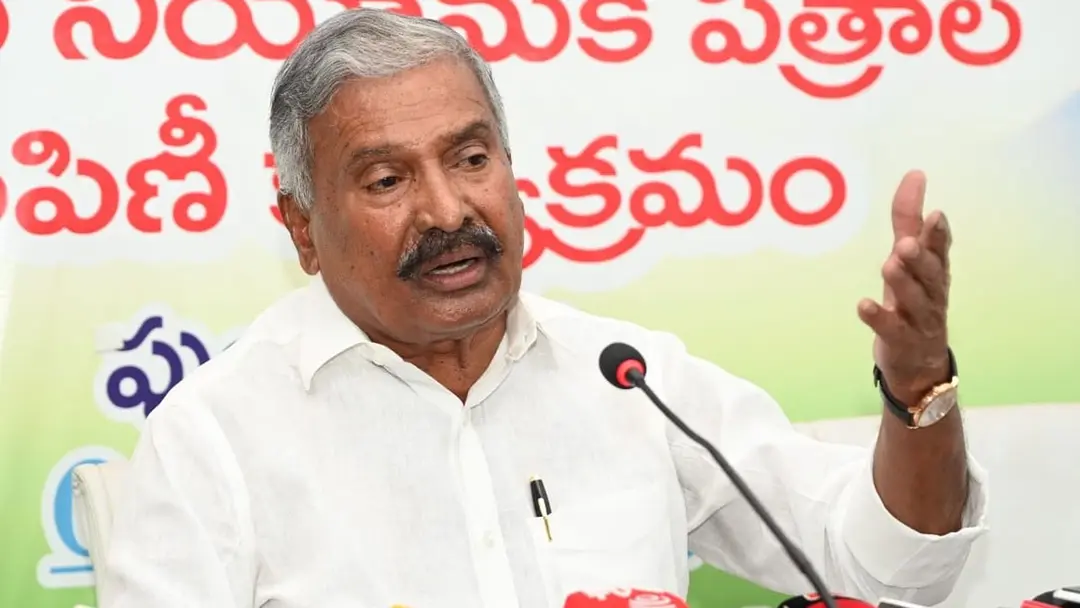
Punganur municipal chairman, 12 councillors join TDP
Punganur municipal chairman Aleem Basha and 12 councillors resigned their YSRCP primary membership and joined the Telugu Desam Party at an event held at the residence of TDP in-charge Challa Ramachandra Reddy. In the 31-member municipality, more councillors are said to be preparing to join within a week. The chairman alleged that although YSRCP gave them posts, power rested with former minister Peddireddy Ramachandra Reddy. Challa alleged people were tired of 25 years of Peddireddy family rule.
Source
Punganur — crime & civic · read the original report ↗
Desk check · some claims need care
What the desk checked (5)
- Punganur municipal chairman Aleem Basha and 12 councillors joined the TDP at TDP in-charge Challa Ramachandra Reddy's residence. — Figure and names appear in the source; no official party statement or document cited.
- Punganur municipality has 31 members in total. — Figure appears in source; no source or record cited for it.
- More councillors are expected to join the TDP within a week. — Presented as unattributed expectation ('it is learnt'); speculative.
- The chairman alleged that posts were given in YSRCP but all power stayed with Peddireddy Ramachandra Reddy. — Attributed to the chairman speaking to the media; allegation, not verified fact.
- Challa Ramachandra Reddy alleged 25 years of Peddireddy family rule and dictatorial conduct in the district. — Attributed political allegation; no independent evidence in source.
Analysts’ view opinion
This is a textbook post-election consolidation move: with the TDP-led side now in office in Andhra Pradesh, a YSRCP municipal chairman and 12 councillors have switched, and in a 31-member body that puts control of Punganur municipality within TDP's reach. The symbolic value is larger than the arithmetic, because Punganur is the political home turf of former minister Peddireddy Ramachandra Reddy, and the defectors have framed their exit as a revolt against one family's grip rather than a policy disagreement. For YSRCP, losing local office holders so soon after a general election defeat signals an erosion of the incentive structure that holds local leaders in an opposition party.
- The timing points to power, not ideology: defections of this kind typically follow a change of government, when local leaders calculate that access to funds and administration lies with the ruling side.
- With 13 of 31 members moved and more claimed to be in the pipeline, TDP's local in-charge Challa Ramachandra Reddy is positioning himself as the constituency's new power centre against the Peddireddy family.
- The chairman's stated grievance — posts without real power — is the classic script of local defectors, and is impossible to verify from the story, but it is politically potent because it targets a rival's alleged personal dominance rather than a party's programme.
- For YSRCP the risk is contagion: once a chairman moves, remaining councillors face pressure to follow or be left without leverage, and the party has not yet responded on the record here.
- Watch also the attempt to open a second front by questioning YSRCP's parliamentary stance towards the BJP-led alliance — an effort to paint the opposition as inconsistent at the national level too.
What to watch — Watch whether the promised additional councillor switches materialise within the stated week and whether any formal change of control or legal and anti-defection challenge follows at Punganur municipality, plus YSRCP's and Peddireddy's own response.
The story rests largely on the claims of those who switched and of the local TDP in-charge; it does not establish YSRCP's or Peddireddy Ramachandra Reddy's response, the legal status of the defections, or that control of the municipality has actually changed hands.
Deep dive
Research brief · 8 facts · 4 dates · exam-readyThe brief
Context
Punganur, an assembly constituency in Andhra Pradesh's Chittoor region, has long been the political base of YSR Congress Party (YSRCP) senior leader and former minister Peddireddy Ramachandra Reddy. Following the change of political fortunes in the State, the municipal chairman of Punganur, Aleem Basha, along with 12 municipal councillors, resigned their YSRCP primary membership and joined the Telugu Desam Party (TDP) on June 27, 2024. The switch took place at the residence of local TDP in-charge Challa Ramachandra Reddy, Peddireddy's long-time rival in the constituency. TDP ranks now expect to take control of the 31-member Punganur municipality.
Key facts
- Punganur municipal chairman Aleem Basha and 12 municipal councillors joined the TDP after resigning YSRCP primary membership.
- The Punganur municipality has a total of 31 members.
- The defections took place at the residence of local TDP in-charge Challa Ramachandra Reddy.
- More councillors are reported to be preparing to join the TDP within a week, according to the source.
- The chairman said that in the YSRCP they were given posts but no power, with all power resting with then minister Peddireddy Ramachandra Reddy.
- The chairman said they could not deliver justice to the people of Punganur during these three years.
- TDP in-charge Challa Ramachandra Reddy alleged people were tired of 25 years of rule by the Peddireddy Ramachandra Reddy family.
- Challa also questioned how MP Mithun Reddy, who until recently criticised the BJP and the NDA alliance, is now supporting the BJP in Parliament.
Timeline
- Past 25 years (as alleged)Challa Ramachandra Reddy alleges the Peddireddy family held sway over Punganur and the district.
- Preceding three yearsChairman Aleem Basha says they held office but could not do justice to Punganur's people.
- June 27, 2024Punganur municipal chairman Aleem Basha and 12 councillors resign YSRCP membership and join the TDP at Challa Ramachandra Reddy's residence.
- Within a week of June 27, 2024 (reported)More councillors said to be ready to switch to the TDP.
Who has a stake
- Aleem Basha, Punganur municipal chairman — Left YSRCP for TDP, alleging he had a post but no real power; his chairmanship and local standing are at stake.
- Peddireddy Ramachandra Reddy, former minister (YSRCP) — Faces erosion of his long-standing hold over Punganur and the district; accused of concentrating power and family rule.
- Challa Ramachandra Reddy, TDP in-charge, Punganur — Credited with the strategy behind the defections; stands to consolidate TDP control over the municipality.
- Telugu Desam Party — Expects to gain control of the 31-member Punganur municipality and strengthen its local organisation.
- YSR Congress Party — Loses its municipal chairman and a bloc of councillors, weakening its hold in a bastion constituency.
- Residents of Punganur — Civic administration and development works depend on which party controls the municipal body.
- MP Mithun Reddy (YSRCP) — Questioned by TDP over supporting the BJP in Parliament after having criticised the BJP and NDA.
Why it matters
Mass defections of an elected municipal chairman and councillors show how local bodies in Andhra Pradesh realign with whichever party holds state power, raising questions about the stability of the popular mandate given in municipal polls. In a 31-member house, 13 crossovers with more expected can flip effective control of the municipality without a fresh election. The episode also frames a wider contest over dominance by a single political family in a constituency and district.
UPSC angle
Prelims pointers
- Punganur is an assembly constituency in Andhra Pradesh associated with former minister Peddireddy Ramachandra Reddy (YSRCP).
- Punganur municipality has 31 members; chairman Aleem Basha and 12 councillors joined the TDP on June 27, 2024.
- Challa Ramachandra Reddy is the TDP in-charge for Punganur.
- Municipal chairpersons in urban local bodies are elected from among councillors; urban local bodies derive their status from the 74th Constitutional Amendment (municipalities).
- Mithun Reddy is an MP named in the story in connection with support to the BJP in Parliament.
- Anti-defection provisions under the Tenth Schedule apply to MPs/MLAs, not to municipal councillors' party switches under it.
Mains framing
The Punganur episode illustrates a recurring feature of Indian local-body politics: once state power changes hands, elected municipal representatives migrate to the ruling party, both to access funds and patronage and to escape political isolation. The stated grievance here — that office was given but real authority remained with a senior minister — points to the deeper problem of centralisation within parties and the weak functional autonomy of urban local bodies, where chairpersons often depend on MLAs and ministers for resources and administrative backing. Consequences include voters' mandates being reversed mid-term without an election, unstable municipal administration, and the entrenchment of family-dominated political networks that opponents allege stifle development. Remedies lie in genuine devolution of funds, functions and functionaries to municipalities so that chairpersons are not dependent on constituency strongmen, greater transparency in municipal finance, and public accountability mechanisms such as ward committees, so that local governance rests on institutional strength rather than proximity to whoever is in power. The source does not state any legal or policy action arising from these defections.
Key terms
- YSRCP (YSR Congress Party)
- Andhra Pradesh political party whose primary membership the Punganur chairman and 12 councillors resigned.
- TDP (Telugu Desam Party)
- Andhra Pradesh party that the Punganur chairman and councillors joined on June 27, 2024.
- Municipal chairman
- Head of a municipality's elected council; in Punganur the post is held by Aleem Basha.
- Party in-charge
- Constituency-level organisational head of a party; Challa Ramachandra Reddy is TDP in-charge for Punganur.
- Primary membership
- Basic membership of a political party; resigning it formally severs ties with the party.
- NDA
- The BJP-led alliance referred to by Challa while questioning MP Mithun Reddy's stance in Parliament.
Practice questions
- Mass defections of councillors after a change in state government undermine the mandate given in urban local body elections. Discuss with reference to the Punganur case.
- To what extent does the dependence of municipalities on MLAs and ministers for funds and patronage defeat the objectives of decentralised urban governance in India?
- Examine how dominance by political families at the district level shapes party competition and development outcomes in Indian states.
Grounded only in the source report — figures and dates are the source's, not inferred.