
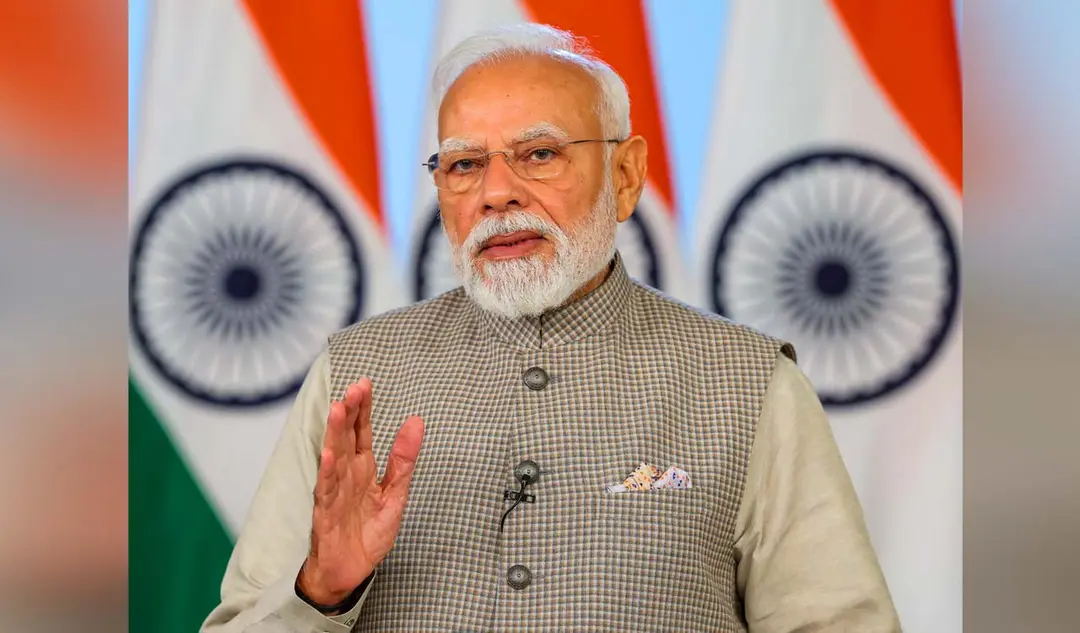
Modi recalls 2016 surgical strikes in Mann Ki Baat address
Prime Minister Narendra Modi said on Sunday in his Mann Ki Baat broadcast that the 2016 surgical strikes were India's decisive response to the pain caused by terror attacks. He said the Indian Army struck terrorist hideouts in Pakistan on September 28-29, 2016, and that India follows a zero-tolerance policy on terrorism, sending a clear message from Balakot to Operation Sindoor. He also spoke on the anti-drugs campaign, cleanliness drives and Ashok Singhal's birth centenary.
Source
Telangana Today · read the original report ↗
Desk check · compared with the source
What the desk checked (5)
- Indian Army carried out surgical strikes on terrorist hideouts in Pakistan on September 28-29, 2016. — Quoted directly from Modi's Mann Ki Baat address in the source.
- The Uri army camp attack in Jammu and Kashmir left 18 soldiers dead. — Figure appears in source as background context, no source attributed.
- Operation Sindoor was launched on May 7 last year in retaliation for the April 22, 2025 Pahalgam attack that killed 26 civilians. — Dates and figure appear in source background; not attributed to a named official.
- India follows a zero-tolerance policy against terrorism. — Attributed to PM Modi in his monthly broadcast.
- Pakistan PM Shehbaz Sharif raised the Kashmir issue at the UN General Assembly two days earlier. — Attributed in source to Sharif's UNGA address; timing stated relative to the broadcast.
Analysts’ view opinion
Marking the tenth anniversary of the 2016 surgical strikes on the Mann Ki Baat platform is not incidental — it consolidates a single narrative of decisive leadership running from Uri to Balakot to Operation Sindoor. By noting that in the past demands for action were allowed to lapse as "time was simply allowed to pass", the message keeps national security on terrain where the BJP is most comfortable. That it comes two days after Pakistan's prime minister raised Kashmir at the UN General Assembly gives it both a diplomatic and a domestic political dividend.
- Using a non-partisan monthly broadcast rather than a party platform lets the message reach a wide audience without looking like overt campaigning.
- Sequencing the post-Uri strikes, Balakot and post-Pahalgam Operation Sindoor builds a continuity story of one consistent decade-long doctrine.
- Criticising earlier approaches without naming any party puts the opposition in an awkward spot, since pushing back risks being framed as soft on security.
- The tributes to Ashok Singhal and the Somnath Swabhiman Parv touch the ideological base, while the reference to his fight against social discrimination signals a broader social outreach.
- The anti-drugs campaign and cleanliness drives form a parallel youth-focused outreach track running alongside the security narrative.
What to watch — Watch how large the official and organisational commemorations around September 28-29 become, and how the opposition chooses to respond.
The story does not establish any specific electoral strategy or party campaign plan, and carries no opposition reaction or evidence of public opinion impact.
Deep dive
Research brief · 8 facts · 10 dates · exam-readyThe brief
Context
In his monthly radio broadcast Mann Ki Baat, Prime Minister Narendra Modi marked the approaching 10th anniversary of the 2016 surgical strikes, calling them India's decisive response to terrorism. The strikes were carried out across the Line of Control on terror camps in Pakistan after terrorists attacked an army camp at Uri in Jammu and Kashmir, killing 18 soldiers. Modi placed the strikes in a decade-long arc of India's counter-terror posture running from the Balakot air strike to Operation Sindoor, launched after the Pahalgam attack. The address came two days after Pakistan PM Shehbaz Sharif raised the Kashmir issue at the UN General Assembly.
Key facts
- Modi said the Indian Army carried out surgical strikes on terrorist hideouts in Pakistan on September 28-29, 2016, marking their 10th anniversary a day after the broadcast.
- The surgical strikes followed a terrorist attack on an army camp at Uri in Jammu and Kashmir in which 18 soldiers died.
- Modi recalled the serial blasts in Delhi on September 13, 2008, and the 26/11 Mumbai attack a few weeks later.
- Operation Sindoor was launched on May 7 last year against terror infrastructure in Pakistan and Pakistan-occupied Kashmir.
- Operation Sindoor was in retaliation for the April 22, 2025 Pahalgam attack that killed 26 civilians.
- Modi noted this year marks 25 years since the 9/11 attacks; after Americans, Indians were the highest number of victims at the World Trade Centre.
- Modi said millions of young people have pledged against substance abuse under the 'Nasha Mukt Yuva Abhiyan'.
- He said Mahmud of Ghazni demolished the Somnath temple for the first time in 1026, a thousand years ago, and referred to the 'Somnath Swabhiman Parv'.
Timeline
- 1026Mahmud of Ghazni demolished the Somnath temple for the first time, as recalled by the PM.
- 2001 (25 years before, per source)9/11 terror attacks; Indians were the largest group of victims at the World Trade Centre after Americans.
- September 13, 2008Serial blasts in Delhi killed many innocent people.
- A few weeks later (2008)The 26/11 attack took place in Mumbai.
- 2014After becoming PM, Modi visited the US and went to New York to pay homage to 9/11 victims.
- September 28-29, 2016Indian Army carried out surgical strikes on terrorist hideouts in Pakistan, after the Uri army camp attack that killed 18 soldiers.
- April 22, 2025Pahalgam attack killed 26 civilians.
- May 7 (last year, per source)India launched Operation Sindoor against terror infrastructure in Pakistan and PoK.
- Two days before the broadcastPakistan PM Shehbaz Sharif raised the Kashmir issue at the UN General Assembly.
- 27 September 2026Modi's Mann Ki Baat address recalling the surgical strikes was published/broadcast.
Who has a stake
- Prime Minister Narendra Modi — Uses Mann Ki Baat to frame a decade of zero-tolerance counter-terror policy from Balakot to Operation Sindoor.
- Indian Army and armed forces — Executed the 2016 cross-LoC surgical strikes and Operation Sindoor; their operations define India's deterrence posture.
- Pakistan and PM Shehbaz Sharif — Accused of cross-border terrorism; Sharif raised Kashmir at the UNGA seeking a 'just and fair solution'.
- Families of terror victims — Victims of Uri, Delhi 2008 blasts, 26/11, Pahalgam and 9/11 were invoked; condolences extended by the PM.
- Indian youth — Central to the 'Nasha Mukt Yuva Abhiyan' anti-drug pledge and to cleanliness drives under 'Swachhata Se Sewa'.
- Vishwa Hindu Parishad and Ashok Singhal's followers — Singhal's birth centenary was marked; PM cited his Ram Mandir movement role and fight against social discrimination.
Why it matters
The PM's framing links a series of military responses — the 2016 surgical strikes, the Balakot air strike and Operation Sindoor — into a declared doctrine of zero tolerance, signalling that cross-border retaliation is now the expected answer to terror attacks. Coming days after Pakistan raised Kashmir at the UNGA, it also underlines the diplomatic contest over Jammu and Kashmir, which India calls an integral and inalienable part of the country. For citizens, the same broadcast ties national security messaging to civic campaigns on drugs and cleanliness.
UPSC angle
Prelims pointers
- Surgical strikes: carried out by the Indian Army on September 28-29, 2016 across the Line of Control after the Uri attack that killed 18 soldiers.
- Operation Sindoor: launched May 7 (last year per source) against terror infrastructure in Pakistan and PoK after the April 22, 2025 Pahalgam attack that killed 26 civilians.
- Mann Ki Baat is the Prime Minister's monthly radio broadcast.
- Nasha Mukt Yuva Abhiyan: youth campaign against drugs and substance abuse; 'Swachhata Se Sewa' covers cleanliness drives.
- Ashok Singhal: Vishwa Hindu Parishad leader associated with the Ram Mandir movement; birth centenary marked in the address.
- Somnath temple was first demolished by Mahmud of Ghazni in 1026; 'Somnath Swabhiman Parv' was celebrated this year.
Mains framing
India's counter-terror posture over the past decade has shifted from diplomatic protest to declared military retaliation, a trajectory the Prime Minister traced from the 2016 cross-LoC surgical strikes after Uri, through the Balakot air strike, to Operation Sindoor launched after the Pahalgam attack that killed 26 civilians. The causes lie in a long history of mass-casualty attacks — the September 13, 2008 Delhi serial blasts, 26/11 in Mumbai, Uri's 18 soldiers — where, as the PM put it, demands for action were earlier 'not given due attention'. The implications are twofold: a credible deterrence signal and a raised risk of escalation, evident in Pakistan's use of the UNGA podium to seek a 'just and fair solution' to Kashmir and to invoke the 'conflict of 2025', which India rejects by restating that Jammu and Kashmir is an integral and inalienable part of the country. A sustainable way forward, on the source's own terms, combines calibrated military response with diplomatic rebuttal at multilateral forums and domestic resilience-building — the anti-drug 'Nasha Mukt Yuva Abhiyan' and community cleanliness drives cited in the same broadcast show how security messaging is being woven into a wider civic mobilisation of youth.
Key terms
- Surgical strikes
- Targeted cross-border action by the Indian Army on terrorist hideouts in Pakistan on September 28-29, 2016, after the Uri attack.
- Line of Control (LoC)
- The de facto military line in Jammu and Kashmir that Indian soldiers crossed to carry out the 2016 strikes.
- Operation Sindoor
- Indian operation launched on May 7 targeting terror infrastructure in Pakistan and PoK after the Pahalgam attack.
- Mann Ki Baat
- Prime Minister Modi's monthly radio broadcast to citizens, used here for the surgical strikes anniversary message.
- Nasha Mukt Yuva Abhiyan
- Campaign under which millions of young people pledge to stay away from drugs and spread the anti-drug message.
- Somnath Swabhiman Parv
- Commemoration marking a thousand years since Mahmud of Ghazni first demolished the Somnath temple in 1026.
Practice questions
- Trace the evolution of India's counter-terrorism response from the 2016 surgical strikes to Operation Sindoor. Does a 'zero tolerance' doctrine strengthen deterrence or heighten escalation risk?
- Pakistan continues to internationalise the Kashmir issue at the UN General Assembly. Examine India's consistent diplomatic response and its effectiveness.
- Discuss how national campaigns such as the Nasha Mukt Yuva Abhiyan and community-led cleanliness drives mobilise youth participation in nation-building.
Grounded only in the source report — figures and dates are the source's, not inferred.