
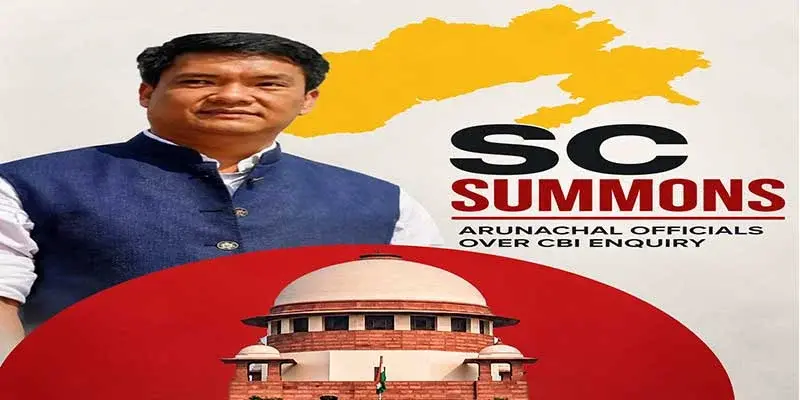
Supreme Court summons Arunachal officials over CBI probe non-cooperation
The Supreme Court on Monday issued notices to Arunachal Pradesh's Chief Secretary and Principal Secretary (Home) after the CBI reported non-cooperation from state authorities in a preliminary enquiry into allegations that public works contracts went to firms linked to relatives of Chief Minister Pema Khandu. A bench of Justices Vikram Nath and Sandeep Mehta ordered both officials to appear personally on August 24. Its April 6 order covers contracts issued between January 1, 2015 and December 31, 2025. The court has made no finding on the merits.
Source
Arunachal Pradesh — CM & govt · read the original report ↗
Desk check · compared with the source
What the desk checked (5)
- Supreme Court issued notices to Arunachal Pradesh Chief Secretary and Principal Secretary (Home) and directed personal appearance on August 24. — Attributed in source to a bench of Justices Vikram Nath and Sandeep Mehta; date appears in source.
- CBI told the court it faced non-cooperation and difficulty obtaining records from state authorities. — Attributed to the CBI's status report as described in the source.
- The April 6 order directed the CBI to begin a preliminary enquiry within two weeks into contracts allegedly awarded to firms linked to relatives of CM Pema Khandu. — Attributed to the court's earlier order; figures and dates appear in source.
- Enquiry covers public works contracts issued between January 1, 2015 and December 31, 2025. — Date range appears in source, citing the court's earlier order.
- Case originated in a petition by NGOs Save Mon Region Federation and Voluntary Arunachal Sena. — Named in source; no independent confirmation possible.
Analysts’ view opinion
This is not yet a corruption case — but politically it is a more awkward stage than one. With the CBI's preliminary enquiry into contracts allegedly linked to Chief Minister Pema Khandu's relatives under way, the court's notice on non-cooperation shifts the conversation from "are the allegations true" to "what is the state withholding". Ordering the Chief Secretary and Principal Secretary (Home) to appear in person on August 24 sharpens pressure on the bureaucracy and, indirectly, on the political leadership above it.
- Even though the court has expressed no view on the merits, the phrase "non-cooperation" itself becomes an immediate talking point for the opposition.
- Summoning senior officials personally thins the usual buffer between political leadership and administration; if officials move to protect themselves, that is uncomfortable for the government.
- The ten-year window from January 2015 to December 2025 means the enquiry is broad, not confined to a single contract or a single administrative period.
- Because the case began with a petition by local NGOs rather than a rival party, the standard "political conspiracy" defence is harder to run.
- The government's natural counter is that this is only a preliminary enquiry and that routine administrative or technical delays in producing records should not be read as obstruction.
What to watch — Watch the explanation the two officials offer on August 24 and how the bench responds — that will shape whether the enquiry escalates and whether specific political demands, such as resignations, gain traction in the state.
The story establishes no proven wrongdoing by the Chief Minister or his relatives, and it does not settle whether the alleged non-cooperation was deliberate, political or merely administrative.
Deep dive
Research brief · 8 facts · 4 dates · exam-readyThe brief
Context
The Supreme Court is monitoring a CBI preliminary enquiry into allegations that public works contracts in Arunachal Pradesh were preferentially awarded to firms allegedly owned by or associated with relatives of Chief Minister Pema Khandu. The enquiry was ordered on April 6 on a petition by two NGOs, Save Mon Region Federation and Voluntary Arunachal Sena, which had sought a CBI or SIT probe into alleged irregularities in government contracts. On Monday, after the CBI told the court it had faced non-cooperation from state authorities in obtaining records, a bench of Justices Vikram Nath and Sandeep Mehta issued notices to the state's Chief Secretary and Principal Secretary (Home). The court has expressed no finding on the merits of the allegations, and the enquiry is ongoing.
Key facts
- The Supreme Court on Monday issued notices to Arunachal Pradesh's Chief Secretary and Principal Secretary (Home) over alleged non-cooperation with the CBI.
- The bench comprised Justices Vikram Nath and Sandeep Mehta.
- Both officials were ordered to file responses and remain personally present before the bench on August 24.
- The CBI's status report said it faced difficulties in obtaining records required for the preliminary enquiry.
- The Supreme Court's April 6 order directed the CBI to begin the enquiry within two weeks.
- The enquiry covers award and execution of public works contracts and work orders issued in Arunachal Pradesh between January 1, 2015 and December 31, 2025.
- Allegations concern contracts awarded to firms allegedly owned by or associated with relatives of Chief Minister Pema Khandu.
- The case arose from a petition by NGOs Save Mon Region Federation and Voluntary Arunachal Sena seeking a CBI investigation or an SIT probe.
Timeline
- January 1, 2015 to December 31, 2025Period of public works contracts and work orders in Arunachal Pradesh covered by the ordered enquiry.
- April 6Supreme Court orders the CBI to initiate a preliminary enquiry within two weeks into the contract award allegations.
- Monday (latest hearing)Court notes CBI status report on non-cooperation; issues notices to Chief Secretary and Principal Secretary (Home).
- August 24Both senior officials directed to appear personally before the bench to explain alleged non-cooperation and non-compliance.
Who has a stake
- Supreme Court bench of Justices Vikram Nath and Sandeep Mehta — Enforcing compliance with its April 6 order and ensuring an independent enquiry proceeds unobstructed.
- Central Bureau of Investigation (CBI) — Must complete the preliminary enquiry but reports difficulty in obtaining records from the state.
- Arunachal Pradesh Chief Secretary and Principal Secretary (Home) — Must file responses and appear personally to explain alleged non-cooperation and non-compliance.
- Chief Minister Pema Khandu — Allegations concern contracts to firms allegedly linked to his relatives; no finding on merits has been made.
- Save Mon Region Federation and Voluntary Arunachal Sena — Petitioner NGOs seeking a CBI or SIT probe into alleged irregularities in award of government contracts.
- Arunachal Pradesh government — Its record-keeping and contract award processes over 2015-2025 are under scrutiny.
Why it matters
The case tests whether a court-monitored central agency enquiry can proceed when the state administration whose records are sought is alleged to be withholding cooperation. Summoning the two most senior civil servants of a state personally signals that judicial directions on document production are not optional. It also raises the wider question of conflict of interest when public works contracts are alleged to favour persons connected to those holding office.
UPSC angle
Prelims pointers
- Bench in the case: Justices Vikram Nath and Sandeep Mehta.
- Supreme Court order dated April 6 directed the CBI to begin a preliminary enquiry within two weeks.
- Enquiry period: January 1, 2015 to December 31, 2025 (public works contracts and work orders in Arunachal Pradesh).
- Petitioner NGOs: Save Mon Region Federation and Voluntary Arunachal Sena; they sought a CBI probe or an SIT.
- Officials summoned to appear personally on August 24: Arunachal Pradesh Chief Secretary and Principal Secretary (Home).
- Court observation: public benefits cannot be distributed on the "whims of any political or administrative functionary".
Mains framing
The proceedings illustrate the friction between judicial oversight of investigations and the practical dependence of central agencies on state cooperation for records. The Supreme Court, acting on a public interest petition by two NGOs, ordered a CBI preliminary enquiry on April 6 into allegations that public works contracts in Arunachal Pradesh between January 1, 2015 and December 31, 2025 were preferentially awarded to firms allegedly owned by or associated with relatives of the Chief Minister, holding that the matter warranted independent investigation and that public benefits cannot be distributed on the whims of political or administrative functionaries. When the CBI's status report reported difficulty in obtaining documents, the court escalated by issuing notices to the Chief Secretary and Principal Secretary (Home) and requiring their personal appearance on August 24 - a route to enforcing compliance through the accountability of the permanent executive rather than the political leadership. The implications concern transparency in public procurement, conflict-of-interest safeguards where contractors may be related to office-holders, and the credibility of court-monitored enquiries. The way forward, on the source's own terms, lies in the state furnishing the required records so the enquiry can proceed; the court has expressed no finding on the merits and the enquiry remains ongoing.
Key terms
- Preliminary enquiry (PE)
- A fact-finding step by the CBI before registering a regular case, here ordered by the Supreme Court to examine contract awards.
- Status report
- A progress report filed by an investigating agency before a court monitoring the matter; the CBI's report flagged non-cooperation.
- Special Investigation Team (SIT)
- A dedicated investigating team a court may constitute; the petitioner NGOs sought either a CBI probe or an SIT.
- Chief Secretary
- The senior-most civil servant of a state government, summoned here along with the Principal Secretary (Home).
- Save Mon Region Federation and Voluntary Arunachal Sena
- The two NGOs whose petition triggered the case on alleged irregularities in the award of government contracts.
Practice questions
- Court-monitored investigations depend on state cooperation for records. Discuss the challenges this poses and the remedies available to constitutional courts, with reference to the Arunachal Pradesh contracts enquiry.
- Examine the safeguards needed in public procurement to prevent award of contracts to entities connected with persons holding public office.
- Should courts order CBI enquiries into state government contract awards on public interest petitions? Critically analyse with reference to federalism and accountability.
Grounded only in the source report — figures and dates are the source's, not inferred.