
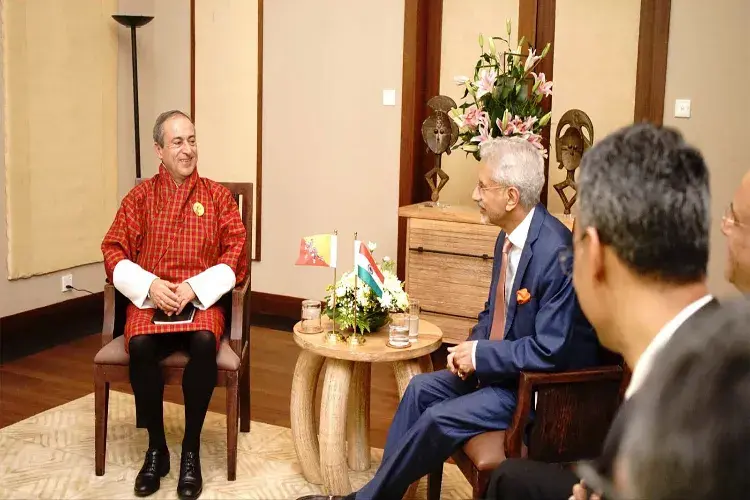
Jaishankar to visit Bhutan on September 16-17 for talks
External Affairs Minister S Jaishankar will pay an official visit to Bhutan from September 16-17, the Ministry of External Affairs said on Wednesday. The visit is at the invitation of Bhutan's Minister of Foreign Affairs and External Trade, Lyonpo D N Dhungyel. Jaishankar will hold bilateral talks with his Bhutanese counterpart to shore up cooperation, receive a royal audience with the King of Bhutan and call on the Prime Minister. The ministry said the visit is in keeping with the tradition of regular high-level exchanges and aims to strengthen close ties of friendship and cooperation.
Source
External Affairs — S. Jaishankar · read the original report ↗
Desk check · compared with the source
What the desk checked (4)
- S Jaishankar will visit Bhutan from September 16-17 on an official visit. — Attributed to the Ministry of External Affairs in the source; dates appear in source text.
- The visit is at the invitation of Bhutan's Minister of Foreign Affairs and External Trade, Lyonpo D N Dhungyel. — Named in source and attributed to the MEA statement.
- Jaishankar will receive a royal audience with the King of Bhutan and call on the Prime Minister of Bhutan. — Attributed to the MEA statement dated Wednesday; individuals not named in source.
- The visit is in keeping with the tradition of regular high-level India-Bhutan exchanges. — Direct quote attributed to the ministry.
Analysts’ view opinion
On the surface this is a routine diplomatic trip, but it reiterates the special place Bhutan holds in India's foreign policy calculus. The MEA's framing — that Jaishankar travels on his counterpart's invitation and will meet both the King and the Prime Minister — is itself the message: the tradition of high-level exchange remains intact. For the government it is a low-risk opportunity to show its neighbourhood-first approach at work, though the official announcement does not spell out what is on the agenda.
- A royal audience plus a call on the Prime Minister signals, in protocol terms, the top-tier priority India accords Bhutan.
- Noting that the invitation came from the Bhutanese side is a deliberate diplomatic signal that the initiative is mutual, not one-way.
- With neighbourhood policy periodically under domestic criticism, visits like this give the government a chance to project continuity and stability.
- Bhutan's government also gains: it can show its own public that ties with India are being maintained at the highest level.
- Ministerial visits often set the stage for higher-level exchanges, but nothing of that sort is indicated in this announcement.
What to watch — Watch what areas of cooperation appear in any post-talks statement, and whether any agreement or a future high-level visit is announced.
The story establishes nothing about the agenda, specific issues, deliverables or strategic context — for now it is only an official announcement of travel.
Deep dive
Research brief · 8 facts · 2 dates · exam-readyThe brief
Context
External Affairs Minister S Jaishankar is undertaking an official visit to Bhutan on September 16-17, at the invitation of Bhutan's Minister of Foreign Affairs and External Trade, Lyonpo D N Dhungyel. The Ministry of External Affairs announced the visit on Wednesday, describing it as part of the established tradition of regular high-level exchanges between India and Bhutan. During the trip, Jaishankar is to hold bilateral talks with his Bhutanese counterpart, receive a royal audience with the King of Bhutan and call on the Prime Minister of Bhutan.
Key facts
- External Affairs Minister S Jaishankar will be on an official visit to Bhutan from September 16-17.
- The visit is at the invitation of Bhutan's Minister of Foreign Affairs and External Trade, Lyonpo D N Dhungyel.
- The Ministry of External Affairs announced the visit on Wednesday.
- Jaishankar will hold bilateral talks with the foreign minister of Bhutan to shore up bilateral cooperation.
- He will receive a royal audience with the King of Bhutan during the visit.
- He will also call on the Prime Minister of Bhutan.
- MEA said the visit is in keeping with the tradition of regular high-level exchanges between India and Bhutan.
- MEA said the visit aims to further strengthen existing close ties of friendship and cooperation between the two countries.
Timeline
- Wednesday (as reported)Ministry of External Affairs announces Jaishankar's forthcoming official visit to Bhutan.
- September 16-17Jaishankar's official visit to Bhutan: bilateral talks with the Bhutanese foreign minister, royal audience with the King, and a call on the Prime Minister.
Who has a stake
- S Jaishankar, External Affairs Minister of India — Leads the visit and the bilateral talks aimed at shoring up cooperation with Bhutan.
- Ministry of External Affairs (MEA), India — Announced and frames the visit as part of regular high-level India-Bhutan exchanges.
- Lyonpo D N Dhungyel, Bhutan's Minister of Foreign Affairs and External Trade — Host and inviting authority; counterpart in the bilateral talks.
- King of Bhutan — Will grant a royal audience to the visiting Indian minister.
- Prime Minister of Bhutan — Will be called on by the External Affairs Minister during the visit.
Why it matters
High-level ministerial visits are the main working instrument through which India and Bhutan sustain their close partnership, and this trip covers both the political leadership and the monarchy. The MEA's framing — regular high-level exchanges and strengthening friendship and cooperation — signals continuity in one of India's closest neighbourhood relationships.
UPSC angle
Prelims pointers
- S Jaishankar's official visit to Bhutan is scheduled for September 16-17.
- The invitation came from Bhutan's Minister of Foreign Affairs and External Trade, Lyonpo D N Dhungyel.
- Bhutan's foreign ministry is titled the Ministry of Foreign Affairs and External Trade.
- Bhutan is a monarchy; the visiting minister is to receive a royal audience with the King of Bhutan.
- 'Lyonpo' is the Bhutanese honorific used for a minister.
- The visit was announced by India's Ministry of External Affairs (MEA).
Mains framing
India-Bhutan relations are sustained less by episodic summitry than by a steady rhythm of high-level exchanges, and Jaishankar's September 16-17 official visit — undertaken at the invitation of Bhutan's Minister of Foreign Affairs and External Trade, Lyonpo D N Dhungyel — fits that pattern. The itinerary itself is instructive: bilateral talks with the counterpart minister to shore up cooperation, a royal audience with the King of Bhutan, and a call on the Prime Minister, engaging both the elected government and the monarchy that anchors Bhutanese politics. The MEA's own stated purpose is twofold: to maintain the tradition of regular high-level contact and to further strengthen existing close ties of friendship and cooperation. The way forward, on the source's terms, lies in institutionalising this predictability — using ministerial visits to review and expand agreed areas of cooperation — while recognising that the source does not specify the agenda items, agreements or outcomes of the visit, which must therefore be assessed after the talks conclude.
Key terms
- Ministry of External Affairs (MEA)
- India's foreign ministry, which announced Jaishankar's Bhutan visit and its stated purpose.
- Lyonpo
- Bhutanese honorific title for a minister, used here for Foreign Minister D N Dhungyel.
- Ministry of Foreign Affairs and External Trade
- Bhutan's ministry handling foreign affairs and external trade, headed by Lyonpo D N Dhungyel.
- Royal audience
- A formal meeting granted by the King of Bhutan to a visiting dignitary.
- Official visit
- A formal government-to-government visit; here, at the invitation of the Bhutanese foreign minister.
Practice questions
- Discuss the role of regular high-level exchanges in sustaining India-Bhutan relations, with reference to the External Affairs Minister's September 16-17 visit.
- Why does India's engagement with Bhutan involve both the elected government and the monarchy? Examine in the context of the itinerary of the recent ministerial visit.
- Evaluate the significance of ministerial-level diplomacy, as distinct from summit-level diplomacy, in India's neighbourhood policy.
Grounded only in the source report — figures and dates are the source's, not inferred.