
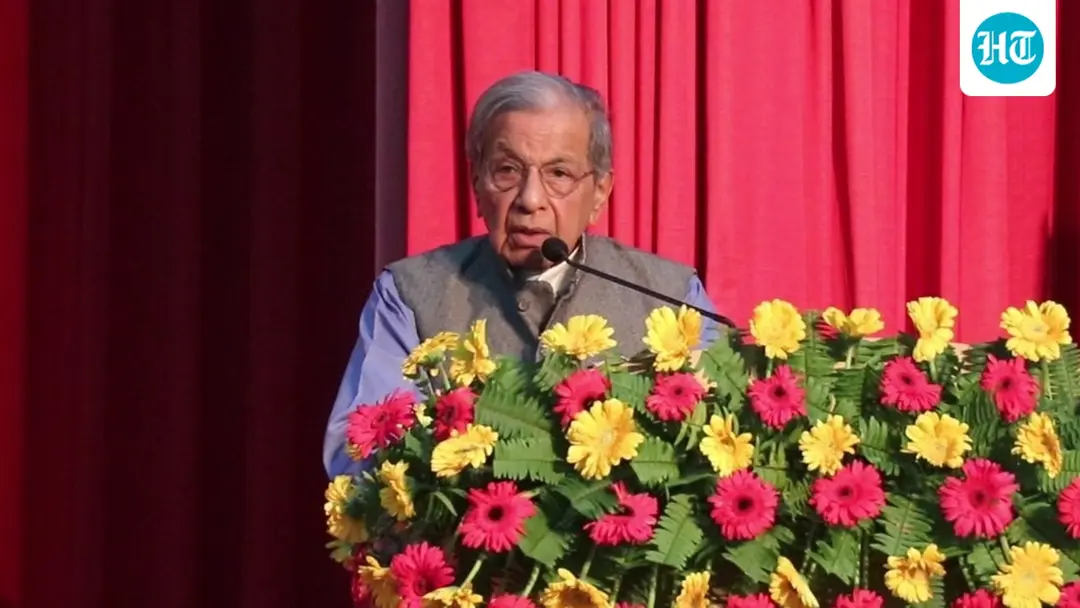
Cooperative federalism key to financing Viksit Bharat, says NK Singh
Fifteenth Finance Commission chairman NK Singh said on Friday that a Viksit Bharat financing strategy requires higher savings, stronger private investment, prudent state finances and stronger cooperative federalism, alongside continued spending on physical and social infrastructure. Addressing a conference of state finance ministers and secretaries, he called for a new centre-state economic compact and competitive federalism. He said the gross domestic savings rate, around 34% of GDP, should rise to 38-40%, citing 7.8% first-quarter growth.
Source
Hindustan Times — India · read the original report ↗
Desk check · compared with the source
What the desk checked (4)
- Viksit Bharat financing needs higher savings, stronger private investment, prudent state finances and cooperative federalism. — Directly attributed to Fifteenth Finance Commission chairman NK Singh in the source.
- India's gross domestic savings rate is around 34% of GDP; target should be 38-40%, with a historical peak near 38%. — Quoted figures appear in the source as Singh's own statement.
- GDP grew 7.8% in the first quarter of the current financial year (FY27), with an upgrade by the Japan Credit Rating Agency. — Attributed to Singh; the FY27 reference and dating are as given in the source and unverified here.
- The finance ministry conference is scheduled for 18-19 September 2026 in New Delhi with three thematic sessions. — Stated in the source, partly citing an unnamed finance ministry official.
Analysts’ view opinion
At its core, what NK Singh laid out is an arithmetic problem: sustaining 7-8% growth requires an investment rate that a 34%-of-GDP savings pool, in his view, cannot finance. Hence the three legs bolted into one strategy — a 38-40% savings target, public spending designed to crowd in private capital, and tighter state finances. The unresolved question is who carries the burden, because lifting the savings rate means changing the income-spending balance of households, firms and governments alike, which no speech can deliver on its own.
- Moving savings from 34% to 38-40% of GDP would need household incomes to rise, savings to shift towards financial instruments, and government deficits to narrow — all working together.
- The call for public finance to "crowd in" private capital signals a gradual transfer of infrastructure funding to the private sector: a gain for investors, but the story does not settle who prices and absorbs project risk.
- The condition of "prudent state finances" puts pressure on state borrowing and subsidy bills, even as much of India's infrastructure capital spending sits with the states themselves.
- That GST 2.0 implications are on the conference agenda matters — without revenue certainty for states, any "new centre-state economic compact" will struggle to hold in practice.
- "Competitive federalism" could spur healthy rivalry to attract investment, but fiscally weaker states risk falling behind; the story itself notes a contrary view describing the trend as 'coercive centralism'.
What to watch — Watch whether the coming budget and GST discussions produce anything concrete for states — revenue protection, easier borrowing limits — since that is the real test of this "new compact".
This is a view expressed at a conference, not policy: the story does not establish what measures would actually lift the savings rate, what the centre-state compact would contain, or whether 7.8% growth will be sustained.
Deep dive
Research brief · 8 facts · 5 dates · exam-readyThe brief
Context
The Union Finance Ministry convened a conference of finance ministers and finance secretaries of states and Union Territories with legislature on "Financing India's Journey towards Viksit Bharat" in New Delhi. Delivering the keynote, Fifteenth Finance Commission chairman NK Singh — also president and life trustee of the Institute of Economic Growth (IEG) — argued that funding the Viksit Bharat goal needs higher domestic savings, more private capital, prudent state finances and stronger cooperative federalism. He urged a new centre-state economic compact and a shift from cooperative to competitive federalism, where states compete on development parameters and share experiences.
Key facts
- NK Singh said India's gross domestic savings rate (households, private sector and government) is around 34% of GDP, which he called inadequate to sustain the 7-8% growth needed for Viksit Bharat.
- He said India's historical peak savings rate was around 38%, and the country should aim for 38-40% to support required investment.
- He cited positive indicators: 7.8% growth in the first quarter of the current financial year (FY27) and a ratings upgrade by the Japan Credit Rating Agency.
- The conference on 'Financing India's Journey towards Viksit Bharat' is organised by the Ministry of Finance on 18 and 19 September 2026 in New Delhi.
- The Union Minister for Finance and Corporate Affairs, several Chief Ministers and State Finance Ministers, and senior state officials are participating.
- The conference has three thematic sessions: macroeconomic overview, financing agricultural transformation, and financing the energy transition.
- Deliberations covered private financing for Viksit Bharat, implications of GST 2.0 for states, agricultural markets and marketing, renewable energy and transmission assets, and carbon capture utilisation and storage.
- Economic affairs secretary Anuradha Thakur also addressed the conference and outlined its objectives.
Timeline
- Planning Commission eraMeetings of the Development Councils were not interactive and became a forum for seeking greater central support, Singh said.
- Post-Planning Commission periodNITI Aayog Governing Council fostered valuable discussions and nurtured new ideas, though 'the hangover of the transition has yet to fully evaporate', per Singh.
- First quarter of current financial year (FY27)India recorded 7.8% growth; Japan Credit Rating Agency issued an upgrade.
- 18-19 September 2026Ministry of Finance holds the Conference of Finance Ministers and Finance Secretaries of States and UTs with Legislature in New Delhi.
- Friday (during the conference)NK Singh delivers keynote address calling for a new centre-state economic compact and competitive federalism.
Who has a stake
- Ministry of Finance / Union Finance Minister — Organiser of the biennial conference; must design a financing strategy that crowds in private capital for Viksit Bharat.
- State and UT governments (CMs, finance ministers, finance secretaries) — Prudent state finances, share of resources, and implications of GST 2.0 for their revenues.
- NK Singh, Fifteenth Finance Commission chairman and IEG president — Advocating a new centre-state economic compact, higher savings and competitive federalism.
- NITI Aayog Governing Council — Cited as the existing consultative forum whose transition 'hangover' has yet to fully evaporate.
- Private investors and financiers — Expected to supply additional capital for infrastructure, agriculture and energy transition projects.
- Households and the private sector — Their savings behaviour determines whether the savings rate rises from about 34% to 38-40% of GDP.
Why it matters
Achieving Viksit Bharat requires sustained 7-8% growth, which Singh says cannot be financed at the current savings rate of about 34% of GDP. Since states execute much of the spending on physical and social infrastructure, agriculture and the energy transition, the quality of centre-state fiscal coordination — and the ability to attract private capital — directly shapes India's growth path.
UPSC angle
Prelims pointers
- NK Singh is chairman of the Fifteenth Finance Commission and president and life trustee of the Institute of Economic Growth (IEG).
- Gross domestic savings rate combines household, private sector and government savings; currently about 34% of GDP, historical peak around 38%.
- Singh's target: raise gross domestic savings to 38-40% of GDP to sustain 7-8% growth.
- Conference on 'Financing India's Journey towards Viksit Bharat' held in New Delhi on 18-19 September 2026 by the Ministry of Finance.
- Q1 FY27 GDP growth reported at 7.8%; upgrade by the Japan Credit Rating Agency.
- Development Councils existed in the Planning Commission era; the NITI Aayog Governing Council is the present consultative forum.
Mains framing
The Viksit Bharat goal turns on a financing question: sustaining 7-8% growth requires investment that a gross domestic savings rate of about 34% of GDP cannot support, which is why NK Singh urges a progressive rise to 38-40%, closer to and beyond the historical peak of 38%. Alongside savings, he identifies stronger private investment, prudent state finances, continued spending on physical and social infrastructure, and public finance that 'crowds in' private capital. Institutionally, he argues that consultative mechanisms have long been elusive — Development Councils in the Planning Commission era became forums for demanding central support, and the NITI Aayog Governing Council still carries the hangover of transition — and proposes a new centre-state economic compact and a move from cooperative to competitive federalism where states compete on development parameters and share experience. The conference agenda itself signals where the financing gaps lie: GST 2.0's implications for states, agricultural markets and resilience, renewable energy and transmission assets, and carbon capture utilisation and storage. The way forward, as framed in the source, lies in institutionalised centre-state dialogue, credible state fiscal management and mobilising private capital, with favourable signals such as 7.8% Q1 FY27 growth and the Japan Credit Rating Agency upgrade providing the backdrop.
Key terms
- Viksit Bharat
- India's developed-nation goal; in this story, the financing strategy needed to sustain the 7-8% growth it requires.
- Gross domestic savings rate
- Combined savings of households, private sector and government as a share of GDP; currently around 34%.
- Cooperative federalism
- Centre and states working jointly on shared goals; Singh calls for deepening it via a new centre-state economic compact.
- Competitive federalism
- States competing meaningfully on development parameters and sharing each other's experiences, as urged by Singh.
- Crowding in private capital
- Using public finance so that it attracts rather than displaces private investment.
- GST 2.0
- The next phase of the goods and services tax regime; its implications for state finances were deliberated at the conference.
Practice questions
- Why does NK Singh argue that India's current gross domestic savings rate is inadequate for the Viksit Bharat goal, and what target does he propose?
- Distinguish between cooperative and competitive federalism. Examine how a 'new centre-state economic compact' could improve development financing in India.
- Discuss the role of state finances and private capital in financing India's infrastructure, agricultural transformation and energy transition.
Grounded only in the source report — figures and dates are the source's, not inferred.