
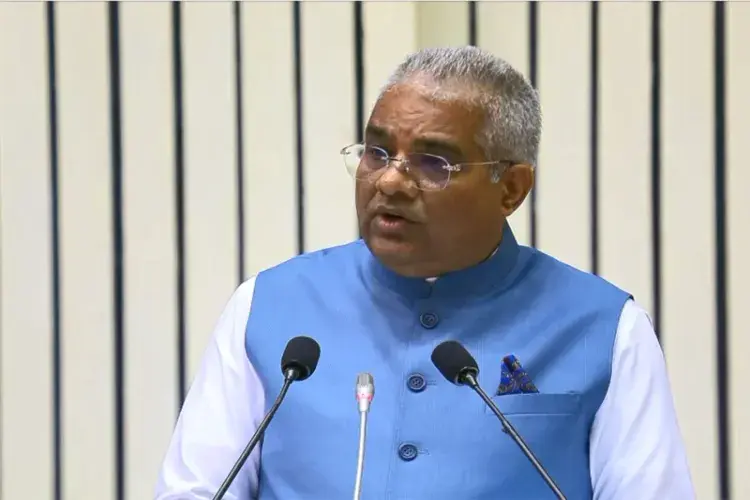
Yadav outlines India's climate, wildlife goals at NGT conference
Union Environment Minister Bhupender Yadav said on Saturday that environmental challenges transcend national boundaries and require cooperation among judges, policymakers, scientists and experts. Addressing an NGT conference, he cited India's targets of 500 GW non-fossil fuel capacity by 2030, a 45 per cent cut in GDP emissions intensity from 2005 levels and net-zero by 2070. He reported growth in tiger, lion and elephant numbers and four cheetah cubs born two days earlier. Prime Minister Narendra Modi inaugurated the conference.
Source
Environment — Bhupender Yadav · read the original report ↗
Desk check · compared with the source
What the desk checked (5)
- India targets 500 GW non-fossil fuel capacity by 2030, a 45% cut in GDP emissions intensity from 2005 levels and net-zero by 2070. — Attributed to Union Minister Bhupender Yadav in the source, including a direct quote.
- Non-fossil sources now make up more than half of India's installed electricity capacity. — Attributed to Yadav; no supporting data or agency figure cited in the source.
- Four new cheetah cubs were born in India two days earlier. — Announced by Yadav per the source; no location or facility named.
- Tiger, lion and elephant populations have grown, with measures for vultures and the Great Indian Bustard. — Attributed to Yadav; no numbers or survey cited.
- PM Narendra Modi inaugurated the conference at Vigyan Bhawan, New Delhi. — Stated in source; described as two-day, though NGT chairperson is quoted referring to four-day deliberations — an internal inconsistency.
Analysts’ view opinion
This was less an environment seminar speech than a carefully staged exercise in defending India's position on a global stage. The Prime Minister inaugurating the conference himself, and Bhupender Yadav listing the 500 GW non-fossil target, the 45 per cent cut in emissions intensity and 2070 net-zero, together work to reframe the "development versus environment" critique as a choice between sustainable and unsustainable development. Yadav's per-capita emissions argument continues a familiar diplomatic strategy of shifting historical responsibility towards the developed world.
- Bringing judges, scientists and policymakers onto one platform gives a government that routinely faces environmental litigation a setting for dialogue with the judiciary.
- Cheetah cubs and rising tiger, lion and elephant numbers are easily grasped, easily communicated success markers with real political value.
- The per-capita emissions line works twice over — as a national-pride message at home and as negotiating leverage in international climate talks.
- NGT Chairperson Justice Prakash Shrivastava's listing of Swachh Bharat, Namami Gange and the Green Hydrogen Mission lends institutional reinforcement to the government's narrative.
- Announcing targets is different from delivering them, and opposition parties and environmental groups could well question ground-level implementation, forest clearances and pollution control — no such response appears in this story.
What to watch — Watch the closing message from the four days of deliberations on "climate justice", and how forcefully India carries the per-capita emissions argument into the next round of global climate negotiations.
The story does not establish how far the stated targets have actually been met, nor does it carry any opposition or independent expert assessment of them.
Deep dive
Research brief · 8 facts · 4 dates · exam-readyThe brief
Context
The National Green Tribunal (NGT) organised an international conference titled "The Future of Environment and Climate Dynamics" at Vigyan Bhawan in New Delhi, inaugurated by Prime Minister Narendra Modi on Saturday. Union Environment, Forest and Climate Change Minister Bhupender Yadav used the platform to restate India's climate targets and wildlife conservation record, arguing that ecological challenges cross national borders and need collaboration among judges, policymakers, scientists and experts. NGT Chairperson Justice Prakash Shrivastava framed environmental protection as a collective national and global responsibility and listed India's flagship green missions. The conference brings together foreign judges, Supreme Court, High Court and district court judges, officials and environmental bodies.
Key facts
- Yadav cited India's target of 500 GW of non-fossil fuel energy capacity by 2030.
- India aims to reduce the emissions intensity of its GDP by 45 per cent from 2005 levels.
- India's net-zero emissions target year is 2070.
- Non-fossil fuel sources now account for more than half of India's installed electricity capacity, per Yadav.
- Yadav said India welcomed four new cheetah cubs two days before the conference address.
- Yadav reported growth in tiger, lion and elephant populations, with intensified efforts for vultures and the Great Indian Bustard.
- In a post dated September 19, 2026, Yadav said India's per capita carbon emission is less than half the global average.
- The NGT conference is described as a two-day international conference at Vigyan Bhawan, New Delhi, with four-day deliberations mentioned by the NGT Chairperson.
Timeline
- Two days before Yadav's addressFour cheetah cubs born in India, cited by the minister as a conservation milestone.
- September 19, 2026 (Yadav's post)Yadav argues responsibility for carbon emissions has been wrongly placed on developing countries; India's per capita emissions less than half the global average.
- SaturdayPrime Minister Narendra Modi inaugurates the NGT international conference on 'The Future of Environment and Climate Dynamics' at Vigyan Bhawan, New Delhi.
- SaturdayYadav and NGT Chairperson Justice Prakash Shrivastava address the conference.
Who has a stake
- Ministry of Environment, Forest and Climate Change — Owns India's climate roadmap (500 GW non-fossil capacity, 45% emissions intensity cut, net-zero 2070) and wildlife conservation programmes.
- National Green Tribunal (NGT) — Organiser of the conference; seeks to strengthen environmental justice and institutional cooperation.
- Judiciary (Supreme Court, High Courts, district courts, foreign judges) — Participants expected to move from principles to practice in environmental law and climate justice.
- Developing countries — Yadav argues carbon emission responsibility has been wrongly placed on them despite low per capita emissions.
- Threatened species (vultures, Great Indian Bustard, cheetah) — Targets of dedicated conservation measures; cheetah cubs cited as progress.
- Communities least responsible for degradation — Justice Shrivastava said they disproportionately bear the consequences of environmental degradation.
Why it matters
The conference links India's climate pledges with the machinery of environmental adjudication, signalling that courts and tribunals are now central to delivering climate and biodiversity goals. It also restates India's equity argument in global climate talks — that historical and per capita emissions, not present-day growth in developing countries, should frame responsibility. For governance, the message is that development and environment are not rival choices but a choice between sustainable and unsustainable development.
UPSC angle
Prelims pointers
- India's climate targets as stated: 500 GW non-fossil fuel capacity by 2030; 45% cut in GDP emissions intensity from 2005 levels; net-zero by 2070.
- NGT Chairperson: Justice Prakash Shrivastava.
- Conference theme: 'The Future of Environment and Climate Dynamics', organised by NGT at Vigyan Bhawan, New Delhi; inaugurated by PM Narendra Modi.
- Missions named by the NGT Chairperson: Swachh Bharat Mission, Jal Jeevan Mission, AMRUT 2.0, Namami Gange, PM-KUSUM, National Green Hydrogen Mission, Green India Mission, International Solar Alliance.
- Threatened species flagged for intensified protection: vultures and the Great Indian Bustard.
- Conference focus areas: climate justice, environmental law and governance, planetary environmental challenges, international cooperation.
Mains framing
India's climate positioning, as articulated at the NGT conference, rests on two pillars: an equity claim and a delivery claim. The equity claim is that responsibility for carbon emissions has historically been misplaced on developing countries, with India's per capita emissions less than half the global average; the delivery claim is measurable — 500 GW non-fossil capacity by 2030, a 45 per cent reduction in GDP emissions intensity from 2005 levels, net-zero by 2070, and non-fossil sources already exceeding half of installed electricity capacity. Alongside energy transition, biodiversity outcomes are offered as evidence: rising tiger, lion and elephant numbers, dedicated action for vultures and the Great Indian Bustard, and four cheetah cubs born days before the conference. The institutional argument advanced by the NGT Chairperson is that environmental protection cannot be the burden of one sector: climate change is reshaping ecosystems, economies and habitation, while degradation's costs fall disproportionately on those least responsible, demanding legal, institutional and social responses together. The way forward suggested at the conference is convergence — judges, policymakers, scientists and practitioners moving from principles to practice and from national effort to global cooperation, with flagship missions such as Namami Gange, Jal Jeevan Mission, National Green Hydrogen Mission and Green India Mission as delivery vehicles, and the framing that the real choice is between sustainable development and development that cannot be sustained.
Key terms
- National Green Tribunal (NGT)
- Specialised environmental adjudication body; organiser of the New Delhi international conference on environment and climate dynamics.
- Emissions intensity of GDP
- Emissions per unit of economic output; India targets a 45 per cent reduction from 2005 levels.
- Net-zero by 2070
- India's stated target year for balancing greenhouse gas emissions with removals.
- Non-fossil fuel capacity
- Installed power capacity from sources other than fossil fuels; India targets 500 GW by 2030 and already exceeds half of installed capacity.
- Great Indian Bustard
- Threatened bird species named by the minister as a focus of intensified protection efforts.
- Climate justice
- A conference focus area; the idea that environmental costs fall disproportionately on those least responsible for degradation.
Practice questions
- Examine how judicial and tribunal institutions such as the NGT can strengthen the delivery of India's climate commitments.
- "The choice is not between development and environment, but between sustainable development and development that cannot be sustained." Discuss with reference to India's stated climate targets.
- Critically assess India's equity argument in global climate negotiations, using per capita emissions and historical responsibility as reference points.
Grounded only in the source report — figures and dates are the source's, not inferred.