
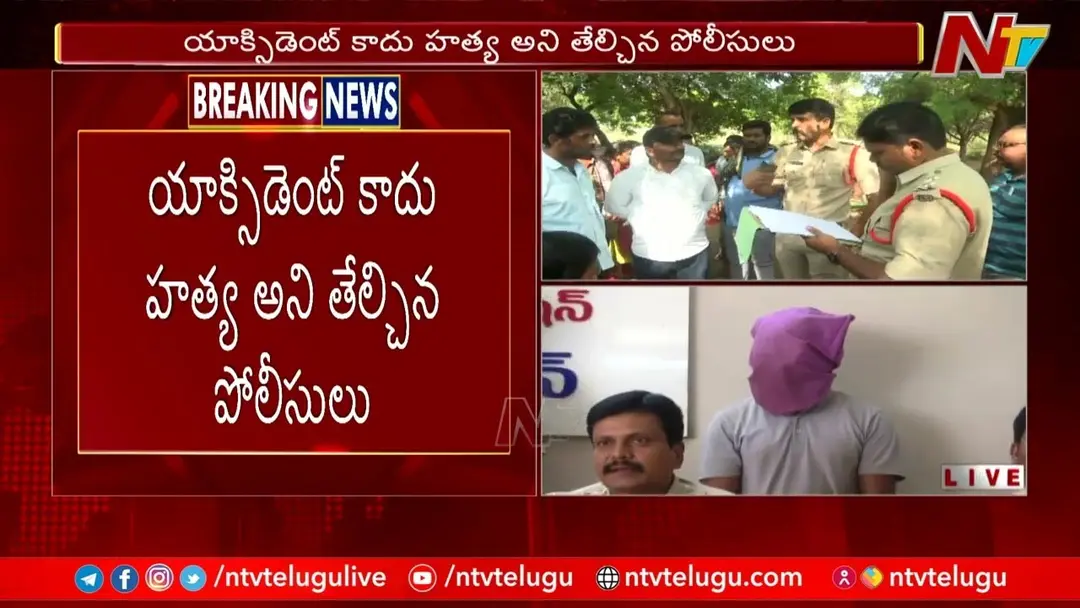
Khammam road accident ruled murder, doctor husband arrested
Police have concluded that a car crash near Harya Thanda in Raghunadhapalem mandal of Khammam district two months ago, in which a woman and her two children died, was murder. Khammam ACP Ramanamurthy said Praveen, the husband and a doctor in Hyderabad, has been arrested. He allegedly killed them with injections in the car, where an empty syringe was found, and staged the crash. An alleged relationship with a nurse is cited as the motive.
Source
Khammam — నేరాలు · read the original report ↗
Desk check · some claims need care
What the desk checked (5)
- A woman and her two children died in what appeared to be a car crash at Harya Thanda in Raghunadhapalem mandal, Khammam district, about two months ago. — Figure and location appear in source; timeline stated variously as two months and 45 days, an internal inconsistency.
- Police have concluded the deaths were murders and arrested the husband, Dr Praveen. — Attributed to Khammam ACP Ramanamurthy in a media briefing.
- The victims were killed with injections, including an anaesthesia injection, and an empty syringe was found in the car. — Attributed to the ACP; forensic confirmation not detailed in source.
- Praveen, a doctor in Hyderabad, was in a relationship with a nurse, described elsewhere in the source as a Kerala woman. — Presented as allegation; source itself is inconsistent on her description.
- Relatives of the deceased woman staged protests at the police station after the case was treated as an accident. — Stated in source without named attribution.
Analysts’ view opinion
The legally significant turn here is reclassification: what was initially recorded and publicly described as a road accident is now being treated as murder. What the ACP has disclosed remains investigative allegation, not adjudicated fact — the burden of proving guilt beyond reasonable doubt rests entirely with the prosecution at trial. The strength of the case will hinge on forensic material, notably the empty syringe said to have been recovered from the car and the medical and chemical examination reports.
- Converting an accident case into a homicide case requires procedural steps — altering the sections invoked and continuing further investigation — and the story does not specify which provisions have now been applied.
- This appears to be a largely circumstantial case, and courts have consistently held that in such cases every link must form a complete, unbroken chain; the syringe, the source of the injections and the medical reports are key links here.
- The accused's medical background may help the prosecution argue access to and knowledge of drugs, but a profession alone proves nothing in law.
- The alleged extramarital relationship and family dispute go to motive, and motive by itself is legally insufficient for conviction.
- The initial police conclusion of an accident, and the relatives' repeated protests, invite scrutiny of investigative delay or lapses — a line the defence could also exploit at trial.
What to watch — Watch how quickly a charge sheet follows remand, whether forensic and chemical analysis reports corroborate the injection theory, and whether the earlier accident finding triggers any internal review.
Everything so far is a police allegation; no court has determined guilt, and the story does not establish the contents of post-mortem or forensic lab reports or the exact charges filed.
Deep dive
Research brief · 8 facts · 6 dates · exam-readyThe brief
Context
About two months ago, a car was found crashed into a tree near Harya Thanda in Raghunadhapalem mandal of Khammam district, Telangana, killing a woman and her two children, while her husband Praveen, a doctor working in Hyderabad, survived with injuries. Police initially treated it as a road accident and said so publicly, even as the woman's relatives alleged murder and staged repeated dharnas outside the police station. After further investigation, Khammam ACP Ramanamurthy has now announced that the deaths were murder and that Praveen has been arrested, with an alleged illicit relationship cited as the motive.
Key facts
- Khammam ACP Ramanamurthy announced the case was cracked 45 days after the incident and that Dr Praveen has been arrested.
- The crash occurred near Harya Thanda in Raghunadhapalem mandal, Khammam district, about two months ago; the wife and two children died on the spot.
- The husband, Praveen, a doctor working in Hyderabad, suffered only injuries in the crash, which raised suspicion against him.
- Police say Praveen administered injections in the car and then staged a collision with a tree to create the appearance of a car accident.
- An empty syringe was found in the car; the ACP said an anaesthesia syringe was used in the killing.
- According to the ACP, a calcium injection mixed with another injection was given on the Khammam-Koyachelaka route after a meal; the children were injected after the wife fell asleep.
- The ACP said an earlier plan to kill using a calcium injection did not succeed.
- Police cite an alleged illicit relationship with a nurse (described as a Kerala woman) as the motive; a dispute between the couple had been running for some time.
Timeline
- MayA quarrel took place at the house; a panchayati (mediation) was held between the parents of the man and the woman, per the ACP.
- Before the crashAn attempt to kill using a calcium injection was planned but did not succeed, police say.
- About two months agoAfter a meal, on the Khammam-Koyachelaka route, injections were allegedly administered; the car was crashed into a tree near Harya Thanda, killing the wife and two children.
- Immediately afterPolice treated it as a road accident and stated so in media briefings; the wife's relatives alleged murder and held dharnas at the police station.
- After the crashPraveen was discharged from a private hospital, prompting protests by villagers.
- 45 days after the incidentPolice conclude it was murder; ACP Ramanamurthy announces the arrest of Dr Praveen and the case details.
Who has a stake
- Dr Praveen, the accused husband — Arrested and named by police as having killed his wife and two children and staged a road accident.
- The deceased woman and her two children — Victims who died in what police now say was a planned murder, not an accident.
- The wife's relatives — Alleged murder from the start and protested repeatedly at the police station against the accident theory; now seeking justice.
- Khammam police / ACP Ramanamurthy — Reversed their initial road-accident conclusion; credibility of the investigation and the strength of the murder case rest on the syringe and forensic evidence.
- Villagers of the area — Agitated when the accused was discharged from a private hospital, pressing for accountability.
- The nurse alleged to be involved — Named in the motive as being in an illicit relationship with the accused; role not stated further in the source.
Why it matters
The case shows how a deliberate killing can be disguised as a routine road accident, and how an initial police conclusion of "accident" can stand for weeks until family pressure and further inquiry force a review. It also raises questions about the misuse of medical knowledge and access to drugs such as anaesthesia and calcium injections by a practising doctor, and about the quality of first-response investigation in fatal crashes.
UPSC angle
Prelims pointers
- Location: Harya Thanda, Raghunadhapalem mandal, Khammam district, Telangana.
- Police officer who announced the findings: Khammam ACP Ramanamurthy; mystery said to be solved 45 days after the incident.
- Accused: Praveen, a doctor working in Hyderabad; victims: his wife and two children.
- Key evidence cited: an empty syringe found in the car; police say an anaesthesia syringe was used.
- Alleged motive: an illicit relationship with a nurse, amid an ongoing dispute between the couple.
- ACP said a calcium injection was mixed with another injection on the Khammam-Koyachelaka route.
Mains framing
The Khammam case illustrates the investigative challenge posed by homicides staged as accidents. The immediate cause, per police, was a marital dispute rooted in an alleged illicit relationship, but the enabling factor was the accused's professional access to and knowledge of injectable drugs — anaesthesia and calcium injections — which leave little visible trauma and can be masked by a crash. Equally significant is the institutional dimension: police initially classified the deaths as a road accident and repeated that in media briefings, and it took sustained dharnas by the victim's relatives, village-level protests and media scrutiny before the case was re-examined and concluded as murder within 45 days. The implications are twofold — the risk of wrongful closure of unnatural deaths where the sole survivor is also the sole witness, and the need for mandatory forensic and toxicological screening in fatal crashes rather than reliance on scene appearance. The way forward suggested by the facts is routine autopsy-plus-chemical analysis in single-vehicle fatal crashes, careful preservation of vehicle evidence such as the syringe recovered here, tighter accountability for custody of scheduled drugs by medical professionals, and responsiveness to credible family complaints before an accident classification is finalised.
Key terms
- ACP (Assistant Commissioner of Police)
- Police officer heading a sub-division in a commissionerate; here ACP Ramanamurthy announced the Khammam findings.
- Mandal
- An administrative sub-district unit in Telangana; the crash site falls in Raghunadhapalem mandal of Khammam district.
- Anaesthesia injection
- A drug used to induce loss of sensation or sleep; police say such a syringe was used in the killings.
- Calcium injection
- An injectable preparation which police say was mixed with another injection and administered to the wife.
- Panchayati
- An informal local mediation between families; the ACP said one was held between the couple's parents in May.
- Staged accident
- A crime made to look like a mishap; here a car was allegedly driven into a tree after the victims were injected.
Practice questions
- Fatal single-vehicle crashes with a lone survivor pose distinct investigative risks. Examine, with reference to the Khammam case, how forensic and procedural safeguards can prevent homicides being closed as accidents.
- Discuss the role of victims' families and the media in compelling the reopening of cases initially classified as accidents by the police.
- What institutional controls are needed over medical professionals' access to injectable and anaesthetic drugs? Analyse in light of the Khammam murder case.
Grounded only in the source report — figures and dates are the source's, not inferred.