
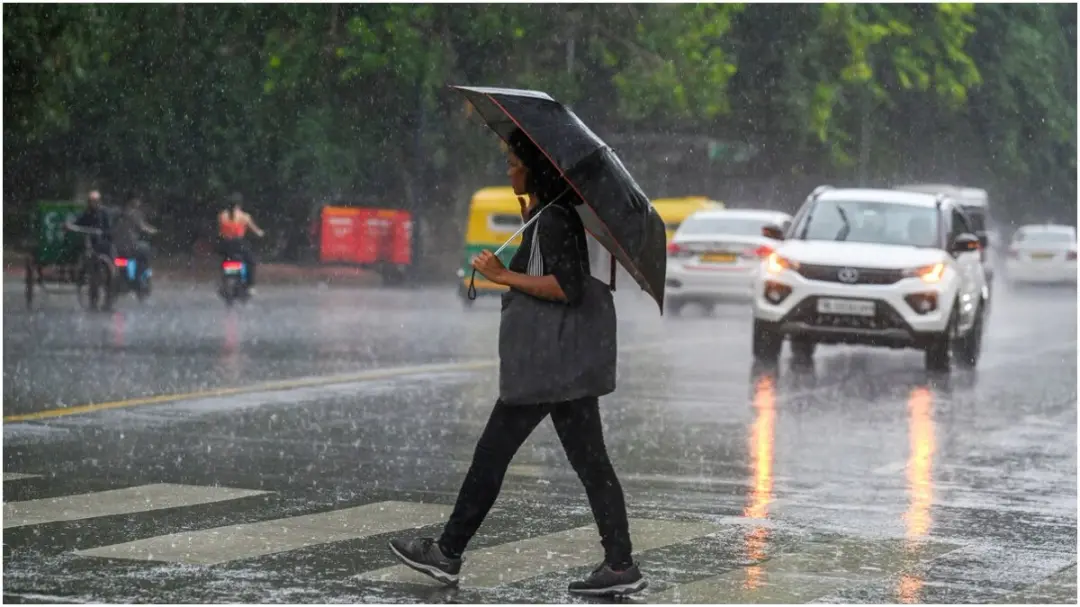
Rain in Delhi-NCR, flood-like situation in Uttar Pradesh
Parts of Delhi-NCR saw light drizzle on Wednesday morning. The IMD forecast generally cloudy skies with light to moderate rain, thunderstorms, lightning and winds of 20-30 km/h, with maximum temperatures of 31-33°C and minimum of 24-26°C. A rain alert was also issued for July 23. In Uttar Pradesh, waterlogging hit hospitals in Firozabad and Unnao and a canal bridge collapsed in Shamli. In Bihar, the Kosi and Kamla Balan rivers are above danger mark.
Source
Weather · read the original report ↗
Desk check · compared with the source
What the desk checked (5)
- IMD forecasts generally cloudy skies in Delhi with light to moderate rain, thunderstorms, lightning and winds of 20-30 km/h — Attributed to India Meteorological Department in the source
- Delhi maximum temperature 31-33°C and minimum 24-26°C; rain alert also issued for 23 July — Figures appear in source, attributed to IMD
- Rainfall on 21 July: Prayagraj 96 mm, Aligarh 70 mm, Bahraich 56 mm, Azamgarh 48 mm, Kanpur 41 mm, Shahjahanpur 34 mm, Meerut 31 mm, Lucknow 19 mm — Attributed to Skymate Weather in the source
- Hospitals in Firozabad and Unnao waterlogged; canal bridge collapsed in Shamli with road caving in about 10 feet — Stated in source without named official source
- Kosi and Kamla Balan rivers flowing above danger mark at several places in Bihar — Stated in source, no agency attributed
Analysts’ view opinion
This reads as a weather story, but its real test is one of governance capacity. Rain may feel like relief in Delhi-NCR, yet flooded government hospitals in Firozabad and Unnao and a collapsed canal bridge in Shamli hand the opposition ready-made arguments about infrastructure quality. In Bihar, the Kosi and Kamla Balan flowing above danger level could once again push flood management to the centre of the political conversation.
- Water inside hospitals is among the most politically costly images for any government — it gets framed as a preparedness failure rather than a rainfall event.
- The Shamli bridge collapse and the road caving in invite questions about construction quality and contract accountability.
- Kosi flooding is a long-running political theme in Bihar; rivers above danger level typically sharpen debate over central-state relief and compensation.
- Delhi-NCR's multi-agency governance structure makes blame-shifting over waterlogging almost routine.
- Because IMD had issued alerts, the governing parties' main line of defence will be how much advance preparation was actually done.
What to watch — Watch for official inquiries or accountability announcements on the hospital flooding and bridge collapse, ministerial site visits, and opposition statements.
The story establishes no political statements, assignment of responsibility, casualty or damage figures, or government response, so the political consequences sketched here remain inference.
Deep dive
Research brief · 8 facts · 5 dates · exam-readyThe brief
Context
An active monsoon system brought rain to Delhi-NCR on the morning of Wednesday, 22 July 2026, with the India Meteorological Department (IMD) forecasting cloudy skies, light to moderate rain, thunderstorms and gusty winds. Persistent heavy rain in the Western Himalaya has pushed extra water downstream, creating flood-like conditions across several districts of Uttar Pradesh. In Bihar too the monsoon is fully active, with the Kosi and Kamla Balan rivers flowing above the danger mark at several points.
Key facts
- Light drizzle was reported in parts of Delhi-NCR on Wednesday morning; ANI visuals came from Safdarjung Road and Rajaji Marg on 22 July 2026.
- IMD forecast for Delhi: generally cloudy sky, light rain at many places and moderate rain at some places between morning and afternoon.
- Thunderstorms, lightning and winds of 20-30 km/h were forecast for Delhi during the day, with light rain again likely between evening and night.
- Delhi's maximum temperature was forecast at 31°C to 33°C and minimum at 24°C to 26°C.
- IMD also issued a rain alert for Delhi-NCR for 23 July.
- In Uttar Pradesh, waterlogging in government hospitals in Firozabad and Unnao disrupted health services.
- In Shamli district a bridge over a canal collapsed and the connected road caved in by about 10 feet, halting traffic completely on that route.
- Skymet Weather rainfall on 21 July: Prayagraj 96 mm, Aligarh 70 mm, Bahraich 56 mm, Azamgarh 48 mm, Kanpur 41 mm, Shahjahanpur 34 mm, Meerut 31 mm, Lucknow 19 mm.
Timeline
- 21 JulyHeavy rain recorded across Uttar Pradesh - Prayagraj 96 mm, Aligarh 70 mm, Bahraich 56 mm, Azamgarh 48 mm, Kanpur 41 mm, Shahjahanpur 34 mm, Meerut 31 mm, Lucknow 19 mm (Skymet).
- 22 July 2026 (Wednesday morning)Light drizzle and rain in parts of Delhi-NCR; ANI visuals from Safdarjung Road and Rajaji Marg.
- 22 July, morning to afternoonIMD forecast light to moderate rain, thunderstorms, lightning and 20-30 km/h winds in Delhi.
- 22 July, evening to nightLight rain again likely at some places in Delhi, as per IMD.
- 23 JulyIMD rain alert issued for Delhi-NCR.
Who has a stake
- India Meteorological Department (IMD) — Official forecaster; issued the Delhi rain forecast for 22 July and the rain alert for 23 July.
- Residents and commuters of Delhi-NCR — Face thunderstorms, lightning and 20-30 km/h winds along with rain-related disruption.
- Patients and staff at government hospitals in Firozabad and Unnao — Health services disrupted by waterlogging inside hospital premises.
- Shamli district residents and road users — Canal bridge collapse and a road caving in by about 10 feet cut off movement on that route.
- Bihar's river-basin population (Kosi, Kamla Balan) — Rivers flowing above danger mark at several places amid continuous rain, raising flood risk.
- Skymet Weather — Private weather agency whose 21 July rainfall data documents the intensity of the Uttar Pradesh spell.
Why it matters
A single active monsoon surge is simultaneously giving Delhi pleasant showers and pushing Uttar Pradesh into flood-like conditions, showing how Himalayan rainfall travels downstream into the plains. When waterlogging shuts down hospital services and a canal bridge collapse cuts a road by 10 feet, the damage is to basic health and connectivity, not just comfort. In Bihar, the Kosi and Kamla Balan above danger mark signal the classic flood season risk in the Ganga plains.
UPSC angle
Prelims pointers
- IMD is the official agency issuing rain alerts; Skymet Weather is a private weather forecasting agency.
- Delhi forecast for 22 July 2026: max 31-33°C, min 24-26°C, winds 20-30 km/h; rain alert also for 23 July.
- Kosi and Kamla Balan are the Bihar rivers reported flowing above the danger mark.
- Highest 21 July rainfall in UP as per Skymet: Prayagraj 96 mm, followed by Aligarh 70 mm.
- Districts named in UP flood-like situation: Firozabad and Unnao (hospital waterlogging), Shamli (canal bridge collapse).
- Heavy rain in the Western Himalaya was cited as the source of extra water flowing into Uttar Pradesh.
Mains framing
The July 2026 spell illustrates how an active monsoon produces sharply unequal outcomes across the Ganga plains: Delhi-NCR received light to moderate rain with thunderstorms and 20-30 km/h winds under an IMD alert extending to 23 July, while Uttar Pradesh moved into flood-like conditions as continuous heavy rain over the Western Himalaya sent surplus water downstream. Skymet's 21 July figures - 96 mm in Prayagraj, 70 mm in Aligarh, 56 mm in Bahraich - show intense localised bursts, and the consequences were institutional rather than merely meteorological: government hospitals in Firozabad and Unnao were waterlogged, disrupting health services, and in Shamli a canal bridge collapsed with the approach road caving in by about 10 feet, severing a transport route. In Bihar, the Kosi and Kamla Balan flowing above danger mark at several points underline the upstream-downstream linkage of Himalayan rainfall with plains flooding. The implications point to the need for flood-resilient siting and drainage of critical public facilities like hospitals, structural audit and maintenance of canal-crossing bridges, and forecast-linked pre-positioning of relief along river basins - while noting that the source describes conditions and does not detail official response measures.
Key terms
- IMD (India Meteorological Department)
- The national weather agency that issued Delhi's 22 July forecast and the 23 July rain alert.
- Skymet Weather
- Private weather agency that recorded the 21 July district-wise rainfall figures for Uttar Pradesh.
- Danger mark
- The river water level beyond which flooding risk is considered serious; Kosi and Kamla Balan crossed it at several places.
- Kosi river
- A Bihar river reported flowing above the danger mark during the active monsoon spell.
- Kamla Balan
- Another Bihar river reported above the danger mark at several locations.
- Flood-like situation
- Conditions of severe waterlogging and inundation short of declared flooding, reported in several parts of Uttar Pradesh.
Practice questions
- How does heavy rainfall in the Western Himalaya translate into flood-like conditions in the plains of Uttar Pradesh and Bihar? Discuss with reference to the July 2026 spell.
- Waterlogging in government hospitals in Firozabad and Unnao disrupted health services. Examine the need for disaster-resilient design of critical public infrastructure.
- Evaluate the role of forecasting agencies such as IMD and Skymet in reducing monsoon-related damage, using the Delhi-NCR alerts of 22-23 July as an example.
Grounded only in the source report — figures and dates are the source's, not inferred.