
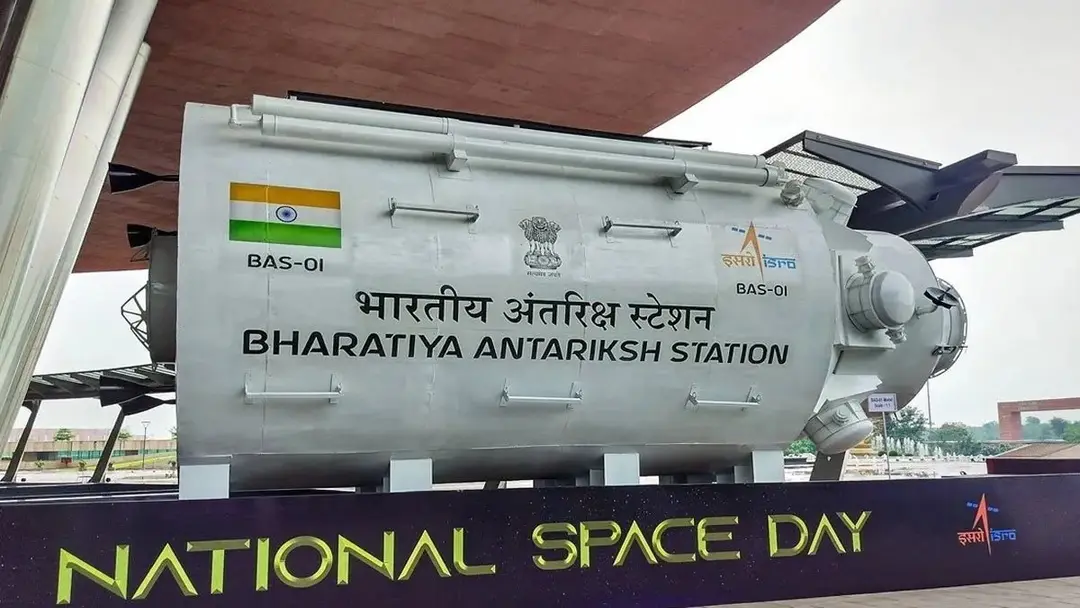
ISRO displays Bharatiya Antariksh Station module model
ISRO displayed a model of the Bharatiya Antariksh Station (BAS) module during National Space Day events. The 10-tonne BAS-01 module is targeted for launch by 2028 into low Earth orbit at an altitude of 450 km, with a full station of five modules planned by 2035. The module will carry a life support system, docking mechanism and airlocks, and host microgravity, space biology and medical research. At present only the ISS and China's Tiangong operate as orbital laboratories.
Source
Science & ISRO · read the original report ↗
Desk check · compared with the source
What the desk checked (5)
- ISRO displayed a model of the Bharatiya Antariksh Station (BAS) module during National Space Day events. — Stated in source and attributed to ISRO; no named official or document cited.
- BAS-01 module is to be launched into orbit by 2028. — Target date appears in source as a stated plan; no formal approval order cited.
- A full station with five modules is targeted by 2035. — Figure appears in source as an ISRO goal; no independent confirmation possible.
- BAS-01 will weigh 10 tonnes and orbit at 450 km in low Earth orbit. — Technical figures appear in source; no source document named.
- The world currently has two main orbital laboratories — the ISS, run by five space agencies, and China's Tiangong. — Background claim in source, unattributed.
Analysts’ view opinion
The unveiling of a BAS-01 mock-up signals that ISRO has moved its space station ambition from announcement to hardware design. The hard technology problem here is not lofting 10 tonnes to a 450 km low Earth orbit — it is mastering human-rated systems indigenously: environmental control and life support, docking and berthing, airlocks, and radiation plus micrometeoroid shielding. A first module in 2028 and a five-module station by 2035 is an ambitious timeline by historical standards, though the phased build is a sensible risk-reduction strategy.
- What was shown is a mock-up, which indicates design maturity rather than flight-hardware readiness.
- References to plug-and-play facilities and integrated avionics fit the modern trend of modular orbital labs where payloads can be swapped quickly.
- With only the ISS and China's Tiangong currently in orbit, an independent Indian platform becomes a strategic asset as the ISS era winds down.
- A domestic microgravity platform for space biology and medicine could open new pipelines for Indian universities, pharma and materials research.
- The story does not detail cost, private-sector participation or a crew transport vehicle — precisely the factors that will govern the pace.
What to watch — Watch whether ground qualification of ECLSS, the docking mechanism and airlocks, plus in-orbit docking demonstrations, stay on schedule — that is the real test of the 2028 target.
The story establishes nothing about budget, launch vehicle, crew transport arrangements or international partnerships, and the dates cited are stated goals rather than confirmed schedules.
Deep dive
Research brief · 8 facts · 3 dates · exam-readyThe brief
Context
ISRO is moving towards building an indigenous orbital space station, the Bharatiya Antariksh Station (BAS). During National Space Day events, the agency displayed a model of the first module, BAS-01. The plan envisages launching BAS-01 by 2028 and completing a five-module station by 2035, giving India its own crewed orbital laboratory. At present only the International Space Station (ISS), run jointly by five space agencies, and China's Tiangong function as orbital laboratories.
Key facts
- ISRO displayed a model of the Bharatiya Antariksh Station (BAS) module during National Space Day events (report published August 22, 2025).
- BAS-01, the first module, is targeted for launch into orbit by 2028.
- The complete station of five modules is targeted for 2035.
- BAS-01 will weigh 10 tonnes and be placed in low Earth orbit at an altitude of 450 km.
- Module systems include Environmental Control and Life Support System (ECLSS), docking and berthing mechanism, and automated hatch system.
- It will also carry propulsion, radiation, thermal and micro-meteoroid (MMOD) protection, space suits, airlocks for extra-vehicular activity, integrated avionics and plug-and-play facilities.
- Research areas planned: microgravity research, technology demonstration, space biology, medical science and interplanetary exploration projects.
- Only two major orbital laboratories currently exist: the ISS, operated jointly by five space agencies, and China's Tiangong space station.
Timeline
- August 22, 2025 (report date, during National Space Day events)ISRO displays the model of the BAS module, including BAS-01 design details.
- By 2028BAS-01 module targeted for launch into low Earth orbit at 450 km.
- By 2035Full Bharatiya Antariksh Station with five modules targeted for completion.
Who has a stake
- ISRO — Lead agency for designing, launching and operating BAS; its credibility in human spaceflight and long-duration missions rests on the 2028 and 2035 targets.
- Indian scientific community — Gains a dedicated orbital platform for microgravity, space biology, chemical and medical experiments.
- Indian astronauts / human spaceflight programme — Airlocks, space suits and life support systems enable extra-vehicular activity and sustained human presence in orbit.
- ISS partner agencies and China (Tiangong) — Currently the only operators of orbital laboratories; BAS would add a third independent platform.
- India's medical and technology sectors — New opportunities from research on microgravity effects on human health and technologies for long-term space habitation.
Why it matters
A national space station would give India autonomy in orbital research instead of depending on foreign platforms, and a permanent testbed for technologies needed for long-duration human presence in space. It also positions India alongside the ISS partnership and China as one of very few actors able to operate a crewed laboratory in orbit, strengthening its weight in international space research.
UPSC angle
Prelims pointers
- Bharatiya Antariksh Station (BAS): ISRO's planned indigenous space station; first module BAS-01 targeted by 2028, full five-module station by 2035.
- BAS-01 specifications: 10 tonnes, low Earth orbit at 450 km altitude.
- ECLSS = Environmental Control and Life Support System, a key BAS-01 subsystem.
- MMOD refers to micro-meteoroid and orbital debris protection on the module.
- Existing orbital laboratories: ISS (run jointly by five space agencies) and China's Tiangong.
- The BAS model was displayed during National Space Day events (reported August 22, 2025).
Mains framing
India's move from launch-and-satellite capability towards a crewed orbital laboratory marks a shift in the ambition of its space programme: the BAS-01 module, at 10 tonnes and orbiting at 450 km, is designed with environmental control and life support, docking and berthing mechanisms, automated hatches, radiation, thermal and micro-meteoroid protection, airlocks for extra-vehicular activity and plug-and-play integrated avionics — the full technology stack needed for sustained human presence. The stated gains are strategic and scientific: independence in orbital research, a dedicated platform for microgravity, space biology, chemical and medical experiments, study of microgravity effects on human health, and testing technologies for interplanetary exploration. The challenges implicit in the plan are the compressed timeline (first module by 2028, five modules by 2035), the need for reliable heavy-lift and docking capability, and the human-rating of life support and crew safety systems; the source does not detail costs or partnerships. The way forward, as framed by the source, is incremental module-by-module assembly, with BAS-01 serving as the demonstrator for the technologies that the later modules and long-duration missions will depend on.
Key terms
- Bharatiya Antariksh Station (BAS)
- India's planned indigenous space station, to be built module by module with five modules targeted by 2035.
- BAS-01
- The first 10-tonne BAS module, to be placed in low Earth orbit at 450 km, targeted for launch by 2028.
- ECLSS
- Environmental Control and Life Support System — regulates air, temperature and life-sustaining conditions for crew aboard the module.
- MMOD protection
- Shielding against micro-meteoroids and orbital debris impacts on the station structure.
- Airlock / extra-vehicular activity
- A sealed compartment allowing astronauts in space suits to exit the module for work outside the station.
- Tiangong
- China's space station; along with the ISS, one of only two orbital laboratories operating at present.
Practice questions
- Discuss the scientific and strategic significance of the Bharatiya Antariksh Station for India's space programme, with reference to its planned capabilities and timeline.
- What technological subsystems are essential for sustaining human presence in low Earth orbit? Illustrate with the design features of the BAS-01 module.
- India plans a national space station by 2035 when only the ISS and Tiangong operate as orbital laboratories. Examine the opportunities and challenges this presents.
Grounded only in the source report — figures and dates are the source's, not inferred.