
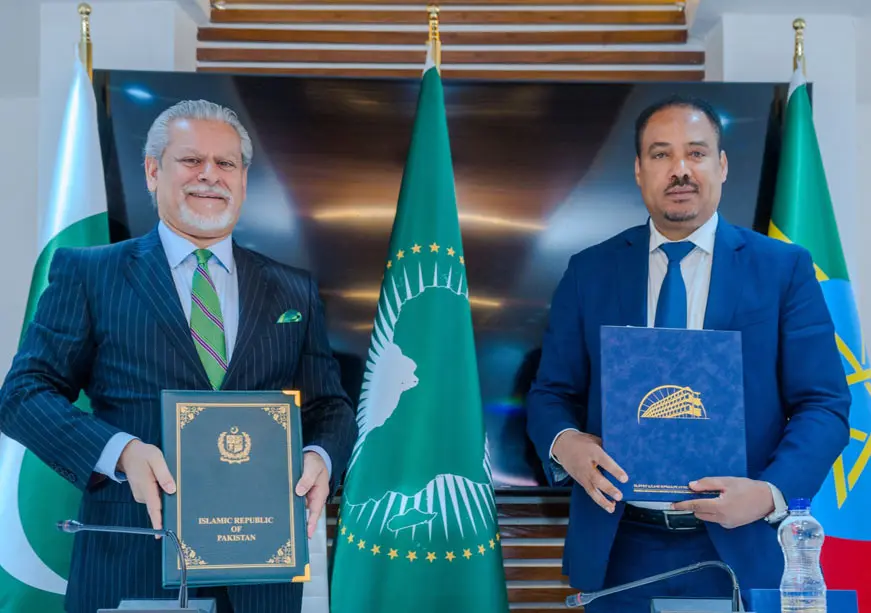
Pakistan's deepening Ethiopia ties seen as signal for India
Pakistan has expanded its relationship with Ethiopia into trade, aviation, agriculture, technology and education, according to an analysis by Observer Research Foundation Fellow Samir Bhattacharya. In January 2025, the two signed a memorandum of understanding on regular bilateral political consultations. Earlier this year, a US$1.5 billion arms and jets deal with Sudan was dropped after Saudi Arabia backed out. With Ethiopia hosting the African Union headquarters, the analysis says growing Pakistani influence could create diplomatic competition for India.
Source
Observer Research Foundation (ORF) · read the original report ↗
Desk check · compared with the source
What the desk checked (5)
- Pakistan sought to supply Sudan with weapons and jets worth US$1.5 billion earlier this year, and dropped the deal after Saudi Arabia backed out. — Figure and sequence appear in the source; no primary document or official cited.
- Pakistan and Ethiopia signed an MoU for regular bilateral political consultations in January 2025. — Date and nature of agreement stated in source; no signing authority named.
- Ethiopian Airlines operates direct Karachi–Addis Ababa flights, aiding trade and people-to-people contact. — Stated in source without attribution to airline or official data.
- Ethiopia hosts the African Union headquarters, giving Pakistan a diplomatic gateway to African institutions. — Presented in source as established context.
- Deepening Pakistan-Ethiopia ties could create diplomatic competition for India in African institutions and multilateral forums. — Author's analytical judgement, attributed to ORF Fellow Samir Bhattacharya.
Analysts’ view opinion
The Pakistan-Ethiopia rapprochement is not an immediate military threat to India, but it is a signal that New Delhi's traditional advantages in Africa can no longer be assumed. Gaining traction in Addis Ababa, where the African Union is headquartered, is never just a bilateral matter — it is a doorway into continental diplomacy. Located beside the Red Sea and the Bab-el-Mandeb, Ethiopia makes this one more thread in an increasingly contested Indian Ocean picture.
- The collapse of the US$1.5 billion Sudan weapons-and-jets deal after Saudi Arabia backed out shows how dependent Pakistan's Africa push remains on third-party financial and political backing.
- The January 2025 MoU on political consultations looks modest, but institutionalised diplomatic machinery is exactly how long-term influence is built.
- Ethiopia's real currency is geography — proximity to the Red Sea and Bab-el-Mandeb trade routes — which is why India will read this through an Indian Ocean lens.
- Both Pakistan and Ethiopia sit within China's Belt and Road framework, raising the prospect of trilateral economic linkages that deepen Indian wariness of Chinese reach in East Africa.
- With India courting African support on UN reform and climate issues, the likely effect is sharper diplomatic competition — and an Indian response built on economic and development diplomacy rather than security moves.
What to watch — Watch whether this cooperation moves beyond trade, aviation and education into defence or maritime security, and whether India visibly scales up its development partnerships across East Africa.
This is one think-tank analyst's reading; the story establishes no defence or maritime agreement between Pakistan and Ethiopia, and no measurable loss to Indian interests.
Deep dive
Research brief · 8 facts · 3 dates · exam-readyThe brief
Context
Pakistan has long sought to become a defence exporter and a player in Africa, and under its Engage Africa Policy it has widened engagement in the Horn of Africa. An analysis by Observer Research Foundation Fellow Samir Bhattacharya argues that Pakistan's once-limited diplomatic contact with Ethiopia has become a multidimensional partnership covering trade, connectivity, education, healthcare and political cooperation. Ethiopia matters because it sits near the Red Sea and the Bab-el-Mandeb Strait and hosts the African Union headquarters in Addis Ababa. India, a long-standing partner of Ethiopia in education, trade, pharmaceuticals and infrastructure, now faces another South Asian competitor in a space where it has traditionally been dominant.
Key facts
- Earlier this year Pakistan sought to supply Sudan with weapons and jets worth US$1.5 billion; the deal was dropped after Saudi Arabia backed out at the last moment.
- In January 2025, Pakistan and Ethiopia signed a Memorandum of Understanding for regular bilateral political consultations.
- Trade, aviation, agriculture, technology and education were jointly identified as priority sectors for Pakistan-Ethiopia engagement.
- Ethiopia hosts the African Union headquarters, giving Pakistan a diplomatic gateway to African politics and institutions.
- Ethiopian Airlines operates direct Karachi-Addis Ababa flights, improving connectivity for trade and people-to-people contact.
- Pakistan has held a single-country exhibition in Addis Ababa and business forums between chambers of commerce.
- Pakistan's Africa outreach is framed under its Engage Africa Policy, aimed partly at diversifying beyond Muslim-majority Africa.
- Both Pakistan (via CPEC) and Ethiopia have strong economic ties with China under the Belt and Road framework, raising the prospect of trilateral economic linkages.
Timeline
- Earlier in 2025Pakistan's proposed US$1.5 billion arms and jets deal with Sudan collapses after Saudi Arabia backs out at the last moment.
- January 2025Pakistan and Ethiopia sign an MoU for regular bilateral political consultations, formalising cooperation.
- Recent years (undated)Pakistan participates in a single-country exhibition in Addis Ababa and chamber-of-commerce business forums; Ethiopian Airlines runs direct Karachi-Addis Ababa flights.
Who has a stake
- Pakistan — Seeks defence exports, African market access and a diplomatic gateway to the African Union via Ethiopia under its Engage Africa Policy.
- Ethiopia — Gains a new South Asian trade and political partner; leverages its Horn of Africa location and AU host status.
- India — Long-standing investments in Ethiopia's education, trade, pharmaceuticals and infrastructure; risks diplomatic competition for influence in African institutions.
- China — Could link its BRI presence in Ethiopia with CPEC in Pakistan, potentially building trilateral economic linkages.
- Saudi Arabia and Türkiye — Pakistan hopes to piggyback on them, and on the Mecca Pact, to open a window into the Horn of Africa.
- African Union — Its Addis Ababa headquarters is the arena where Indian and Pakistani diplomatic outreach may compete.
Why it matters
The Horn of Africa sits astride the Red Sea and Bab-el-Mandeb Strait, on maritime routes linking Asia, Africa and Europe, so any new outside presence there affects Indian Ocean strategy. Pakistan's outreach could win African diplomatic support in forums such as the UN and the OIC, where India also courts votes on UN reform, climate change and global governance. The analysis frames this less as a direct threat than a signal that India's traditional advantages in Africa can no longer be assumed.
UPSC angle
Prelims pointers
- Ethiopia hosts the African Union headquarters at Addis Ababa.
- Bab-el-Mandeb Strait and the Red Sea lie next to the Horn of Africa's key maritime trade routes.
- Pakistan's Africa outreach framework: Engage Africa Policy.
- CPEC is Pakistan's component of China's Belt and Road Initiative; Ethiopia also hosts Chinese-funded infrastructure.
- Pakistan-Ethiopia MoU on regular bilateral political consultations was signed in January 2025.
- Observer Research Foundation (ORF) Fellow Samir Bhattacharya authored the analysis.
Mains framing
Pakistan's deepening engagement with Ethiopia illustrates how Africa's strategic weight is rising in South Asian foreign policy calculations. The drivers are visible: Pakistan's ambition to be a defence exporter (seen in the failed US$1.5 billion Sudan arms and jets deal), its Engage Africa Policy, the search for markets for its textiles, pharmaceuticals, agriculture, food products and manufacturing, and the desire for a diplomatic foothold at the African Union headquarters in Addis Ababa. Ethiopia offers location near the Red Sea and Bab-el-Mandeb, a large and fast-growing economy, and connectivity via Ethiopian Airlines' direct Karachi-Addis Ababa flights. The implications for India are threefold: competition for influence within African institutions where India has traditionally been the leading South Asian partner; possible trilateral linkages as both Pakistan (through CPEC) and Ethiopia align with China's Belt and Road framework, feeding Indian wariness about Chinese influence in the Indian Ocean and East Africa; and contestation for African diplomatic support in the UN and OIC on UN reform, climate change and global governance. The way forward suggested by the analysis is for New Delhi to intensify economic diplomacy and development partnerships in Ethiopia and across East Africa, treating the development less as a threat than as a signal that inherited advantages must be actively defended.
Key terms
- Engage Africa Policy
- Pakistan's diplomatic outreach framework for expanding political and economic ties across the African continent.
- Bab-el-Mandeb Strait
- Chokepoint near the Horn of Africa on maritime trade routes connecting Asia, Africa and Europe via the Red Sea.
- African Union (AU)
- Continental organisation of African states whose headquarters is in Ethiopia, making Addis Ababa a hub of African diplomacy.
- CPEC
- China-Pakistan Economic Corridor, Pakistan's flagship project under China's Belt and Road Initiative.
- Belt and Road Initiative (BRI)
- China's global infrastructure and connectivity framework, under which both Pakistan and Ethiopia have major projects.
- Organisation of Islamic Cooperation (OIC)
- Multilateral grouping of Muslim-majority states, cited as a forum where Pakistan could mobilise African diplomatic support.
Practice questions
- Examine how Pakistan's deepening engagement with Ethiopia affects India's position as Africa's leading South Asian partner. What should India's response be?
- Discuss the strategic significance of the Horn of Africa for Indian Ocean security, with reference to the Red Sea and the Bab-el-Mandeb Strait.
- How does the overlap of China's Belt and Road Initiative in Pakistan and Ethiopia shape India's strategic calculations in East Africa?
Grounded only in the source report — figures and dates are the source's, not inferred.